Andraos Stephanie, Jones Beatrix, Lange Katherine, Clifford Susan A, Thorstensen Eric B, Kerr Jessica A, Wake Melissa, Saffery Richard, Burgner David P, O'Sullivan Justin M
Liggins Institute, The University of Auckland, Auckland, New Zealand.
Department of Statistics, Faculty of Science, The University of Auckland, Auckland, New Zealand.
Curr Dev Nutr. 2020 Dec 11;5(1):nzaa179. doi: 10.1093/cdn/nzaa179. eCollection 2021 Jan.
Trimethylamine N-oxide (TMAO) is a diet- and microbiome-derived metabolite and a proposed biomarker of adverse cardiometabolic outcomes. TMAO studies have mainly been conducted in individuals with cardiometabolic disease, and studies in population-derived samples are limited.
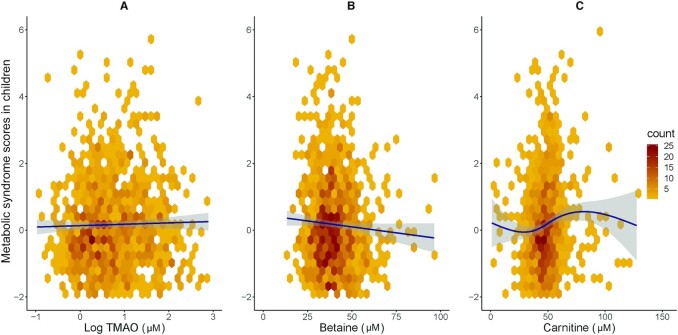
We aimed to investigate the associations between plasma TMAO concentrations and its precursors [carnitine, choline, betaine, and dimethylglycine (DMG)] with metabolic syndrome (MetS) scores, preclinical cardiovascular phenotypes, and inflammatory biomarkers (i.e. high-sensitivity C-reactive protein and serum glycoprotein acetyls) in a population-derived cohort of children and their parents.
The concentrations of TMAO and its precursors were quantified using UHPLC coupled with tandem MS (UHPLC/MS-MS) in 1166 children (mean age 11 y ± 0.5 y, 51% female) and 1324 adults (44 y ± 5.1 y, 87% female) participating in The Growing Up in Australia's Child Health CheckPoint Study. We developed multivariable fractional polynomial models to analyze associations between TMAO, its precursors, MetS (adjusted for sex and age), and cardiovascular phenotypes (adjusted for sex, age, BMI, household income, and the urinary albumin to creatinine ratio). Pearson's correlations were computed to identify associations between TMAO, its precursors, and inflammatory biomarkers.
The concentrations of TMAO precursors, but not TMAO itself, were associated with MetS, cardiovascular phenotypes, and inflammatory biomarkers in children and adults.
TMAO precursors, but not TMAO itself, were associated with adverse cardiometabolic and inflammatory phenotypes in children and adults. TMAO precursor concentrations may better reflect cardiovascular health and inflammatory status within the wider population. Replication in other population settings and mechanistic studies are warranted.
氧化三甲胺(TMAO)是一种源自饮食和微生物群的代谢产物,也是一种被认为与不良心脏代谢结局相关的生物标志物。TMAO的研究主要在患有心脏代谢疾病的个体中进行,而在人群样本中的研究有限。
我们旨在研究血浆TMAO浓度及其前体(肉碱、胆碱、甜菜碱和二甲基甘氨酸[DMG])与代谢综合征(MetS)评分、临床前心血管表型以及炎症生物标志物(即高敏C反应蛋白和血清糖蛋白乙酰化产物)在一组儿童及其父母人群队列中的相关性。
在参与澳大利亚儿童健康检查点成长研究的1166名儿童(平均年龄11岁±0.5岁,51%为女性)和1324名成年人(44岁±5.1岁,87%为女性)中,使用超高效液相色谱-串联质谱法(UHPLC/MS-MS)对TMAO及其前体的浓度进行定量。我们建立了多变量分数多项式模型,以分析TMAO、其前体、MetS(根据性别和年龄进行调整)以及心血管表型(根据性别、年龄、体重指数、家庭收入和尿白蛋白与肌酐比值进行调整)之间的相关性。计算Pearson相关性以确定TMAO、其前体与炎症生物标志物之间的关联。
TMAO的前体浓度而非TMAO本身与儿童和成年人的MetS、心血管表型以及炎症生物标志物相关。
TMAO的前体而非TMAO本身与儿童和成年人的不良心脏代谢和炎症表型相关。TMAO前体浓度可能能更好地反映更广泛人群的心血管健康和炎症状态。有必要在其他人群环境中进行重复研究和机制研究。