O'Connell Martin, de Paula Áureo, Smith Kate
Institute for Fiscal Studies; University College London.
Fisc Stud. 2021 Jun;42(2):249-264. doi: 10.1111/1475-5890.12271. Epub 2021 Jun 8.
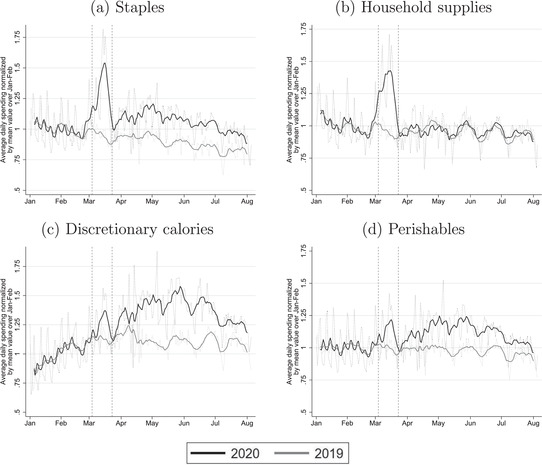
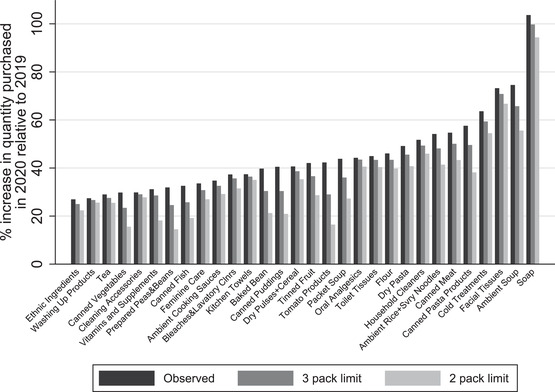
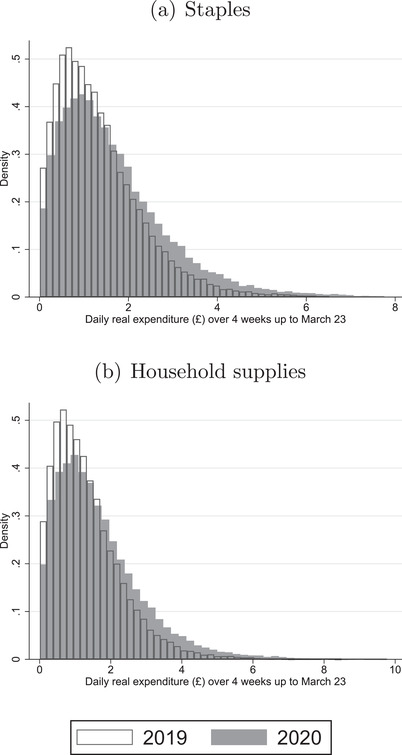
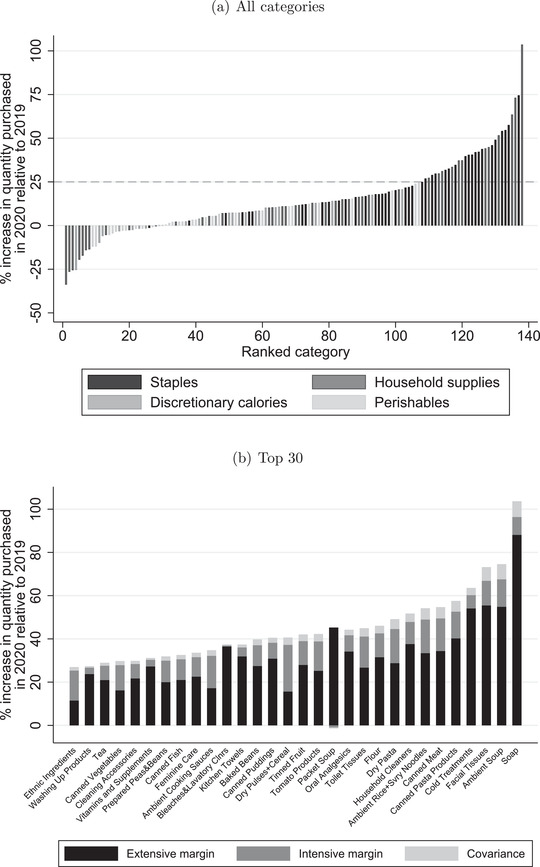
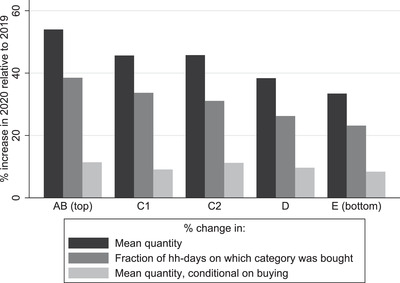
In times of heightened uncertainty, consumers face incentives to build up precautionary stocks of essential supplies. We study consumer spending dynamics during one such time, the first infection wave of the COVID-19 pandemic, using household scanner data covering fast-moving consumer goods in the United Kingdom. We document large increases in demand for storable products, such as food staples and household supplies, in the days before lockdown. Households in all socio-economic groups exhibit unusually high demand pre-lockdown, but there is a clear gradient, with the largest demand spikes for wealthier households. Although stories of people purchasing extreme amounts received a lot of attention, higher aggregate demand was mainly driven by more households than usual choosing to buy storable products, with only small increases in average quantities bought on a given trip. Temporary limits on the number of units per transaction, introduced following the demand spike, are therefore unlikely to lead to the avoidance of stock-outs.
在不确定性加剧的时期,消费者面临着建立基本物资预防性库存的动机。我们利用涵盖英国快速消费品的家庭扫描数据,研究了在这样一个时期,即新冠疫情第一波感染期间的消费者支出动态。我们记录了在封锁前几天,对耐储存产品(如主食和家庭用品)的需求大幅增加。所有社会经济群体的家庭在封锁前都表现出异常高的需求,但存在明显的梯度差异,富裕家庭的需求峰值最大。尽管人们大量购买物资的故事受到了广泛关注,但更高的总需求主要是由比平时更多的家庭选择购买耐储存产品推动的,单次购买的平均数量仅略有增加。因此,在需求激增后实施的每次交易单位数量临时限制不太可能避免缺货情况。