Reginelli Alfonso, Grassi Roberta, Feragalli Beatrice, Belfiore Maria Paola, Montanelli Alessandro, Patelli Gianluigi, La Porta Michelearcangelo, Urraro Fabrizio, Fusco Roberta, Granata Vincenza, Petrillo Antonella, Giacobbe Giuliana, Russo Gaetano Maria, Sacco Palmino, Grassi Roberto, Cappabianca Salvatore
Department of Precision Medicine, Università degli Studi della Campania Luigi Vanvitelli, 80121 Naples, Italy.
Oral and Biotechnological Sciences-Radiology Unit "G. D'Annunzio", Department of Medical, University of Chieti-Pescara, 66100 Chieti, Italy.
Biology (Basel). 2021 Jan 25;10(2):89. doi: 10.3390/biology10020089.
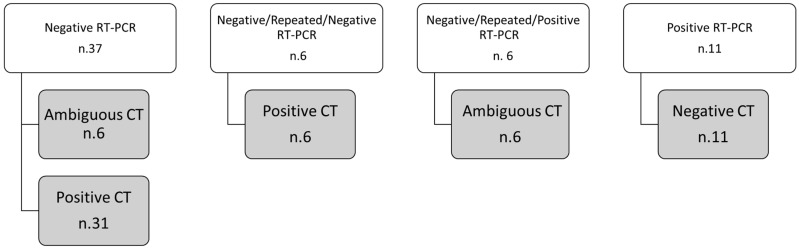
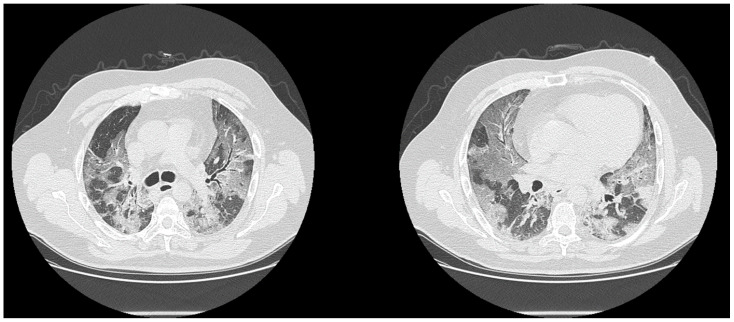
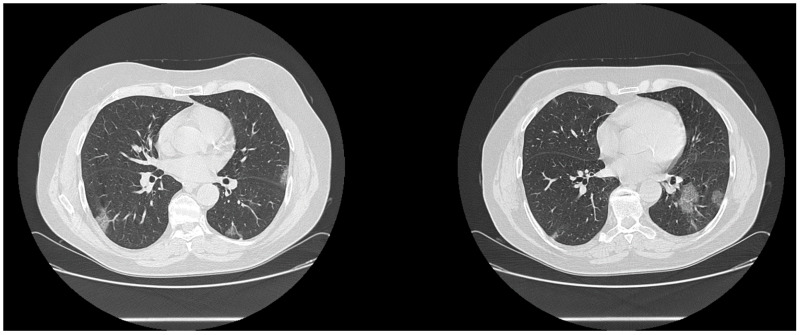
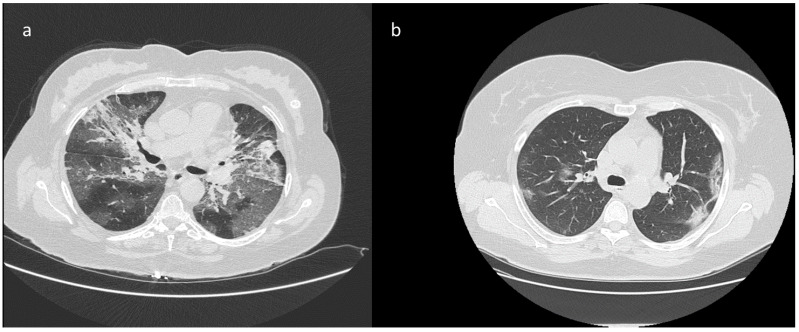
To assess the performance of the second reading of chest compute tomography (CT) examinations by expert radiologists in patients with discordance between the reverse transcription real-time fluorescence polymerase chain reaction (RT-PCR) test for COVID-19 viral pneumonia and the CT report. Three hundred and seventy-eight patients were included in this retrospective study (121 women and 257 men; 71 years median age, with a range of 29-93 years) and subjected to RT-PCR tests for suspicious COVID-19 infection. All patients were subjected to CT examination in order to evaluate the pulmonary disease involvement by COVID-19. CT images were reviewed first by two radiologists who identified COVID-19 typical CT patterns and then reanalyzed by another two radiologists using a CT structured report for COVID-19 diagnosis. Weighted к values were used to evaluate the inter-reader agreement. The median temporal window between RT-PCRs execution and CT scan was zero days with a range of (-9,11) days. The RT-PCR test was positive in 328/378 (86.8%). Discordance between RT-PCR and CT findings for viral pneumonia was revealed in 60 cases. The second reading changed the CT diagnosis in 16/60 (26.7%) cases contributing to an increase the concordance with the RT-PCR. Among these 60 cases, eight were false negative with positive RT-PCR, and 36 were false positive with negative RT-PCR. Sensitivity, specificity, positive predictive value and negative predictive value of CT were respectively of 97.3%, 53.8%, 89.0%, and 88.4%. Double reading of CT scans and expert second readers could increase the diagnostic confidence of radiological interpretation in COVID-19 patients.
评估在新型冠状病毒肺炎逆转录实时荧光聚合酶链反应(RT-PCR)检测结果与胸部计算机断层扫描(CT)报告不一致的患者中,专家放射科医生对胸部CT检查进行二次解读的表现。本回顾性研究纳入了378例患者(121例女性和257例男性;中位年龄71岁,范围29-93岁),对其进行了可疑新型冠状病毒感染的RT-PCR检测。所有患者均接受CT检查以评估新型冠状病毒肺炎累及的肺部疾病。CT图像首先由两名识别出新型冠状病毒肺炎典型CT表现的放射科医生进行阅片,然后由另外两名放射科医生使用针对新型冠状病毒肺炎诊断的CT结构化报告进行重新分析。采用加权к值评估阅片者间的一致性。RT-PCR检测与CT扫描之间的中位时间间隔为0天,范围为(-9,11)天。RT-PCR检测结果为阳性的有328/378(86.8%)。60例患者的RT-PCR与病毒性肺炎的CT表现存在不一致。二次解读改变了16/60(26.7%)例患者的CT诊断结果,使与RT-PCR的一致性有所提高。在这60例患者中,8例RT-PCR阳性但为假阴性,36例RT-PCR阴性但为假阳性。CT的敏感性、特异性、阳性预测值和阴性预测值分别为97.3%、53.8%、89.0%和88.4%。对CT扫描进行双重阅片以及专家二次阅片可提高对新型冠状病毒肺炎患者放射学解读的诊断信心。