
微生物组作为饮食对结直肠癌风险的中介:维生素 D、炎症标志物和脂肪因子的作用。
Microbiome as Mediator of Diet on Colorectal Cancer Risk: The Role of Vitamin D, Markers of Inflammation and Adipokines.
机构信息
Division of Cancer Prevention and Genetics, IEO European Institute of Oncology IRCCS, 20125 Milan, Italy.
Department of Experimental Oncology, IEO European Institute of Oncology IRCCS, 20125 Milan, Italy.
出版信息
Nutrients. 2021 Jan 25;13(2):363. doi: 10.3390/nu13020363.
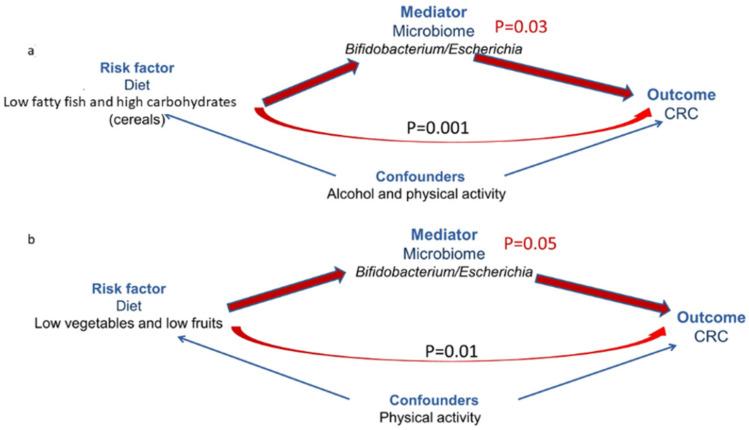
Obesity and diet are associated with colorectal cancer (CRC) risk, and microbiome could mediate this risk factor. To investigate this interaction, we performed a case-control study (34 CRC cases and 32 controls) and analyzed fecal microbiota composition using 16S rRNA metabarcoding and sub-sequential shotgun analyses of genomic bacterial DNA to evaluate the role of microbiome and diet in CRC etiology, taking into account vitamin D and other risk biomarkers. Dietary habits were evaluated using a short questionnaire. Multivariate methods for data integration and mediation analysis models were used to investigate causal relationships. CRC cases were significantly more often deficient in vitamin D than controls ( = 0.04); and polymorphism frequency were different between cases and controls ( = 0.03 and = 0.02, respectively). A diet poor in fatty fish and rich in carbohydrates was found to be significantly associated with CRC risk ( = 0.011). The mediation analysis confirmed the significant role of the microbiome in mediating CRC risk-increasing levels of / genera ratio, an indicator of "healthy" intestinal microbiome, can overcome the effect of diet on CRC risk ( = 0.03). This study suggests that microbiome mediates the diet effect on CRC risk, and that vitamin D, markers of inflammation, and adipokines are other factors to consider in order to achieve a better knowledge of the whole carcinogenic process.
肥胖和饮食与结直肠癌(CRC)风险相关,而微生物组可能介导这种风险因素。为了研究这种相互作用,我们进行了一项病例对照研究(34 例 CRC 病例和 32 例对照),并使用 16S rRNA 代谢组学和基因组细菌 DNA 的亚测序分析来分析粪便微生物组组成,以评估微生物组和饮食在 CRC 病因学中的作用,同时考虑维生素 D 和其他风险生物标志物。使用简短的问卷评估饮食习惯。使用数据集成的多变量方法和中介分析模型来研究因果关系。CRC 病例的维生素 D 缺乏明显比对照组更常见( = 0.04);病例和对照组之间的 多态性频率也不同(分别为 = 0.03 和 = 0.02)。发现脂肪鱼摄入不足、碳水化合物摄入丰富的饮食与 CRC 风险显著相关( = 0.011)。中介分析证实了微生物组在介导 CRC 风险增加方面的显著作用,/属比的增加,这是“健康”肠道微生物组的一个指标,可以克服饮食对 CRC 风险的影响( = 0.03)。这项研究表明,微生物组介导了饮食对 CRC 风险的影响,而维生素 D、炎症标志物和脂肪因子是为了更好地了解整个致癌过程而需要考虑的其他因素。




 Zotero 插件