Department of Economic Management, Yingkou Institute of Technology, Yingkou 115014, China.
School of Economics and Management, Dalian University of Technology, Dalian 116024, China.
J Healthc Eng. 2021 Jan 12;2021:6698122. doi: 10.1155/2021/6698122. eCollection 2021.
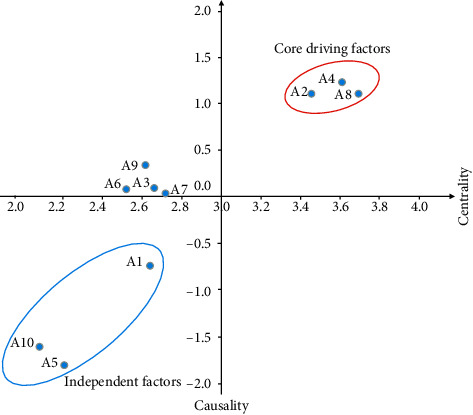
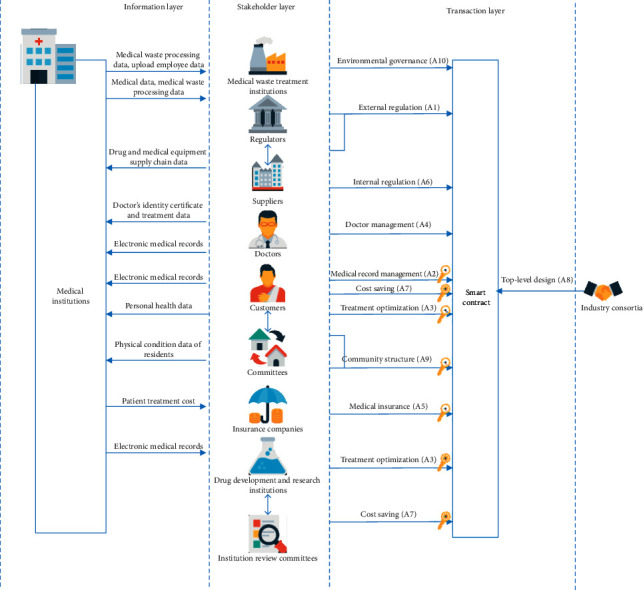
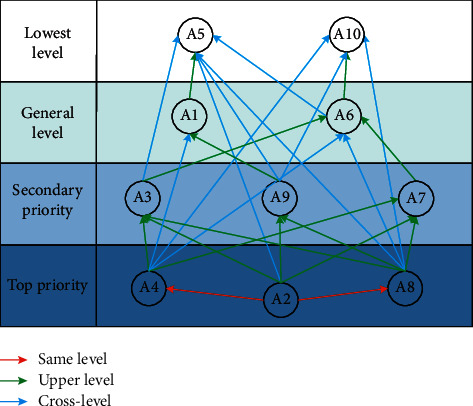
This study aims to explore the application of blockchain technology in smart healthcare, establish a hierarchical theoretical framework of smart healthcare, reveal the impact of blockchain on smart healthcare, and finally, construct a development application system of smart healthcare under the blockchain based on stakeholder theory. However, such a hierarchical theoretical framework should consider not only the necessary attributes and the interrelationship among various aspects and attributes but also the role of multiple stakeholders. Therefore, the paper uses fuzzy set theory to filter unnecessary attributes, proposes a decision-making and experimental evaluation laboratory (DEMATEL) to manage the complex interrelationships between various aspects and attributes, and uses Interpretive Structure Modeling (ISM) to divide the hierarchy and construct a hierarchical theoretical framework. The results show that (1) the top-level design, the medical record management, and the doctor management are the root causes of system. (2) The specific application of blockchain in the field of smart healthcare is mainly carried out around the intelligent contract, which relies on the medical record management and is constrained by the system, and optimization of application is the key to system upgrading. (3) The internal and external regulation, the medical insurance, and the environmental governance play a guaranteed role for the development of the system and effectively safeguard the interests of stakeholders. (4) The application system of smart healthcare under the blockchain needs to be built based on three layers: the transaction layer, information layer, and stakeholder layer. The theoretical hierarchical framework is intended to guide smart healthcare towards blockchain applications, and stakeholders are suggested to participate in the development application systems.
本研究旨在探讨区块链技术在智慧医疗中的应用,建立智慧医疗的分层理论框架,揭示区块链对智慧医疗的影响,最后基于利益相关者理论构建区块链下的智慧医疗发展应用系统。然而,这样的分层理论框架不仅要考虑必要属性以及各方面和属性之间的相互关系,还要考虑到多个利益相关者的作用。因此,本文采用模糊集理论筛选不必要属性,提出决策试验和评价实验室(DEMATEL)来管理各方面和属性之间的复杂相互关系,并采用解释结构模型(ISM)对层次进行划分,构建分层理论框架。研究结果表明:(1)顶层设计、病历管理和医生管理是系统的根本原因;(2)区块链在智慧医疗领域的具体应用主要围绕智能合约展开,该合约依赖于病历管理,并受到系统的约束,应用的优化是系统升级的关键;(3)内部和外部监管、医疗保险和环境治理为系统的发展提供了保障作用,有效维护了利益相关者的利益;(4)需要基于交易层、信息层和利益相关者层来构建区块链下的智慧医疗应用系统。该理论分层框架旨在指导智慧医疗向区块链应用发展,建议利益相关者参与开发应用系统。