Centre for Evidence and Social Innovation, Queen's University Belfast, Belfast, UK.
School of Social Sciences, Education and Social Work, Queen's University Belfast, Belfast, UK.
Addiction. 2021 Sep;116(9):2454-2462. doi: 10.1111/add.15422. Epub 2021 Jan 28.
To provide public health-related research evidence on types and usage patterns of new psychoactive substances (NPS), developmental pathways into NPS and decision-making factors for, and associated harms of, NPS use.
Three-phase mixed-methods design, including a latent class analysis (LCA) of the longitudinal Belfast Youth Development Study (BYDS), a narrative analysis of interviews with NPS users and a three-step approach manual method modelling using regressions to reveal classes of substance use and their associated predictors and outcomes.
Northern Ireland.
A total of 2039 people who responded to the questions on 'ever use' of the drug variables included at wave 7 (aged 21 years) of the BYDS. Eighty-four narrative interviews with NPS users.
Categories of drug use identified by LCA. Predictors and outcomes included measures of family, partners, peers, substance use, school, delinquency and mental health.
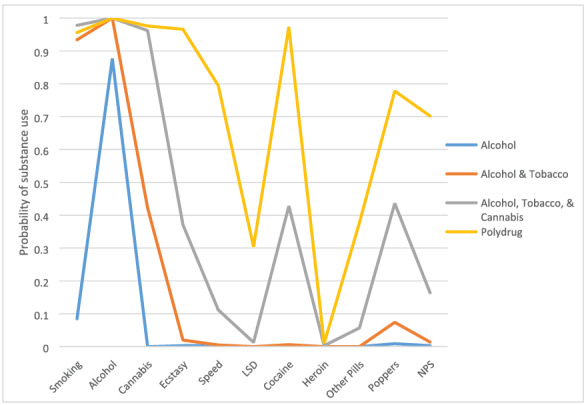
A four-class solution provided the best fit for the data: alcohol; alcohol and tobacco; alcohol, tobacco and cannabis; and polydrug (the latter including NPS). The qualitative analysis yielded a taxonomy that distinguished how NPS operate within a wider range of drug repertoires from experimental to problematic.
In Northern Ireland, new psychoactive substances appear to be a feature of broader polydrug use rather than a standalone class of drug use.
提供与新精神活性物质(NPS)的类型和使用模式、进入 NPS 的发展途径以及使用 NPS 的决策因素和相关危害有关的公共卫生研究证据。
包括纵向贝尔法斯特青年发展研究(BYDS)的潜在类别分析(LCA)、对 NPS 用户访谈的叙述性分析以及使用回归揭示物质使用及其相关预测因素和结果的类别的三步手动方法模型。
北爱尔兰。
共有 2039 人对 BYDS 第 7 波(21 岁)包含的“曾使用”药物变量的问题做出了回应。对 84 名 NPS 用户进行了叙述性访谈。
LCA 确定的药物使用类别。预测因素和结果包括家庭、伴侣、同伴、物质使用、学校、犯罪和心理健康的测量。
四类别解决方案为数据提供了最佳拟合:酒精;酒精和烟草;酒精、烟草和大麻;以及多药(后者包括 NPS)。定性分析产生了一个分类法,区分了 NPS 在更广泛的药物组合中的作用,从实验性到有问题的。
在北爱尔兰,新精神活性物质似乎是更广泛的多药使用的特征,而不是单独的一类药物使用。