J Phys Act Health. 2021 Mar 1;18(3):254-261. doi: 10.1123/jpah.2020-0398. Epub 2021 Jan 28.
Though moderate- to vigorous-intensity physical activity is recommended, limited research exists on sedentary behavior (SED) during pregnancy.
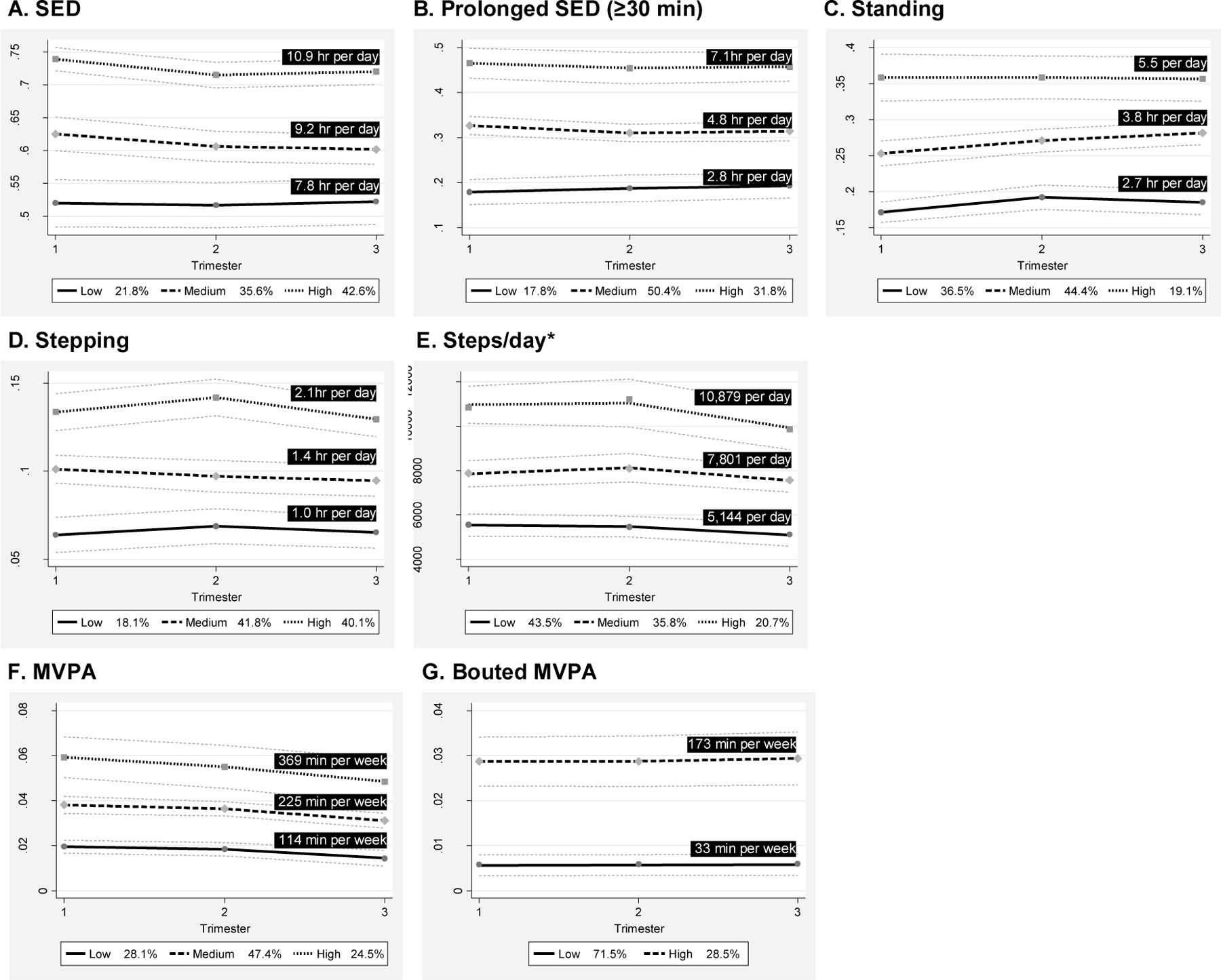
The authors conducted a prospective cohort study to describe objectively measured patterns of SED and activity during each trimester of pregnancy. Women wore thigh- (activPAL3) and waist-mounted (ActiGraph GT3X) activity monitors. SED and activity were compared across trimesters using likelihood ratio tests and described using group-based trajectories. Exploratory analyses associated SED and activity trajectories with adverse pregnancy outcomes and excessive gestational weight gain.
Pregnant women (n = 105; mean [SD] age = 31 [5] y; prepregnancy body mass index = 26.2 [6.6] kg/m2) had mean SED of 9.7, 9.5, and 9.5 hours per day (P = .062) across trimesters, respectively. Some activities differed across trimesters: standing (increased, P = .01), stepping (highest in second trimester, P = .04), steps per day (highest in second trimester, P = .008), and moderate- to vigorous-intensity physical activity (decreased, P < .001). Prolonged SED (bouts ≥ 30 min) and bouted moderate- to vigorous-intensity physical activity (≥10 min) were stable (P > .05). In exploratory analyses, higher SED and lower standing, stepping, and steps per day trajectories were associated with increased odds of adverse pregnancy outcomes (P < .05). No trajectories were associated with excessive gestational weight gain.
Pregnant women exhibited stable SED of nearly 10 hours per day across pregnancy. Future research evaluating SED across pregnancy and adverse pregnancy outcome risk is warranted.
尽管推荐进行中等至剧烈强度的身体活动,但关于妊娠期间久坐行为(SED)的研究有限。
作者进行了一项前瞻性队列研究,以描述妊娠各期SED 和活动的客观测量模式。女性佩戴大腿(activPAL3)和腰部(ActiGraph GT3X)活动监测器。使用似然比检验比较了各孕期SED 和活动的差异,并使用基于群组的轨迹进行了描述。探索性分析将 SED 和活动轨迹与不良妊娠结局和过度妊娠体重增加联系起来。
105 名孕妇(平均[标准差]年龄为 31[5]岁;孕前体重指数为 26.2[6.6]kg/m2)SED 分别为每天 9.7、9.5 和 9.5 小时(P=.062)。一些活动在各孕期有所不同:站立(增加,P=.01)、踏步(第二孕期最高,P=.04)、每日步数(第二孕期最高,P=.008)和中等到剧烈强度的身体活动(减少,P <.001)。长时间的 SED(持续≥30 分钟的时间块)和中等至剧烈强度的身体活动(持续≥10 分钟的时间块)是稳定的(P>.05)。在探索性分析中,SED 较高、站立、踏步和每日步数较低的轨迹与不良妊娠结局的发生风险增加相关(P<.05)。没有轨迹与过度妊娠体重增加有关。
孕妇在整个妊娠期间的 SED 稳定在近 10 小时/天。未来需要进一步研究妊娠期间 SED 与不良妊娠结局风险的关系。