Department of Health and Human Physiology, University of Iowa, Iowa City, Iowa; Department of Epidemiology, University of Iowa, Iowa City, Iowa.
Department of Health and Human Physiology, University of Iowa, Iowa City, Iowa.
Womens Health Issues. 2021 Jul-Aug;31(4):366-375. doi: 10.1016/j.whi.2021.02.003. Epub 2021 Mar 11.
Sleep, sedentary behavior, and moderate-to-vigorous physical activity (MVPA) are altered in pregnancy and may affect pregnancy health; however, how these behaviors are associated with each other is unclear.
Pregnant women (N = 120) completed the Pittsburgh Sleep Quality Index and wore an activPAL3 micro and ActiGraph GT3X for 7 days in each trimester to assess sleep, sedentary behavior, and MVPA, respectively. Latent trajectories described patterns of sleep duration, efficiency, and quality as well as sedentary behavior and MVPA. Multinomial logistic regression examined associations of sleep patterns with sedentary behavior and MVPA patterns and, in exploratory analyses, with adverse pregnancy outcomes.
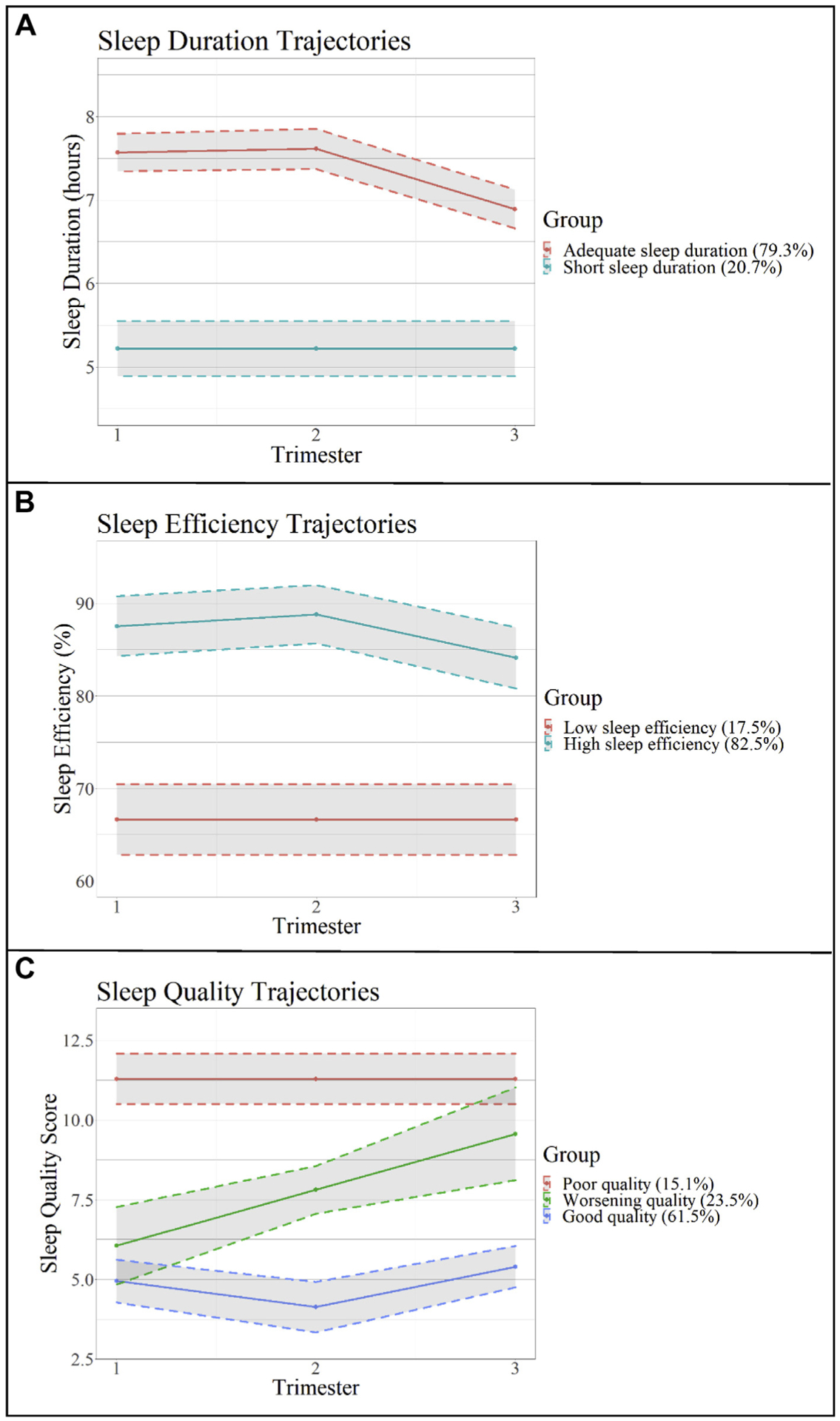
Trajectories were identified for sleep duration (consistently short, 20.7% of sample; consistently adequate, 79.3%), efficiency (consistently low, 17.5%; consistently high, 82.5%), and quality (consistently poor, 15.1%; worsening, 23.5%; and consistently good, 61.5%). Compared with those in more optimal sleep groups, women in the short duration, low efficiency, and worsening quality groups had lower odds of being in the moderate and/or high sedentary behavior group (odds ratio range, 0.21-0.31; 95% confidence interval range, 0.09-0.65). Women in the worsening quality group had greater odds of being in the low MVPA group (odds ratio, 2.51; 95% confidence interval, 1.18-5.38). Trends were observed with women in less optimal sleep groups having greater odds of adverse pregnancy outcomes and lower odds of excessive gestational weight gain.
Less optimal sleep patterns in pregnancy are associated with less sedentary behavior and MVPA; additional research is needed to confirm associations between sleep and pregnancy outcomes.
睡眠、久坐行为和中等到剧烈的身体活动(MVPA)在怀孕期间会发生改变,可能会影响妊娠健康;然而,这些行为彼此之间是如何关联的尚不清楚。
研究纳入了 120 名孕妇,分别在每个孕期的第 7 天完成匹兹堡睡眠质量指数(PSQI)、佩戴 activPAL3 微活动记录仪和 ActiGraph GT3X 以评估睡眠、久坐行为和 MVPA。潜在轨迹描述了睡眠持续时间、效率和质量以及久坐行为和 MVPA 的模式。多项逻辑回归分析了睡眠模式与久坐行为和 MVPA 模式的关联,并在探索性分析中,还分析了与不良妊娠结局的关联。
确定了睡眠持续时间(始终较短,占样本的 20.7%;始终充足,占 79.3%)、效率(始终较低,占 17.5%;始终较高,占 82.5%)和质量(始终较差,占 15.1%;恶化,占 23.5%;始终良好,占 61.5%)轨迹。与处于更优睡眠组的女性相比,处于较短睡眠持续时间、较低睡眠效率和睡眠质量恶化组的女性更有可能处于中等到较高久坐行为组(比值比范围,0.21-0.31;95%置信区间范围,0.09-0.65)。处于睡眠质量恶化组的女性更有可能处于低 MVPA 组(比值比,2.51;95%置信区间,1.18-5.38)。有趋势表明,处于睡眠较差组的女性更有可能出现不良妊娠结局,而过度妊娠体重增加的可能性较小。
妊娠期间较差的睡眠模式与较少的久坐行为和 MVPA 相关;需要进一步研究以确认睡眠与妊娠结局之间的关联。