Academic Unit, Peninsula Clinical School, Monash University Central Clinical School, Melbourne, Victoria, Australia
Peninsula Health, Frankston, Victoria, Australia.
BMJ Open Diabetes Res Care. 2021 Jan;9(1). doi: 10.1136/bmjdrc-2020-001646.
Women comprise two-thirds of people with dementia, making female sex a significant dementia risk factor. Both type 1 diabetes (T1D) and type 2 diabetes (T2D) are known dementia risk factors with an increasing global incidence. Understanding whether subtle sex differences persist in cognitive function prior to dementia in the context of diabetes may help elucidate the magnitude of sex effects on dementia risk.
We examined cross-sectional data from the Study of Longevity in Diabetes (SOLID), a prospective cohort study of members of Kaiser Permanente Northern California aged 60 years and older with T1D (n=758), T2D (n=232) and without either T1D or T2D (n=247). We used factor analysis to generate summary scores of cognitive domains and used regression analyses to examine the associations between sex and cognition adjusting for sociodemographic and cardiovascular confounders.
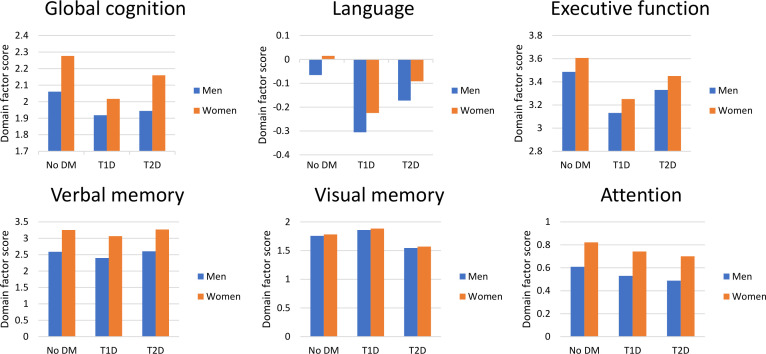
We included 1237 participants (630 women and 607 men) with mean age 68 years. By design, the distribution of men and women in T1D, T2D and no diabetes was similar. Women had better cognitive performance than men in global cognition (β=0.21, 95% CI 0.16 to 0.26), language (β=0.08, 95% CI 0.004 to 0.15), executive function (β=0.13, 95% CI 0.05 to 0.20), episodic verbal memory (β=0.68, 95% CI 0.59 to 0.77) and attention (β=0.20, 95% CI 0.11 to 0.28) but not in episodic visual memory (β=0.006, 95% CI -0.07 to 0.09) adjusting for age and education independent of diabetes status. We did not find an interaction between sex and diabetes status for any of the cognitive outcomes.
Women in late mid-life have better cognitive performance than men in many cognitive domains independent of the presence of T1D or T2D. Further work is required to understand whether these differences change over time or in older cohorts and to understand their relationship to subsequent dementia.
女性占痴呆症患者的三分之二,这使得女性性别成为痴呆症的一个重要危险因素。1 型糖尿病(T1D)和 2 型糖尿病(T2D)均为已知的痴呆症危险因素,且其在全球的发病率呈上升趋势。了解在患有糖尿病的情况下,女性在痴呆症之前的认知功能中是否存在细微的性别差异,可能有助于阐明性别对痴呆症风险的影响程度。
我们分析了 Kaiser Permanente Northern California 年龄在 60 岁及以上的 SOLID 研究(一项针对 1 型糖尿病(T1D)(n=758)、2 型糖尿病(T2D)(n=232)和无 1 型或 2 型糖尿病(n=247)患者的前瞻性队列研究)的横断面数据。我们使用因子分析生成认知域的综合评分,并使用回归分析,在校正社会人口统计学和心血管混杂因素后,检查性别与认知之间的关联。
我们纳入了 1237 名参与者(630 名女性和 607 名男性),平均年龄为 68 岁。按设计,男性和女性在 1 型糖尿病、2 型糖尿病和无糖尿病中的分布相似。与男性相比,女性在总体认知(β=0.21,95%CI 0.16 至 0.26)、语言(β=0.08,95%CI 0.004 至 0.15)、执行功能(β=0.13,95%CI 0.05 至 0.20)、情景性言语记忆(β=0.68,95%CI 0.59 至 0.77)和注意力(β=0.20,95%CI 0.11 至 0.28)方面的认知表现更好,但在情景性视觉记忆方面没有差异(β=0.006,95%CI -0.07 至 0.09),且这些差异独立于糖尿病状态,不受年龄和教育程度的影响。我们没有发现性别与糖尿病状态之间在任何认知结果上存在交互作用。
在中年后期,女性在许多认知领域的认知表现优于男性,而与是否患有 1 型或 2 型糖尿病无关。需要进一步研究以了解这些差异是否随时间变化或在年龄较大的队列中发生变化,并了解它们与随后发生痴呆症的关系。