Tian Mengke, Li Youfeng, Wang Xiao, Tian Xuan, Pei Lu-Lu, Wang Xin, Zhang Luyang, Sun Wenxian, Wu Jun, Sun Shilei, Ning Mingming, Buonanno Ferdinando, Xu Yuming, Song Bo
Department of Neurology, the First Affiliated Hospital of Zhengzhou University, Zhengzhou, China.
Henan Key Laboratory of Cerebrovascular Diseases, Zhengzhou, China.
Front Neurol. 2021 Jan 12;11:610318. doi: 10.3389/fneur.2020.610318. eCollection 2020.
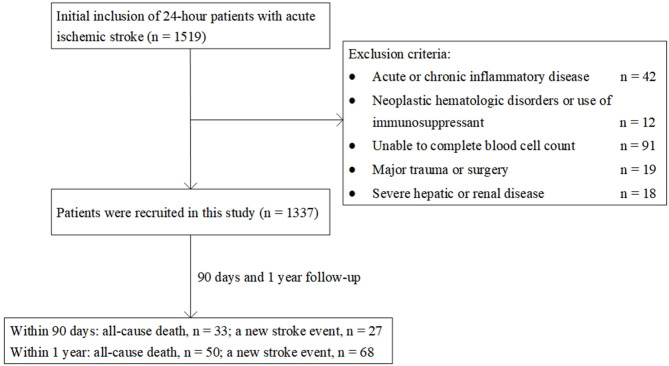
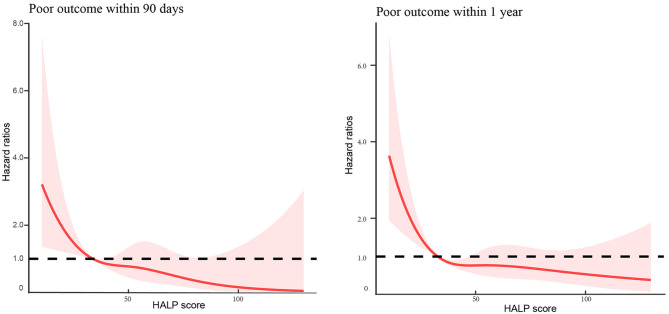
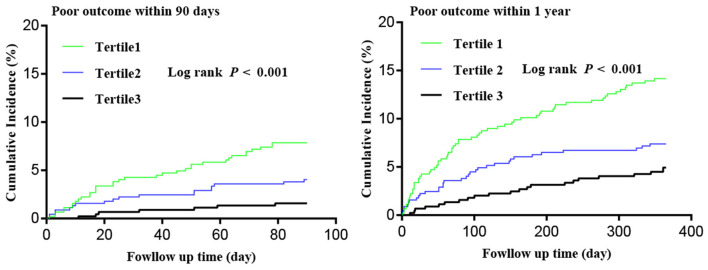
The combined index of hemoglobin, albumin, lymphocyte, and platelet (HALP) is considered a novel score to reflect systemic inflammation and nutritional status. This study aimed to investigate the association between HALP score and poor outcome in patients with acute ischemic stroke (AIS). Consecutive AIS patients within 24 h after onset were prospectively enrolled. Poor outcome was a combination of a new stroke event (ischemic and hemorrhagic) and all-cause death within 90 days and 1 year. The association between HALP score and poor outcome was analyzed using Cox proportional hazards. A total of 1,337 patients were included. Overall, 60 (4.5%) and 118 (8.8%) patients experienced poor outcome within 90 days and 1 year, respectively. Patients in the highest tertile of HALP score had a lower risk of poor outcome within 90 days and 1 year (hazard ratio: 0.25 and 0.42; 95% confidence intervals: 0.11-0.57 and 0.25-0.69, for trend <0.01 for all) compared with those in the lowest tertile after adjusting relevant confounding factors. Adding HALP score to the conventional risk factors improved prediction of poor outcome in patients with AIS within 90 days and 1 year (net reclassification index, 48.38 and 28.95%; integrated discrimination improvement, 1.51 and 1.51%; < 0.05 for all). Increased HALP score was associated with a decreased risk of recurrent stroke and death within 90 days and 1 year after stroke onset, suggesting that HALP score may serve as a powerful indicator for AIS.
血红蛋白、白蛋白、淋巴细胞和血小板综合指数(HALP)被认为是反映全身炎症和营养状况的一项新指标。本研究旨在探讨HALP评分与急性缺血性脑卒中(AIS)患者不良预后之间的关联。前瞻性纳入发病后24小时内的连续AIS患者。不良预后定义为90天和1年内新发卒中事件(缺血性和出血性)及全因死亡。采用Cox比例风险模型分析HALP评分与不良预后之间的关联。共纳入1337例患者。总体而言,分别有60例(4.5%)和118例(8.8%)患者在90天和1年内出现不良预后。在调整相关混杂因素后,HALP评分处于最高三分位数的患者在90天和1年内出现不良预后的风险较低(风险比分别为0.25和0.42;95%置信区间分别为0.11 - 0.57和0.25 - 0.69,所有趋势均<0.01),与最低三分位数的患者相比。将HALP评分纳入传统危险因素可改善对AIS患者90天和1年内不良预后的预测(净重新分类指数分别为48.38%和28.95%;综合判别改善分别为1.51%和1.51%;所有P<0.05)。HALP评分升高与卒中发病后90天和1年内复发性卒中和死亡风险降低相关,提示HALP评分可能是AIS的一个有力指标。