Bi Jiahua, Jing Xiaoran, Wu Lunjie, Zhou Xia, Gu Jie, Nie Yao, Xu Yan
School of Biotechnology and Key Laboratory of Industrial Biotechnology, Ministry of Education, Jiangnan University, Wuxi 214122, China.
Suqian Industrial Technology Research Institute of Jiangnan University, Suqian 223814, China.
Comput Struct Biotechnol J. 2021 Jan 5;19:577-585. doi: 10.1016/j.csbj.2020.12.043. eCollection 2021.
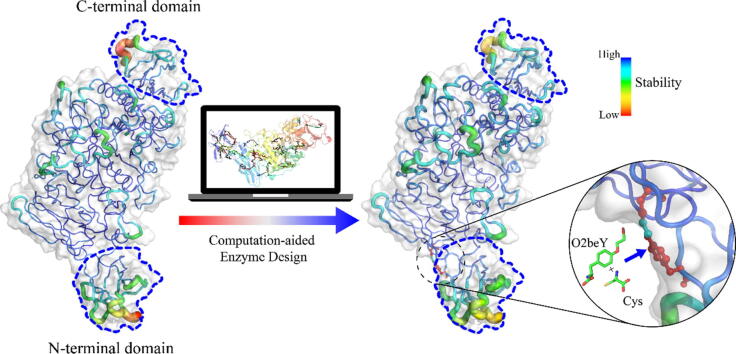
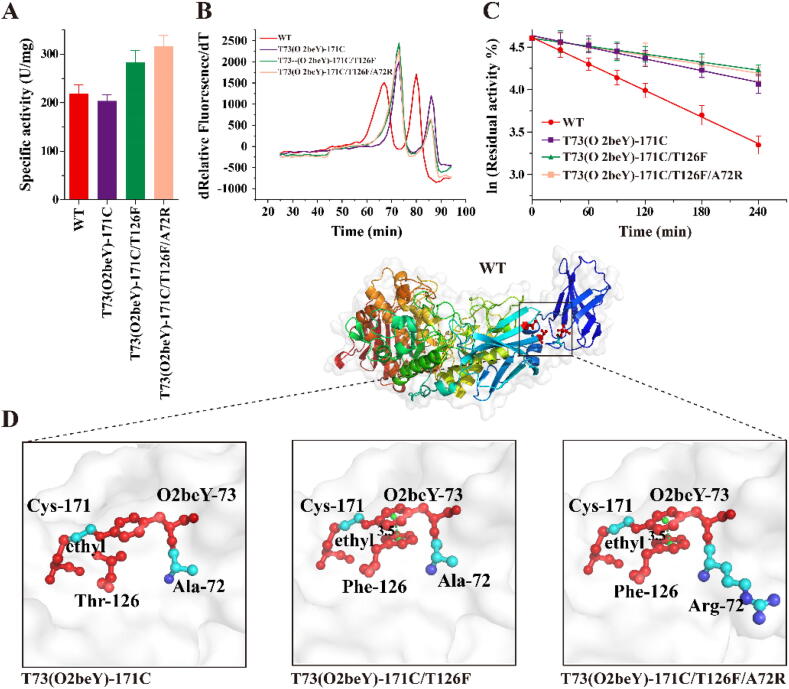
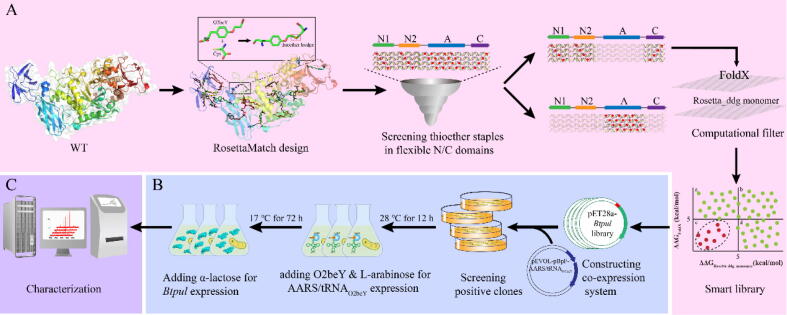
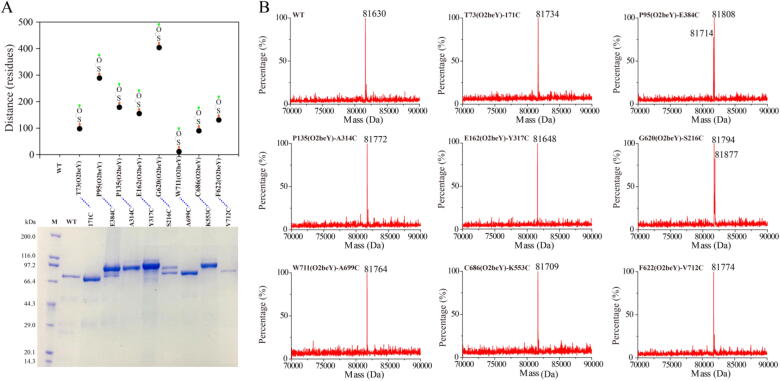
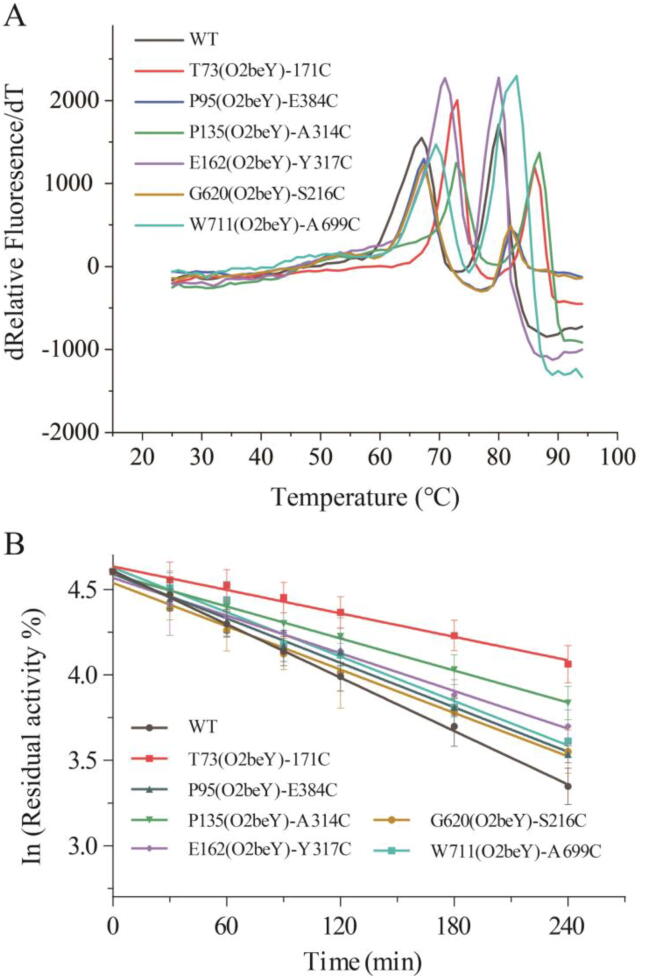
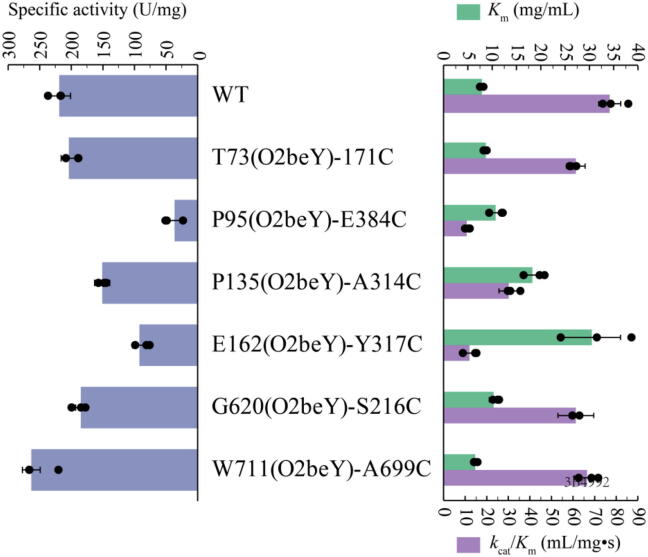
Enzyme thermostabilization is considered a critical and often obligatory step in biosynthesis, because thermostability is a significant property of enzymes that can be used to evaluate their feasibility for industrial applications. However, conventional strategies for thermostabilizing enzymes generally introduce non-covalent interactions and/or natural covalent bonds caused by natural amino acid substitutions, and the trade-off between the activity and stability of enzymes remains a challenge. Here, we developed a computationally guided strategy for constructing thioether staples by incorporating noncanonical amino acid (ncAA) into the more flexible N/C-terminal domains of the multi-modular pullulanase from (BtPul) to enhance its thermostability. First, potential thioether staples located in the N/C-terminal domains of BtPul were predicted using RosettaMatch. Next, eight variants involving stable thioether staples were precisely predicted using FoldX and Rosetta ddg_monomer. Six positive variants were obtained, of which T73(O2beY)-171C had a 157% longer half-life at 70 °C and an increase of 7.0 °C in , when compared with the wild-type (WT). T73(O2beY)-171C/T126F/A72R exhibited an even more improved thermostability, with a 211% increase in half-life at 70 °C and a 44% enhancement in enzyme activity compared with the WT, which was attributed to further optimization of the local interaction network. This work introduces and validates an efficient strategy for enhancing the thermostability and activity of multi-modular enzymes.
酶的热稳定性被认为是生物合成中的关键且通常必不可少的步骤,因为热稳定性是酶的一项重要特性,可用于评估其在工业应用中的可行性。然而,传统的酶热稳定策略通常会引入由天然氨基酸取代引起的非共价相互作用和/或天然共价键,酶的活性和稳定性之间的权衡仍然是一个挑战。在此,我们开发了一种计算指导策略,通过将非天然氨基酸(ncAA)引入来自嗜热栖热放线菌(BtPul)的多模块支链淀粉酶更灵活的N/C末端结构域来构建硫醚钉,以提高其热稳定性。首先,使用RosettaMatch预测位于BtPul的N/C末端结构域中的潜在硫醚钉。接下来,使用FoldX和Rosetta ddg_monomer精确预测了八个涉及稳定硫醚钉的变体。获得了六个阳性变体,其中T73(O2beY)-171C在70°C下的半衰期比野生型(WT)长157%,并且在Tm时增加了7.0°C。与WT相比,T73(O2beY)-171C/T126F/A72R表现出更优异的热稳定性,在70°C下的半衰期增加了211%,酶活性提高了44%,这归因于局部相互作用网络的进一步优化。这项工作引入并验证了一种提高多模块酶热稳定性和活性的有效策略。