Department of Public Health, Erasmus MC University Medical Center, Rotterdam, the Netherlands.
Departments of Family and Social Medicine and Epidemiology and Population Health, Albert Einstein College of Medicine, Bronx, NY, USA.
J Natl Cancer Inst. 2021 Aug 2;113(8):1017-1026. doi: 10.1093/jnci/djaa218.
A paucity of research addresses breast cancer screening strategies for women at lower-than-average breast cancer risk. The aim of this study was to examine screening harms and benefits among women aged 50-74 years at lower-than-average breast cancer risk by breast density.
Three well-established, validated Cancer Intervention and Surveillance Network models were used to estimate the lifetime benefits and harms of different screening scenarios, varying by screening interval (biennial, triennial). Breast cancer deaths averted, life-years and quality-adjusted life-years gained, false-positives, benign biopsies, and overdiagnosis were assessed by relative risk (RR) level (0.6, 0.7, 0.85, 1 [average risk]) and breast density category, for US women born in 1970.
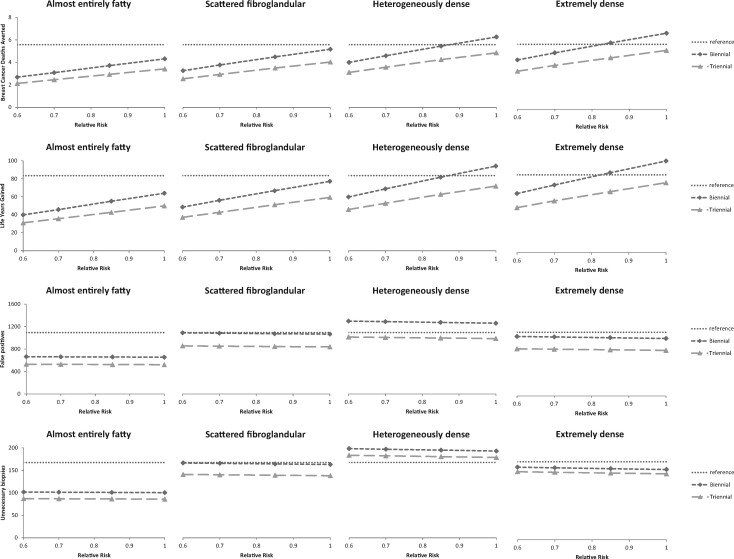
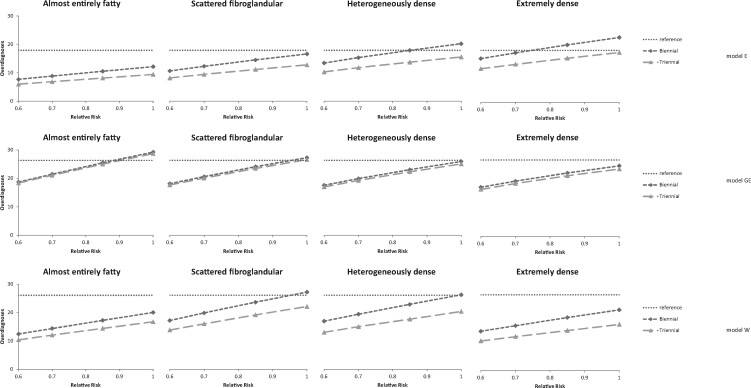
Screening benefits decreased proportionally with decreasing risk and with lower breast density. False-positives, unnecessary biopsies, and the percentage overdiagnosis also varied substantially by breast density category; false-positives and unnecessary biopsies were highest in the heterogeneously dense category. For women with fatty or scattered fibroglandular breast density and a relative risk of no more than 0.85, the additional deaths averted and life-years gained were small with biennial vs triennial screening. For these groups, undergoing 4 additional screens (screening biennially [13 screens] vs triennially [9 screens]) averted no more than 1 additional breast cancer death and gained no more than 16 life-years and no more than 10 quality-adjusted life-years per 1000 women but resulted in up to 232 more false-positives per 1000 women.
Triennial screening from age 50 to 74 years may be a reasonable screening strategy for women with lower-than-average breast cancer risk and fatty or scattered fibroglandular breast density.
针对低乳腺癌风险女性的乳腺癌筛查策略研究较少。本研究旨在通过乳腺密度来研究低乳腺癌风险的 50-74 岁女性的筛查危害和益处。
使用三种成熟的、经过验证的癌症干预和监测网络模型来估计不同筛查方案的终生获益和危害,筛查间隔不同(每两年、每三年)。通过相对风险(RR)水平(0.6、0.7、0.85、1[平均风险])和乳腺密度类别来评估乳腺癌死亡人数减少、生命年和质量调整生命年增加、假阳性、良性活检和过度诊断,针对的是 1970 年出生的美国女性。
筛查获益与风险降低和乳腺密度降低成正比。假阳性、不必要的活检和过度诊断的百分比也因乳腺密度类别而有很大差异;在异质致密型中假阳性和不必要的活检最高。对于脂肪型或散在纤维腺体型乳腺密度和 RR 不超过 0.85 的女性,与每三年筛查相比,每两年筛查可额外减少的乳腺癌死亡人数和生命年数较小。对于这些群体,每两年进行 4 次额外筛查(每两年筛查 13 次),每 1000 名女性中额外可避免的乳腺癌死亡人数不超过 1 人,可增加的生命年数不超过 16 年,可增加的质量调整生命年数不超过 10 年,但每 1000 名女性中会有多达 232 次假阳性。
对于低乳腺癌风险和脂肪型或散在纤维腺体型乳腺密度的女性,从 50 岁到 74 岁每三年进行一次筛查可能是一种合理的筛查策略。