The Ohio State University College of Nursing, The Ohio State University Medical Center, Columbus, Ohio.
The Ohio State University Medical Center, Columbus, Ohio.
Endocr Pract. 2021 Apr;27(4):354-361. doi: 10.1016/j.eprac.2021.01.011. Epub 2021 Jan 27.
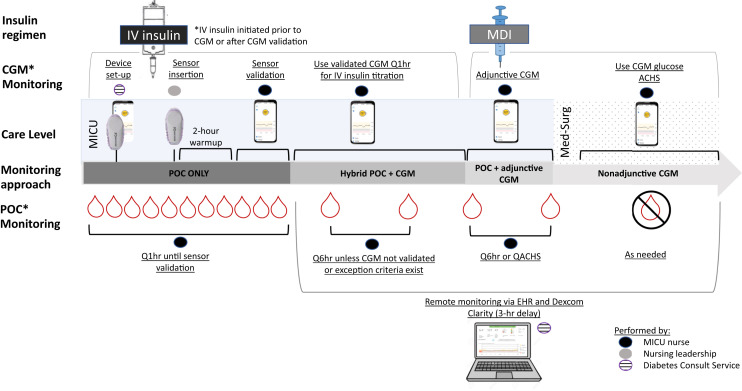
We describe our implementation of a continuous glucose monitoring (CGM) guideline to support intravenous insulin administration and reduce point of care (POC) glucose monitoring frequency in the coronavirus disease 2019 medical intensive care unit (MICU) and evaluate nurses' experience with implementation of CGM and hybrid POC + CGM protocol using the Promoting Action on Research in Health Services framework.
A multidisciplinary team created a guideline providing criteria for establishing initial sensor-meter agreement within each individual patient followed by hybrid use of CGM and POC. POC measures were obtained hourly during initial validation, then every 6 hours. We conducted a focus group among MICU nurses to evaluate initial implementation efforts with content areas focused on initial assessment of evidence, context, and facilitation to identify barriers and facilitators. The focus group was analyzed using a qualitative descriptive approach.
The protocol was integrated through a rapid cycle review process and ultimately disseminated nationally. The Diabetes Consult Service performed device set-up and nurses received just-in-time training. The majority of barriers centered on contextual factors, including limitations of the physical environment, complex device set-up, hospital firewalls, need for training, and CGM documentation. Nurses' perceived device accuracy and utility were exceptionally high. Solutions were devised to maximize facilitation and sustainability for nurses while maintaining patient safety.
Outpatient CGM systems can be implemented in the MICU using a hybrid protocol implementation science approach. These efforts hold tremendous potential to reduce healthcare worker exposure while maintaining glucose control during the COVID-19 pandemic.
我们描述了我们实施连续血糖监测 (CGM) 指南的情况,以支持静脉内胰岛素给药,并降低 2019 年冠状病毒病 (COVID-19) 重症监护病房 (MICU) 中的即时护理 (POC) 血糖监测频率,并使用促进卫生服务研究行动框架评估护士实施 CGM 和混合 POC+CGM 方案的经验。
一个多学科团队制定了一项指南,为每个患者的初始传感器-测量仪一致性提供了标准,然后是 CGM 和 POC 的混合使用。在初始验证期间每小时进行一次 POC 测量,然后每 6 小时进行一次。我们在 MICU 护士中进行了一次焦点小组讨论,以评估初始实施工作的内容领域,重点是对证据、背景和促进因素的初步评估,以确定障碍和促进因素。焦点小组采用定性描述方法进行分析。
该方案通过快速循环审查过程进行整合,并最终在全国范围内传播。糖尿病咨询服务部门负责设备设置,护士接受即时培训。大多数障碍集中在环境因素上,包括物理环境的局限性、复杂的设备设置、医院防火墙、培训需求和 CGM 文档。护士对设备的准确性和实用性的评价非常高。为了在保持患者安全的同时最大限度地促进和维持护士的可持续性,制定了解决方案。
可以使用混合方案实施科学方法在 MICU 中实施门诊 CGM 系统。这些努力有很大的潜力可以减少医护人员的暴露,同时在 COVID-19 大流行期间保持血糖控制。