Beijing Research and Development Center for Grass and Environment, Beijing Academy of Agriculture and Forestry Sciences, Beijing 100097, China.
Beijing Research and Development Center for Grass and Environment, Beijing Academy of Agriculture and Forestry Sciences, Beijing 100097, China.
Poult Sci. 2021 Feb;100(2):1049-1058. doi: 10.1016/j.psj.2020.11.005. Epub 2020 Nov 19.
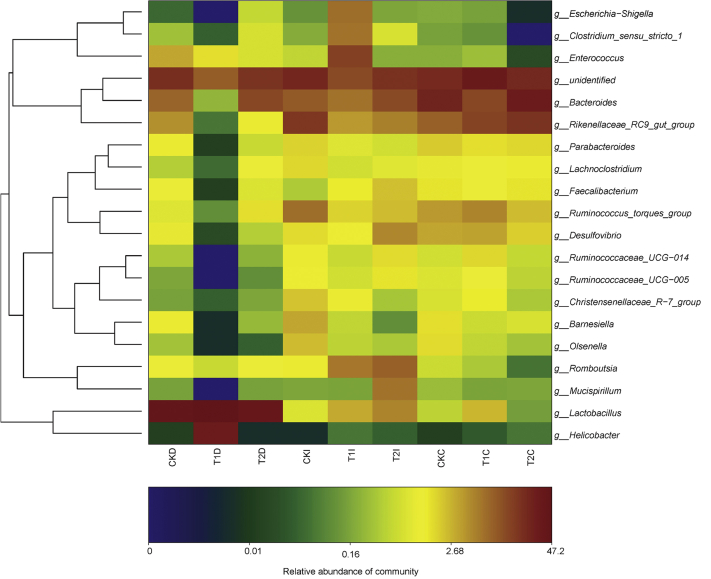
There is an increasing interest in free-range poultry with the increasing focus on food safety and animal welfare. This study was conducted to evaluate the effects of grazing mixed-grass pastures on growth performance, immune responses, and intestinal microbiota in free-range laying chickens. Ten-week-old female Beijing-you chickens were blocked by the BW and randomly assigned to 3 free-range systems in poplar plantations for 120 d: forage-removed paddocks with a high stocking density of 5 m/hen (control [CK]); mixed-grass pastures with a low stocking density of 6 m/hen ;or mixed-grass pastures with a high stocking density of 5 m/hen. Intestinal microbial community analysis was performed by 16S rRNA gene sequencing using Illumina MiSeq. The results revealed that no differences (P > 0.05) were found between the 3 raising systems for the BW and ADG. Chickens grazing mixed-grass pastures exhibited decreased (P > 0.05) mortality and improved immune responses as evidenced by increased T-lymphocyte proliferation (P > 0.05) and immunoglobulin A (P > 0.05) and immunoglobulin M concentrations (P < 0.05) compared with those raised in forage-removed paddocks. Metagenomic analysis indicated that grazing mixed-grass pastures regulated the intestinal microbiota by increasing the prevalence of beneficial bacteria, such as Lactobacillus, Bacteroides, and Faecalibacterium, and reducing potentially pathogenic bacteria population, such as the Rikenellaceae_RC9_gut_group compared with the CK. Therefore, this study indicated that grazing mixed-grass pastures could positively influence intestinal microbiota that may contribute to the overall growth and immunity of free-range chickens and that a low stocking density of 6 m/hen was optimal to Beijing-you chickens grazing mixed-grass pastures.
人们越来越关注放养家禽,这主要是出于对食品安全和动物福利的关注。本研究旨在评估在放养鸡舍中放牧混合草牧场对生长性能、免疫反应和肠道微生物群的影响。选择 10 周龄的雌性北京油鸡,按 BW 进行分组,然后随机分配到 3 种不同的放养鸡舍系统中,共 120 天:高密度去放牧草地,每只鸡 5 平方米(对照组[CK]);低密度混合草牧场,每只鸡 6 平方米;或高密度混合草牧场,每只鸡 5 平方米。采用 Illumina MiSeq 进行 16S rRNA 基因测序,对肠道微生物群落进行分析。结果表明,在 BW 和 ADG 方面,3 种饲养系统之间没有差异(P>0.05)。与去放牧草地相比,放牧混合草牧场的鸡死亡率降低(P>0.05),免疫反应增强,表现为 T 淋巴细胞增殖(P>0.05)、免疫球蛋白 A(P>0.05)和免疫球蛋白 M 浓度(P<0.05)增加。宏基因组分析表明,与 CK 相比,放牧混合草牧场通过增加有益菌(如乳杆菌、拟杆菌和粪杆菌)的流行率,减少潜在的致病菌(如 Rikenellaceae_RC9_gut_group)的数量,调节肠道微生物群。因此,本研究表明,放牧混合草牧场可以积极影响肠道微生物群,从而可能有助于放养鸡的整体生长和免疫力,而 6 平方米/只的低饲养密度对北京油鸡放牧混合草牧场最为理想。