Raffan Sarah, Halford Nigel G
Plant Sciences Department Rothamsted Research Harpenden UK.
Ann Appl Biol. 2021 Jan;178(1):6-22. doi: 10.1111/aab.12632. Epub 2020 Sep 4.
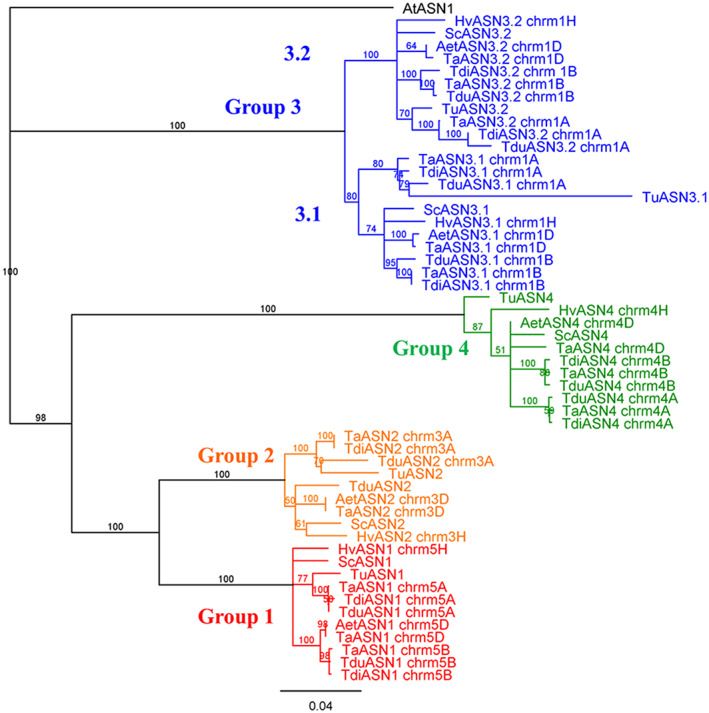
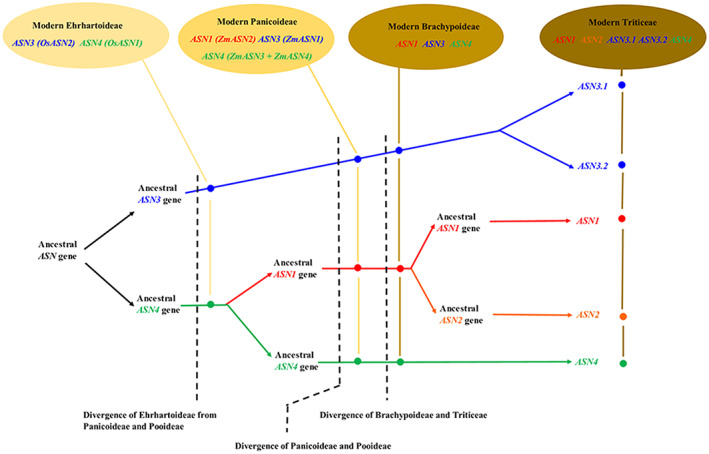
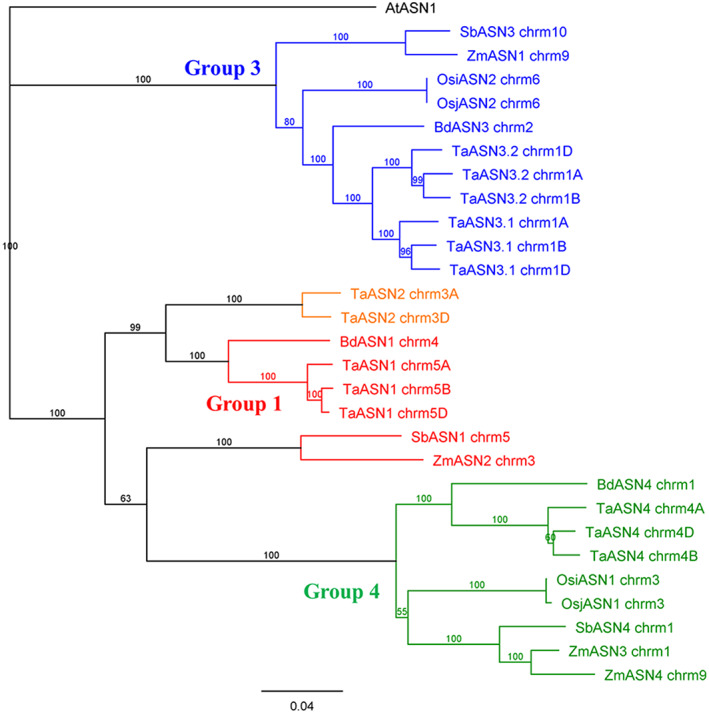
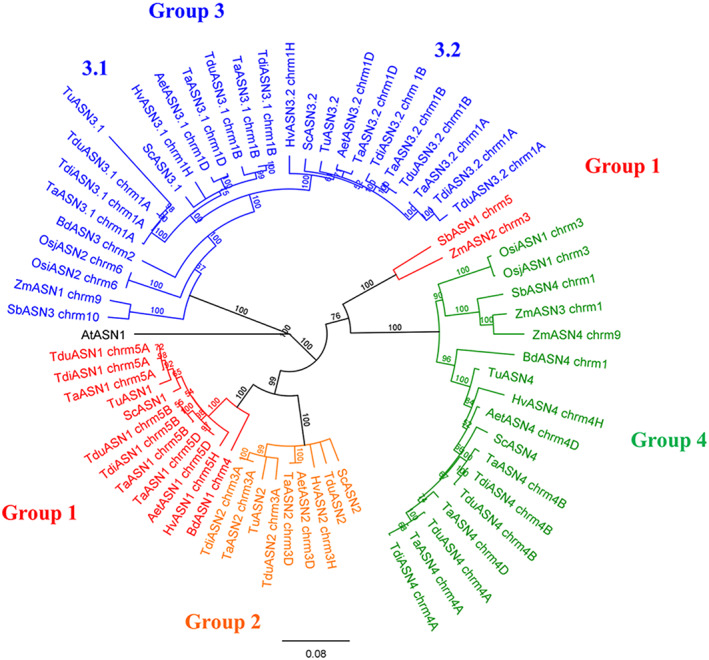
Asparagine synthetase catalyses the transfer of an amino group from glutamine to aspartate to form glutamate and asparagine. The accumulation of free (nonprotein) asparagine in crops has implications for food safety because free asparagine is the precursor for acrylamide, a carcinogenic contaminant that forms during high-temperature cooking and processing. Here we review publicly available genome data for asparagine synthetase genes from species of the Pooideae subfamily, including bread wheat and related wheat species ( and spp.), barley () and rye () of the Triticeae tribe. Also from the Pooideae subfamily: brachypodium () of the Brachypodiae tribe. More diverse species are also included, comprising sorghum () and maize () of the Panicoideae subfamily and rice () of the Ehrhartoideae subfamily. The asparagine synthetase gene families of the Triticeae species each comprise five genes per genome, with the genes assigned to four groups: 1, 2, 3 (subdivided into 3.1 and 3.2) and 4. Each species has a single gene per genome in each group, except that some bread wheat varieties (genomes AABBDD) and emmer wheat (; genomes AABB) lack a group 2 gene in the B genome. This raises questions about the ancestry of cultivated pasta wheat and the B genome donor of bread wheat, suggesting that the hybridisation event that gave rise to hexaploid bread wheat occurred more than once. In phylogenetic analyses, genes from the other species cluster with the Triticeae genes, but brachypodium, sorghum and maize lack a group 2 gene, while rice has only two genes, one group 3 and one group 4. This means that , the most highly expressed asparagine synthetase gene in wheat grain, has no equivalent in maize, rice, sorghum or brachypodium. An evolutionary pathway is proposed in which a series of gene duplications gave rise to the five genes found in modern Triticeae species.
天冬酰胺合成酶催化谷氨酰胺中的氨基转移至天冬氨酸,形成谷氨酸和天冬酰胺。作物中游离(非蛋白质)天冬酰胺的积累对食品安全具有重要意义,因为游离天冬酰胺是丙烯酰胺的前体,丙烯酰胺是一种在高温烹饪和加工过程中形成的致癌污染物。在此,我们综述了来自早熟禾亚科物种的天冬酰胺合成酶基因的公开基因组数据,包括面包小麦及相关小麦物种( 属和 属)、小麦族的大麦( )和黑麦( )。同样来自早熟禾亚科的还有短柄草族的短柄草( )。还纳入了更多样化的物种,包括黍亚科的高粱( )和玉米( )以及稻亚科的水稻( )。小麦族物种的天冬酰胺合成酶基因家族每个基因组各包含五个基因,这些基因被分为四组:1、2、3(细分为3.1和3.2)和4。每个物种在每组中每个基因组有一个单一基因,但一些面包小麦品种(基因组AABBDD)和二粒小麦( ;基因组AABB)在B基因组中缺少2组基因。这引发了关于栽培意大利面小麦的祖先以及面包小麦B基因组供体的问题,表明导致六倍体面包小麦产生的杂交事件不止发生过一次。在系统发育分析中,其他物种的基因与小麦族基因聚类,但短柄草、高粱和玉米缺少2组基因,而水稻只有两个基因,一个3组基因和一个4组基因。这意味着小麦籽粒中表达量最高的天冬酰胺合成酶基因 在玉米、水稻、高粱或短柄草中没有对应基因。本文提出了一种进化途径,即一系列基因复制产生了现代小麦族物种中发现的五个基因。