Department of Medical Genetics, Oslo University Hospital and University of Oslo, Oslo, Norway.
Helmholtz Zentrum München, Institute of Bioinformatics and Systems Biology, Ingolstädter Landstrasse 1, München, Germany.
New Phytol. 2013 Sep;199(4):1060-1068. doi: 10.1111/nph.12337. Epub 2013 May 23.
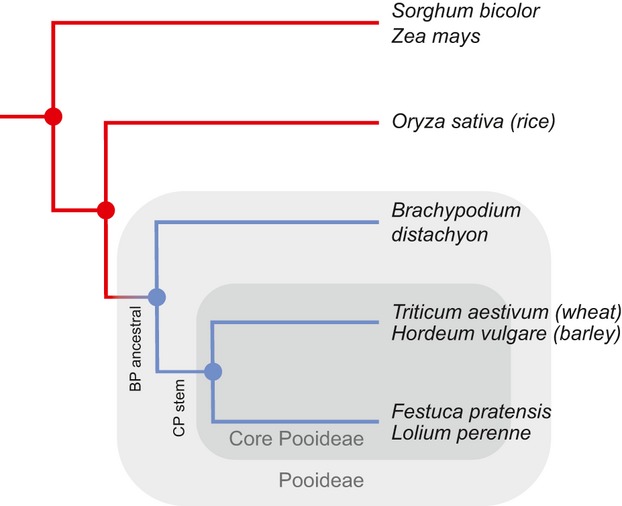
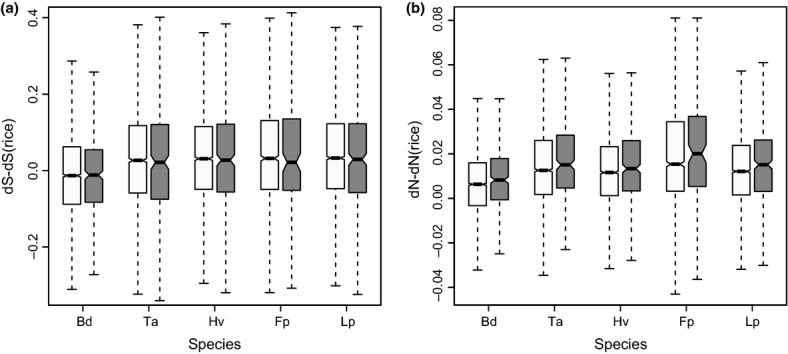
Adaptation to temperate environments is common in the grass subfamily Pooideae, suggesting an ancestral origin of cold climate adaptation. Here, we investigated substitution rates of genes involved in low-temperature-induced (LTI) stress responses to test the hypothesis that adaptive molecular evolution of LTI pathway genes was important for Pooideae evolution. Substitution rates and signatures of positive selection were analyzed using 4330 gene trees including three warm climate-adapted species (maize (Zea mays), sorghum (Sorghum bicolor), and rice (Oryza sativa)) and five temperate Pooideae species (Brachypodium distachyon, wheat (Triticum aestivum), barley (Hordeum vulgare), Lolium perenne and Festuca pratensis). Nonsynonymous substitution rate differences between Pooideae and warm habitat-adapted species were elevated in LTI trees compared with all trees. Furthermore, signatures of positive selection were significantly stronger in LTI trees after the rice and Pooideae split but before the Brachypodium divergence (P < 0.05). Genome-wide heterogeneity in substitution rates was also observed, reflecting divergent genome evolution processes within these grasses. Our results provide evidence for a link between adaptation to cold habitats and adaptive evolution of LTI stress responses in early Pooideae evolution and shed light on a poorly understood chapter in the evolutionary history of some of the world's most important temperate crops.
适应温带环境在禾本科 Poaceae 亚科中很常见,这表明冷气候适应的祖先起源。在这里,我们研究了参与低温诱导(LTI)应激反应的基因的替代率,以检验 LTI 途径基因的适应性分子进化对 Poaceae 进化很重要的假设。使用包括三个温暖气候适应物种(玉米(Zea mays)、高粱(Sorghum bicolor)和水稻(Oryza sativa))和五个温带 Poaceae 物种(短柄草(Brachypodium distachyon)、小麦(Triticum aestivum)、大麦(Hordeum vulgare)、黑麦草(Lolium perenne)和紫羊茅(Festuca pratensis)的 4330 个基因树分析了替代率和正选择的特征。与所有树木相比,在 LTI 树木中,禾本科和温暖栖息地适应物种之间的非同义替代率差异升高。此外,在水稻和 Poaceae 分裂后,但在短柄草分歧之前,LTI 树木中正向选择的特征明显更强(P < 0.05)。还观察到替代率的全基因组异质性,反映了这些草类内部不同的基因组进化过程。我们的研究结果为寒冷栖息地适应与早期 Poaceae 进化中 LTI 应激反应的适应性进化之间的联系提供了证据,并为世界上一些最重要的温带作物的进化历史中一个了解甚少的章节提供了线索。