Hadei Mostafa, Mohebbi Seyed Reza, Hopke Philip K, Shahsavani Abbas, Bazzazpour Shahriyar, Alipour Mohammadreza, Jafari Ahmad Jonidi, Bandpey Anooshiravan Mohseni, Zali Alireza, Yarahmadi Maryam, Farhadi Mohsen, Rahmatinia Masoumeh, Hasanzadeh Vajihe, Nazari Seyed Saeed Hashemi, Asadzadeh-Aghdaei Hamid, Tanhaei Mohammad, Zali Mohammad Reza, Kermani Majid, Vaziri Mohmmad Hossien, Chobineh Hamid
Department of Environmental Health Engineering, School of Public Health, Tehran University of Medical Sciences, Tehran, Iran.
Gastroenterology and Liver Diseases Research Center, Research Institute for Gastroenterology and Liver Diseases, Shahid Beheshti University of Medical Sciences, Tehran, Iran.
Atmos Pollut Res. 2021 Mar;12(3):302-306. doi: 10.1016/j.apr.2020.12.016. Epub 2021 Jan 2.
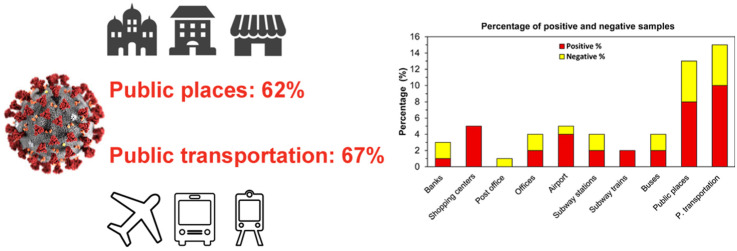
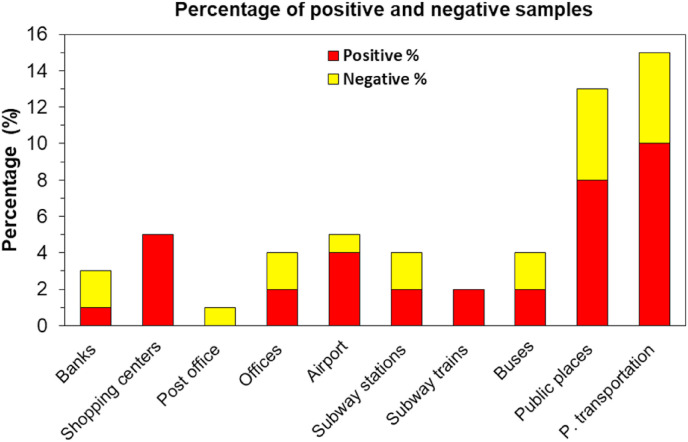
This study investigated the presence of SARS-CoV-2 in air of public places such as shopping centers, a post office, banks, governmental offices, and public transportation facilities including an airport, subways, and buses in Tehran, Iran. A total of 28 air samples were collected from the eight groups of public and transportation locations. The airborne particle samples were collected on PTFE or glass fiber filters using two types of samplers with flow rates of 40 and 3.5 L/min, respectively. The viral samples were leached and concentrated, and RNA was extracted from each. The presence of viral RNA was evaluated using novel coronavirus nucleic acid diagnostic real time PCR kits. In 64% of the samples, SARS-CoV-2 RNA (62% and 67% from the public places and transportation, respectively) was detected. Positive samples were detected in banks (33%), shopping centers (100%), governmental offices (50%), the airport (80%), subway stations (50%), subway trains (100%), and buses (50%). Logistic regression showed that number of people present during the sampling and the sampled air volume were positively associated with presence of SARS-CoV-2; while the percentage of people with masks, air temperature, and sampling site's volume were negatively related to SARS-CoV-2's presence. However, none of these associations were statistically significant. This study showed that most public places and transportation vehicles were contaminated with SARS-CoV-2. Thus, strategies to control the spread of COVID-19 should include reducing the number of people in indoor spaces, more intense disinfection of transport vehicles, and requiring people to wear masks.
本研究调查了伊朗德黑兰的公共场所(如购物中心、邮局、银行、政府办公室)以及公共交通设施(包括机场、地铁和公交车)空气中新型冠状病毒(SARS-CoV-2)的存在情况。总共从八组公共和交通场所采集了28个空气样本。使用两种流速分别为40和3.5升/分钟的采样器,将空气中的颗粒样本采集到聚四氟乙烯(PTFE)或玻璃纤维滤膜上。对病毒样本进行浸出和浓缩,然后从每个样本中提取RNA。使用新型冠状病毒核酸诊断实时荧光定量PCR试剂盒评估病毒RNA的存在情况。在64%的样本中检测到了SARS-CoV-2 RNA(公共场所和交通工具样本中分别为62%和67%)。在银行(33%)、购物中心(100%)、政府办公室(50%)、机场(80%)、地铁站(50%)、地铁列车(100%)和公交车(50%)中检测到了阳性样本。逻辑回归分析表明,采样期间在场人数和采样空气量与SARS-CoV-2的存在呈正相关;而戴口罩的人员比例、气温和采样地点的空间大小与SARS-CoV-2的存在呈负相关。然而,这些关联均无统计学意义。本研究表明,大多数公共场所和交通工具都被SARS-CoV-2污染。因此,控制新冠病毒传播的策略应包括减少室内空间的人数、加强对运输车辆的消毒以及要求人们佩戴口罩。