Plasencia Felix A, Estrada Yanira, Flores Francisco B, Ortíz-Atienza Ana, Lozano Rafael, Egea Isabel
Department of Stress Biology and Plant Pathology, Centro de Edafologia y Biologia Aplicada del Segura (CEBAS), Consejo Superior de Investigaciones Científicas (CSIC), Campus Universitario Espinardo, Murcia, Spain.
Centro de Investigación en Biotecnología Agroalimentaria (BITAL), Universidad de Almería, Almería, Spain.
Front Plant Sci. 2021 Jan 15;11:599944. doi: 10.3389/fpls.2020.599944. eCollection 2020.
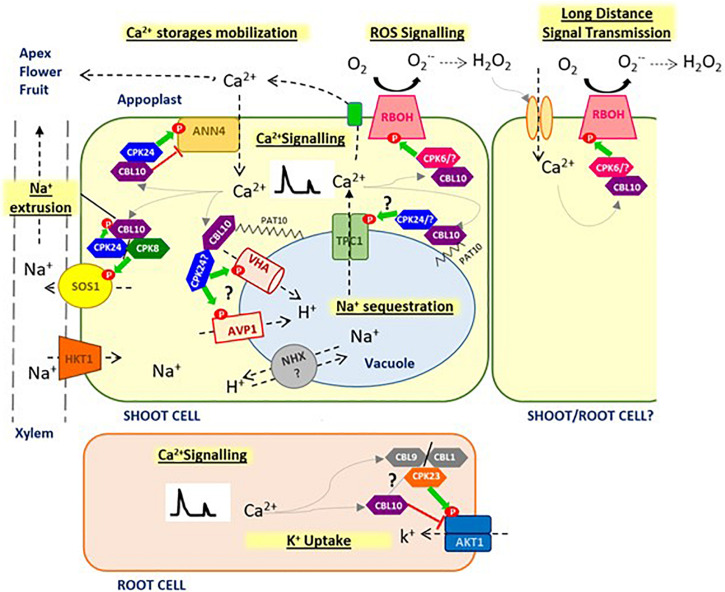
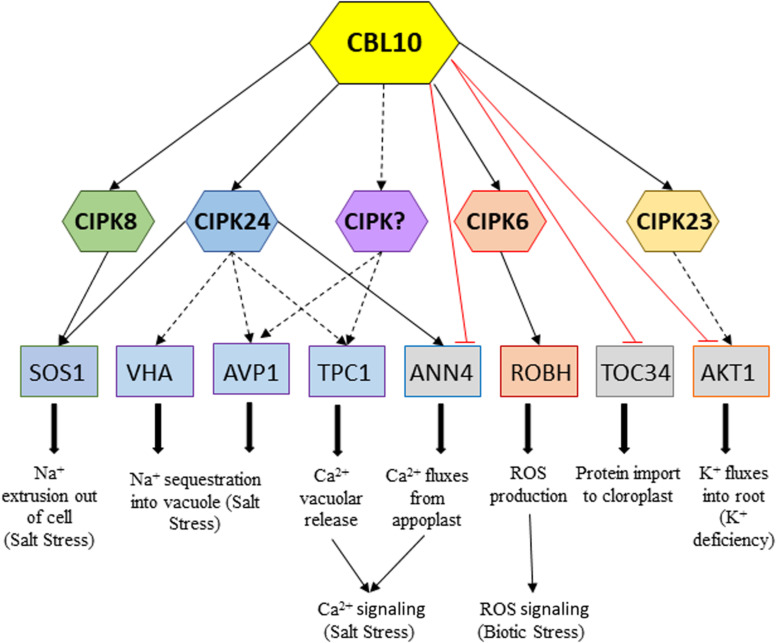
Ca is a second messenger that mediates plant responses to abiotic stress; Ca signals need to be decoded by Ca sensors that translate the signal into physiological, metabolic, and molecular responses. Recent research regarding the Ca sensor CALCINEURIN B-LIKE PROTEIN 10 (CBL10) has resulted in important advances in understanding the function of this signaling component during abiotic stress tolerance. Under saline conditions, CBL10 function was initially understood to be linked to regulation of Na homeostasis, protecting plant shoots from salt stress. During this process, CBL10 interacts with the CBL-interacting protein kinase 24 (CIPK24, SOS2), this interaction being localized at both the plasma and vacuolar (tonoplast) membranes. Interestingly, recent studies have exposed that CBL10 is a regulator not only of Na homeostasis but also of Ca under salt stress, regulating Ca fluxes in vacuoles, and also at the plasma membrane. This review summarizes new research regarding functions of CBL10 in plant stress tolerance, predominantly salt stress, as this is the most commonly studied abiotic stress associated with the function of this regulator. Special focus has been placed on some aspects that are still unclear. We also pay particular attention on the proven versatility of CBL10 to activate (in a CIPK-dependent manner) or repress (by direct interaction) downstream targets, in different subcellular locations. These in turn appear to be the link through which CBL10 could be a key master regulator of stress signaling in plants and also a crucial participant in fruit development and quality, as disruption of results in inadequate Ca partitioning in plants and fruit. New emerging roles associated with other abiotic stresses in addition to salt stress, such as drought, flooding, and K deficiency, are also addressed in this review. Finally, we provide an outline of recent advances in identification of potential targets of CBL10, as CBL10/CIPKs complexes and as CBL10 direct interactions. The aim is to showcase new research regarding this master regulator of abiotic stress tolerance that may be essential to the maintenance of crop productivity under abiotic stress. This is particularly pertinent when considering the scenario of a projected increase in extreme environmental conditions due to climate change.
钙是一种第二信使,介导植物对非生物胁迫的响应;钙信号需要由钙传感器解码,将信号转化为生理、代谢和分子响应。最近关于钙传感器类钙调神经磷酸酶B蛋白10(CBL10)的研究在理解该信号组分在非生物胁迫耐受性中的功能方面取得了重要进展。在盐胁迫条件下,CBL10的功能最初被认为与钠稳态的调节有关,保护植物地上部分免受盐胁迫。在此过程中,CBL10与CBL相互作用蛋白激酶24(CIPK24,SOS2)相互作用,这种相互作用定位于质膜和液泡(液泡膜)膜上。有趣的是,最近的研究表明,CBL10不仅是盐胁迫下钠稳态的调节因子,也是钙的调节因子,调节液泡以及质膜中的钙通量。本综述总结了关于CBL10在植物胁迫耐受性,主要是盐胁迫耐受性中的功能的新研究,因为这是与该调节因子功能相关的最常研究的非生物胁迫。特别关注了一些仍不清楚的方面。我们还特别关注CBL10在不同亚细胞位置激活(以CIPK依赖的方式)或抑制(通过直接相互作用)下游靶标的已证实的多功能性。这些反过来似乎是CBL10可能成为植物胁迫信号关键主调节因子以及果实发育和品质关键参与者的联系,因为其破坏会导致植物和果实中钙分配不足。除盐胁迫外,与其他非生物胁迫相关的新出现的作用,如干旱、洪涝和钾缺乏,也在本综述中进行了探讨。最后,我们概述了CBL10潜在靶标的鉴定方面的最新进展,作为CBL10/CIPK复合物以及CBL10直接相互作用。目的是展示关于这种非生物胁迫耐受性主调节因子的新研究,这对于在非生物胁迫下维持作物生产力可能至关重要。考虑到由于气候变化预计极端环境条件会增加的情况,这一点尤为相关。