Saito Shunya, Uozumi Nobuyuki
Department of Biomolecular Engineering, Graduate School of Engineering, Tohoku University, Sendai, Japan.
Front Plant Sci. 2020 Feb 11;11:44. doi: 10.3389/fpls.2020.00044. eCollection 2020.
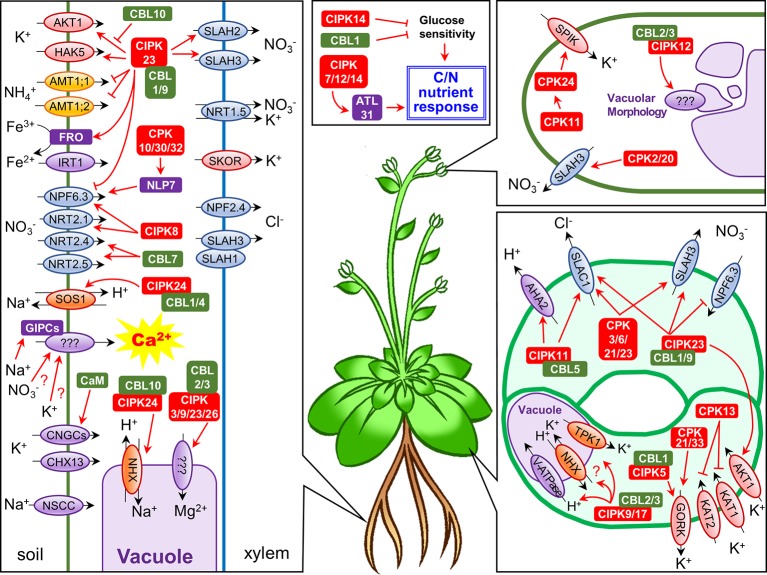
Essential elements taken up from the soil and distributed throughout the whole plant play diverse roles in different tissues. Cations and anions contribute to maintenance of intracellular osmolarity and the formation of membrane potential, while nitrate, ammonium, and sulfate are incorporated into amino acids and other organic compounds. In contrast to these ion species, calcium concentrations are usually kept low in the cytosol and calcium displays unique behavior as a cytosolic signaling molecule. Various environmental stresses stimulate increases in the cytosolic calcium concentration, leading to activation of calcium-regulated protein kinases and downstream signaling pathways. In this review, we summarize the stress responsive regulation of nutrient uptake and balancing by two types of calcium-regulated phosphorylation systems: CPK and CBL-CIPK. CPK is a family of protein kinases activated by calcium. CBL is a group of calcium sensor proteins that interact with CIPK kinases, which phosphorylate their downstream targets. In , quite a few ion transport systems are regulated by CPKs or CBL-CIPK complexes, including channels/transporters that mediate transport of potassium (KAT1, KAT2, GORK, AKT1, AKT2, HAK5, SPIK), sodium (SOS1), ammonium (AMT1;1, AMT1;2), nitrate and chloride (SLAC1, SLAH2, SLAH3, NRT1.1, NRT2.4, NRT2.5), and proton (AHA2, V-ATPase). CPKs and CBL-CIPKs also play a role in C/N nutrient response and in acquisition of magnesium and iron. This functional regulation by calcium-dependent phosphorylation systems ensures the growth of plants and enables them to acquire tolerance against various environmental stresses. Calcium serves as the key factor for the regulation of membrane transport systems.
从土壤中吸收并分布于整个植物的必需元素在不同组织中发挥着多样的作用。阳离子和阴离子有助于维持细胞内渗透压以及膜电位的形成,而硝酸盐、铵和硫酸盐则被整合到氨基酸和其他有机化合物中。与这些离子种类不同,细胞质中钙的浓度通常保持在较低水平,并且钙作为一种细胞质信号分子表现出独特的行为。各种环境胁迫会刺激细胞质钙浓度升高,从而导致钙调节蛋白激酶和下游信号通路的激活。在本综述中,我们总结了两种钙调节磷酸化系统(CPK和CBL-CIPK)对养分吸收和平衡的胁迫响应调节。CPK是一类由钙激活的蛋白激酶。CBL是一组钙传感蛋白,它们与CIPK激酶相互作用,CIPK激酶会磷酸化其下游靶标。在植物中,相当多的离子转运系统受CPK或CBL-CIPK复合物调节,包括介导钾(KAT1、KAT2、GORK、AKT1、AKT2、HAK5、SPIK)、钠(SOS1)、铵(AMT1;1、AMT1;2)、硝酸盐和氯离子(SLAC1、SLAH2、SLAH3、NRT1.1、NRT2.4、NRT2.5)以及质子(AHA2、V-ATPase)运输的通道/转运体。CPK和CBL-CIPK在碳/氮养分响应以及镁和铁的获取中也发挥作用。这种由钙依赖性磷酸化系统进行的功能调节确保了植物的生长,并使它们能够获得对各种环境胁迫的耐受性。钙是调节膜运输系统的关键因素。