Chan Zuckerberg Biohub, 499 Illinois Street, San Francisco, CA, 94158, USA.
Chan Zuckerberg Initiative, 601 Marshall Street, Redwood City, CA, 94063, USA.
Sci Rep. 2021 Sep 29;11(1):19308. doi: 10.1038/s41598-021-98211-5.
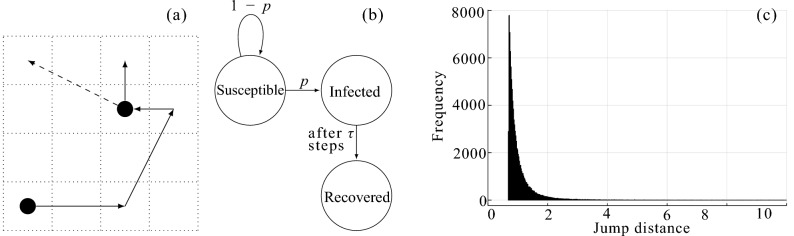
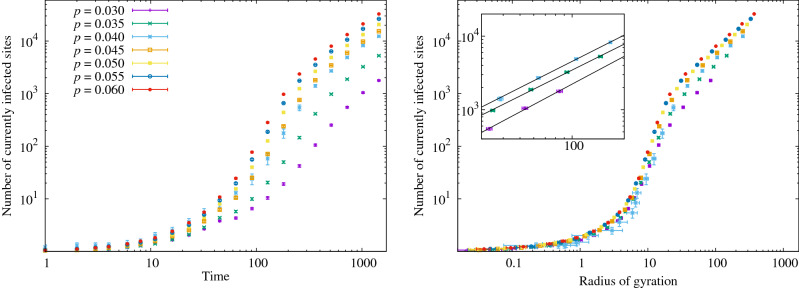
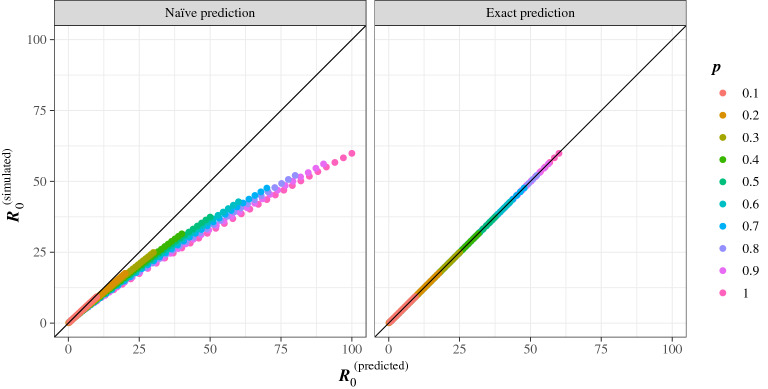
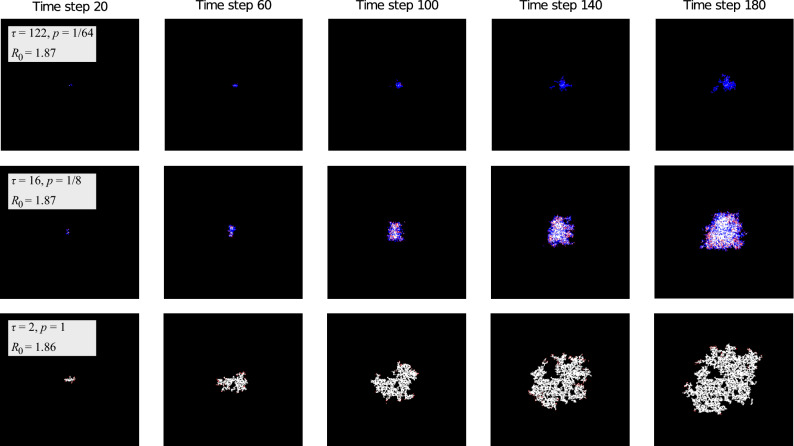
Random walkers on a two-dimensional square lattice are used to explore the spatio-temporal growth of an epidemic. We have found that a simple random-walk system generates non-trivial dynamics compared with traditional well-mixed models. Phase diagrams characterizing the long-term behaviors of the epidemics are calculated numerically. The functional dependence of the basic reproductive number [Formula: see text] on the model's defining parameters reveals the role of spatial fluctuations and leads to a novel expression for [Formula: see text]. Special attention is given to simulations of inter-regional transmission of the contagion. The scaling of the epidemic with respect to space and time scales is studied in detail in the critical region, which is shown to be compatible with the directed-percolation universality class.
我们使用二维正方形格子上的随机行走者来探索传染病的时空增长。我们发现,与传统的完全混合模型相比,简单的随机行走系统会产生非平凡的动力学。通过数值计算得到了描述传染病长期行为的相图。基本繁殖数[Formula: see text]对模型定义参数的函数依赖性揭示了空间波动的作用,并导致了[Formula: see text]的新表达式。特别关注传染病在区域间传播的模拟。在临界区域中详细研究了传染病相对于空间和时间尺度的标度,结果表明它与有向渗流普适类兼容。