Faculty of Science and Technology, Norwegian University of Life Sciences, Ås, Norway.
Protein-Ligand Engineering and Molecular Biology Research Team, National Center for Genetic Engineering and Biotechnology, Khlong Neung, Thailand.
Microbiome. 2021 Feb 1;9(1):36. doi: 10.1186/s40168-020-00987-7.
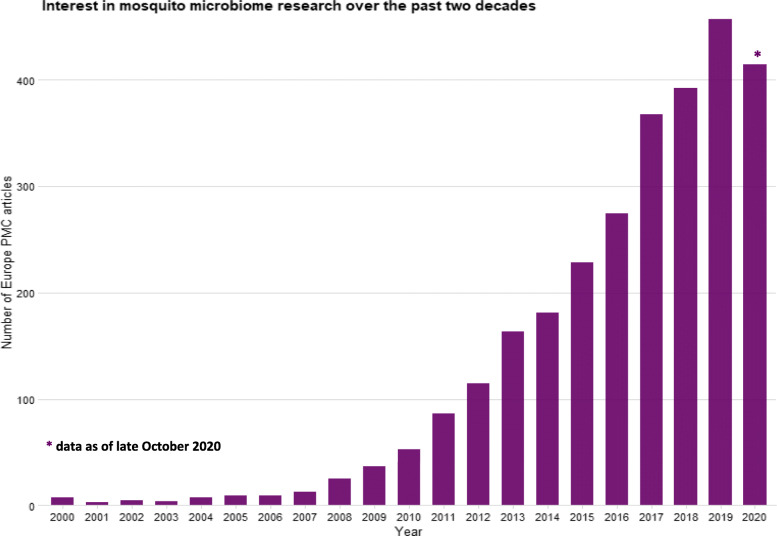
In the past decade, there has been increasing interest in mosquito microbiome research, leading to large amounts of data on different mosquito species, with various underlying physiological characteristics, and from diverse geographical locations. However, guidelines and standardized methods for conducting mosquito microbiome research are lacking. To streamline methods in mosquito microbiome research and optimize data quality, reproducibility, and comparability, as well as facilitate data curation in a centralized location, we are establishing the Mosquito Microbiome Consortium, a collaborative initiative for the advancement of mosquito microbiome research. Our overall goal is to collectively work on unraveling the role of the mosquito microbiome in mosquito biology, while critically evaluating its potential for mosquito-borne disease control. This perspective serves to introduce the consortium and invite broader participation. It highlights the issues we view as most pressing to the community and proposes guidelines for conducting mosquito microbiome research. We focus on four broad areas in this piece: (1) sampling/experimental design for field, semi-field, or laboratory studies; (2) metadata collection; (3) sample processing, sequencing, and use of appropriate controls; and (4) data handling and analysis. We finally summarize current challenges and highlight future directions in mosquito microbiome research. We hope that this piece will spark discussions around this area of disease vector biology, as well as encourage careful considerations in the design and implementation of mosquito microbiome research. Video Abstract.
在过去的十年中,人们对蚊子微生物组的研究越来越感兴趣,导致了大量关于不同蚊子物种的数据,这些蚊子具有不同的潜在生理特征,并来自不同的地理位置。然而,目前缺乏进行蚊子微生物组研究的指导方针和标准化方法。为了简化蚊子微生物组研究的方法,优化数据质量、可重复性和可比性,并在集中的位置方便数据管理,我们正在建立蚊子微生物组联盟,这是一个促进蚊子微生物组研究的合作倡议。我们的总体目标是共同努力揭示蚊子微生物组在蚊子生物学中的作用,同时批判性地评估其在控制蚊媒疾病方面的潜力。本观点旨在介绍该联盟并邀请更广泛的参与。它强调了我们认为对该领域最重要的问题,并提出了进行蚊子微生物组研究的指导方针。我们在这篇文章中重点关注四个广泛的领域:(1)野外、半野外或实验室研究的采样/实验设计;(2)元数据收集;(3)样本处理、测序和适当对照的使用;(4)数据处理和分析。最后,我们总结了当前的挑战,并强调了蚊子微生物组研究的未来方向。我们希望这篇文章能够引发关于疾病媒介生物学这一领域的讨论,并鼓励在设计和实施蚊子微生物组研究时进行仔细考虑。