Department of Population Medicine, Ontario Veterinary College, University of Guelph, Guelph, Ontario, Canada.
Department of Clinical Studies, Ontario Veterinary College, University of Guelph, Guelph, Ontario, Canada.
PLoS One. 2021 Feb 1;16(2):e0245632. doi: 10.1371/journal.pone.0245632. eCollection 2021.
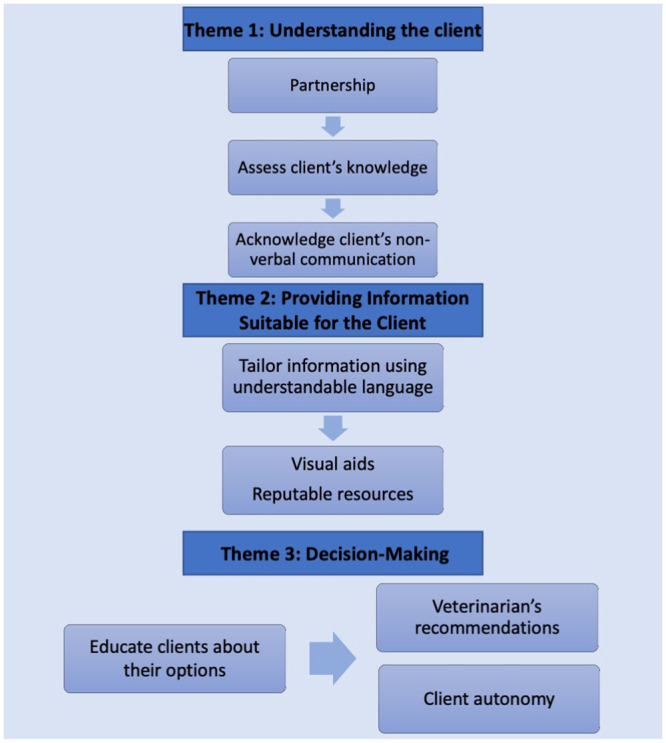
One of the most complex aspects of the veterinarian-client-patient interaction is the clinical decision-making process. Research suggests that the approach to communication used by veterinarians can impact veterinary clients' involvement in the decision-making process and their ultimate satisfaction. Using different approaches to the decision-making process may affect how information is exchanged and consequently how decisions are made. The objective of this study was to determine pet owners' expectations with respect to information exchange and decision-making during veterinarian-client-patient interactions and to compare veterinarians' perceptions of those expectations and the challenges they face in meeting them. Five pet owner focus groups (27 owners) and three veterinarian focus groups (24 veterinarians) were conducted with standardized open-ended questions and follow-up probes. Thematic analysis of the transcribed data was conducted to identify trends and patterns that emerged during the focus groups. Three pet owner-based themes were identified: 1) understanding the client; 2) providing information suitable for the client; and 3) decision-making. In addition, three barriers for veterinarians affecting information exchange and decision-making were identified: 1) time constraints; 2) involvement of multiple clients; and 3) language barriers. Results suggest that pet owners expect to be supported by their veterinarian to make informed decisions by understanding the client's current knowledge, tailoring information and educating clients about their options. Breakdowns in the information exchange process can impact pet owners' perceptions of veterinarians' motivations. Pet owners' emphasis on partnership suggests that a collaborative approach between veterinarians and clients may improve client satisfaction.
兽医-客户-患者互动中最复杂的方面之一是临床决策过程。研究表明,兽医使用的沟通方法可以影响兽医客户参与决策过程的程度及其最终满意度。采用不同的决策方法可能会影响信息的交流方式,从而影响决策的制定。本研究的目的是确定宠物主人在兽医-客户-患者互动中对信息交流和决策的期望,并比较兽医对这些期望的看法以及他们在满足这些期望方面所面临的挑战。采用标准化的开放式问题和后续探究方法进行了 5 个宠物主人焦点小组(27 位所有者)和 3 个兽医焦点小组(24 位兽医)。对转录数据进行主题分析,以确定焦点小组期间出现的趋势和模式。确定了基于三个宠物主人的主题:1)了解客户;2)为客户提供合适的信息;3)决策。此外,还确定了影响信息交流和决策的兽医面临的三个障碍:1)时间限制;2)涉及多个客户;3)语言障碍。结果表明,宠物主人希望通过了解客户当前的知识,调整信息并向客户传授其选择,由兽医来支持他们做出明智的决策。信息交流过程中的中断会影响宠物主人对兽医动机的看法。宠物主人对合作伙伴关系的重视表明,兽医和客户之间的协作方法可能会提高客户满意度。