DeChant Mallory T, Bunker Paul C, Hall Nathaniel J
Department of Food and Animal Sciences, Texas Tech University, Lubbock, TX 79409, USA.
Chiron K9, San Antonio, TX 78251, USA.
Animals (Basel). 2021 Jan 28;11(2):326. doi: 10.3390/ani11020326.
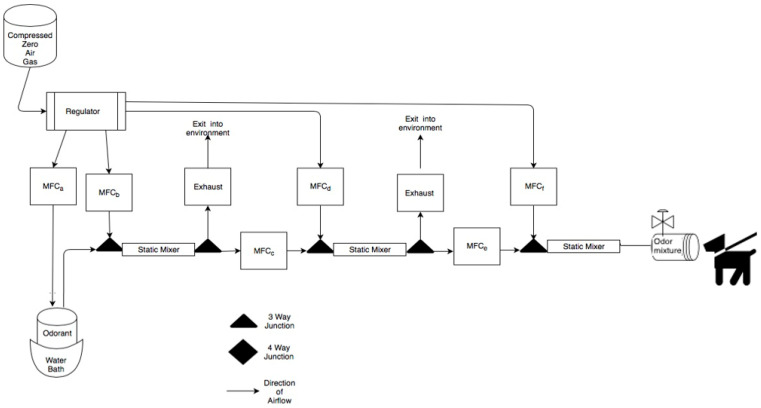
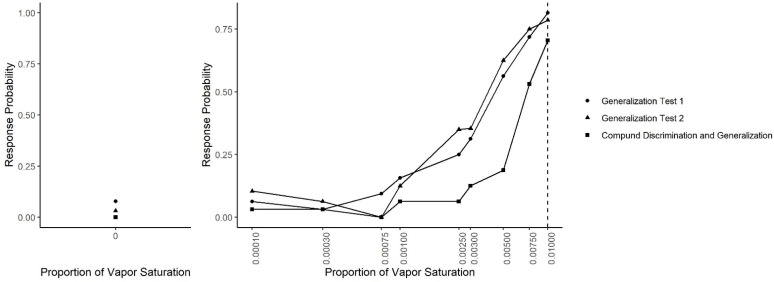
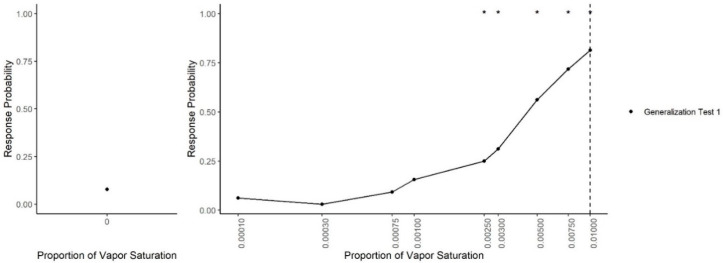
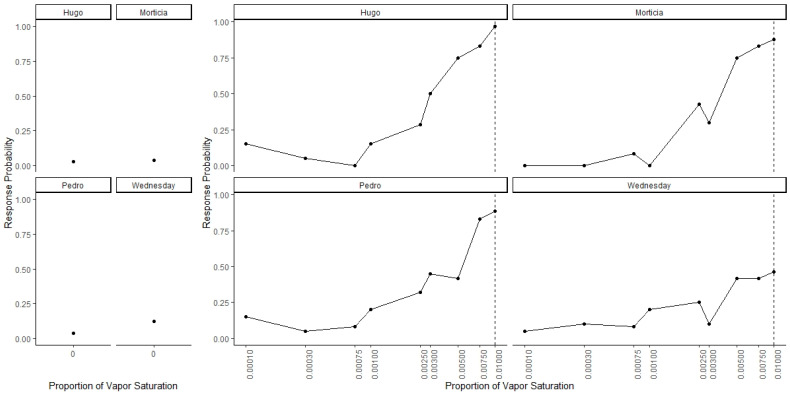
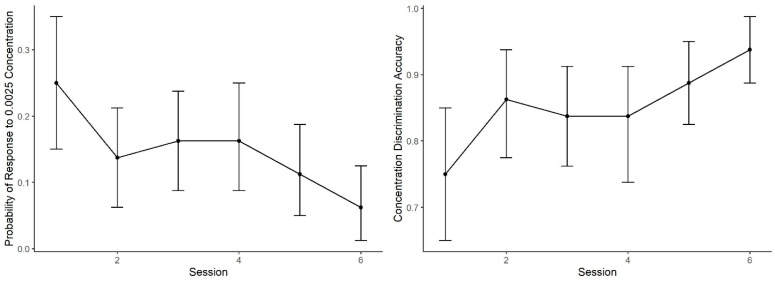
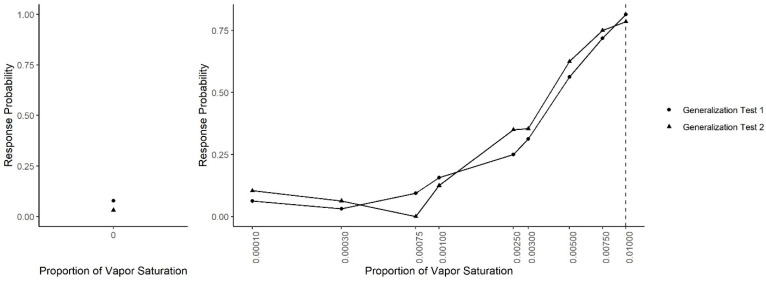
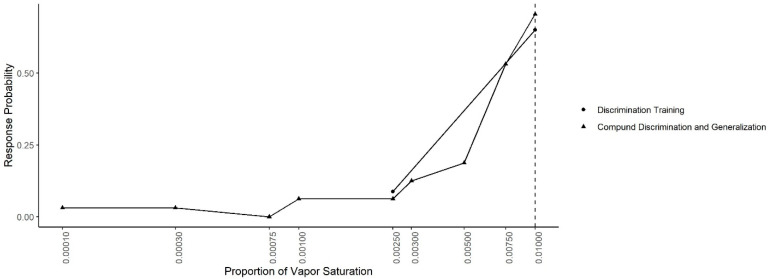
Despite dogs' widespread use as detection systems, little is known about how dogs generalize to variations of an odorant's concentration. Further, it is unclear whether dogs can be trained to discriminate between similar concentration variations of an odorant. Four dogs were trained to an odorant (0.01 air dilution of isoamyl acetate) in an air-dilution olfactometer, and we assessed spontaneous generalization to a range of concentrations lower than the training stimulus (Generalization Test 1). Dogs generalized to odors within a 10-fold range of the training odorant. Next, we conducted discrimination training to suppress responses to concentrations lower than a concentration dogs showed initial responding towards in Generalization Test 1 (0.0025 air dilution). Dogs successfully discriminated between 0.0025 and 0.01, exceeding 90% accuracy. However, when a second generalization test was conducted (Generalization Test 2), responding at the 0.0025 concentration immediately recovered and was no different than in Generalization Test 1. Dogs were then tested in another generalization test (Compound Discrimination and Generalization) in which generalization probes were embedded within discrimination trials, and dogs showed suppression of responding to the 0.0025 concentration and lower concentrations in this preparation. These data suggest dogs show limited spontaneous generalization across odor concentration and that dogs can be trained to discriminate between similar concentrations of the same odorant. Stimulus control, however, may depend on the negative stimulus, suggesting olfactory concentration generalization may depend on relative stimulus control. These results highlight the importance of considering odor concentration as a dimension for generalization in canine olfactory research.
尽管狗被广泛用作检测系统,但对于狗如何将气味剂浓度的变化进行泛化却知之甚少。此外,尚不清楚狗是否可以被训练来区分气味剂相似的浓度变化。在空气稀释嗅觉计中,对四只狗进行了一种气味剂(乙酸异戊酯的0.01空气稀释液)的训练,并且我们评估了它们对一系列低于训练刺激浓度的自发泛化能力(泛化测试1)。狗对训练气味剂10倍范围内的气味有泛化反应。接下来,我们进行了辨别训练,以抑制狗对低于泛化测试1中它们最初有反应的浓度(0.0025空气稀释液)的反应。狗成功地区分了0.0025和0.01的浓度,准确率超过90%。然而,当进行第二次泛化测试(泛化测试2)时,在0.0025浓度下的反应立即恢复,与泛化测试1中的情况没有差异。然后在另一个泛化测试(复合辨别与泛化)中对狗进行测试,其中泛化探测嵌入在辨别试验中,在这种情况下狗对0.0025浓度及更低浓度的反应受到抑制。这些数据表明,狗在气味浓度上的自发泛化能力有限,并且狗可以被训练来区分同一气味剂的相似浓度。然而,刺激控制可能取决于负性刺激,这表明嗅觉浓度泛化可能取决于相对刺激控制。这些结果突出了在犬类嗅觉研究中考虑气味浓度作为泛化维度的重要性。