Jeschke Gunnar
Department of Chemistry and Applied Biosciences, ETH Zürich, Vladimir-Prelog-Weg 2, CH-8093 Zürich, Switzerland.
Emerg Top Life Sci. 2018 Apr 20;2(1):9-18. doi: 10.1042/ETLS20170143.
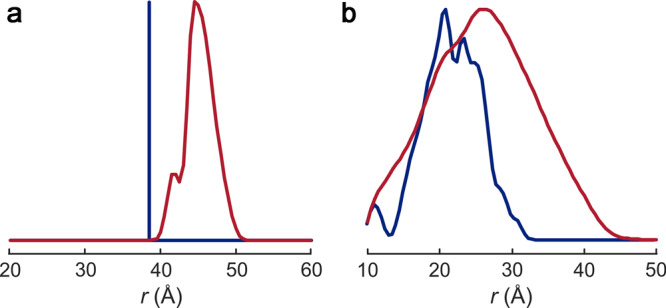
Electron paramagnetic resonance (EPR) spectroscopy combined with site-directed spin labelling is applicable to biomolecules and their complexes irrespective of system size and in a broad range of environments. Neither short-range nor long-range order is required to obtain structural restraints on accessibility of sites to water or oxygen, on secondary structure, and on distances between sites. Many of the experiments characterize a static ensemble obtained by shock-freezing. Compared with characterizing the dynamic ensemble at ambient temperature, analysis is simplified and information loss due to overlapping timescales of measurement and system dynamics is avoided. The necessity for labelling leads to sparse restraint sets that require integration with data from other methodologies for building models. The double electron-electron resonance experiment provides distance distributions in the nanometre range that carry information not only on the mean conformation but also on the width of the native ensemble. The distribution widths are often inconsistent with Anfinsen's concept that a sequence encodes a single native conformation defined at atomic resolution under physiological conditions.
电子顺磁共振(EPR)光谱结合定点自旋标记适用于生物分子及其复合物,无论系统大小如何,且适用于广泛的环境。无论是短程还是长程有序,都无需获得关于位点对水或氧的可及性、二级结构以及位点之间距离的结构限制。许多实验表征的是通过速冻获得的静态集合。与在环境温度下表征动态集合相比,分析得以简化,并且避免了由于测量和系统动力学的时间尺度重叠而导致的信息丢失。标记的必要性导致了稀疏的限制集,这需要与来自其他方法的数据相结合来构建模型。双电子 - 电子共振实验提供了纳米范围内的距离分布,这些分布不仅携带有关平均构象的信息,还携带有关天然集合宽度的信息。分布宽度通常与安芬森的概念不一致,即序列在生理条件下编码在原子分辨率下定义的单一天然构象。