Biomolecular Sciences, Laurentian University, Sudbury, ON, Canada.
Division of Medical Sciences, Northern Ontario School of Medicine, Sudbury, ON, Canada.
Brain Behav. 2021 Apr;11(4):e02049. doi: 10.1002/brb3.2049. Epub 2021 Feb 2.
Fetal programming was characterized a few decades ago, explaining the correlation of physiological phenotypes of offspring exposed to early-life stress. High acute or chronic prenatal stress can overwhelm the enzymatic placental barrier, inducing transcriptional changes in the fetus that can result in different adverse behavioral and physiological phenotypes. The current study investigates the impact of exposure to the synthetic glucocorticoid, dexamethasone, during late gestation on behavioral outcomes.
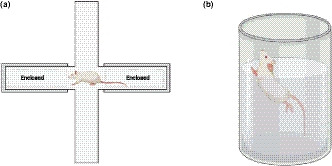
Pregnant Wistar Kyoto rats were given daily subcutaneous injections from gestational days 15-21 of either dexamethasone (0.9% NaCl, 4% EtOH, 100 µg kg day ) or were physically manipulated as naïve controls. Pups were raised normally until 17 weeks of age and underwent the Porsolt swim task and elevated plus maze for depressive and anxiety-like behaviors, respectively. Neural tissue was preserved for genetic analysis using quantitative real-time polymerase chain reaction.
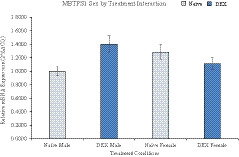
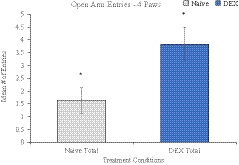
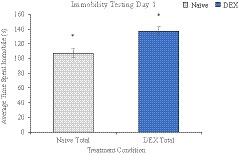
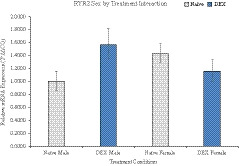
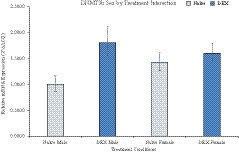
Statistical analyses show significant disruption of behavior and genetic profiles of offspring exposed to dexamethasone in-utero. Exposed animals spent more time immobile on the swim task and entered open arms of the elevated plus maze more often than their naïve counterparts. In the prefrontal cortex, there was a sex by treatment interaction on gene expression relevant to neural transmission in ryanodine receptor 2, as well as increased gene expression in SNAP25, COMT, and LSAMP in males prenatally exposed to dexamethasone compared with controls. Both dysregulated genes and behavior are linked to decreased anxiety and fear inhibition.
Our results indicate adult offspring exposed to dexamethasone in-utero have a tendency toward passive stress-coping strategies and an inhibition of anxiety on behavioral tasks. Methyltransferase activity, synaptic activity, and cellular processes were disrupted in the prefrontal cortices of these animals. Specifically, genes involved in emotional response pathways were overexpressed, supporting the link between the behavioral and genetic profiles. Combined, we determine that dexamethasone offspring have adaptive predispositions when faced with novel situations, with increased immobility in the swim task and increased exploration on the elevated plus maze.
几十年前,人们提出了胎儿编程的概念,用以解释后代在早期生活中暴露于应激源后产生的生理表型相关性。急性或慢性的高产前应激会使胎盘的酶屏障不堪重负,导致胎儿的转录发生变化,从而导致不同的不良行为和生理表型。本研究旨在探讨孕晚期暴露于合成糖皮质激素地塞米松对行为结果的影响。
从妊娠第 15 天至第 21 天,给怀孕的 Wistar 京都大鼠每天皮下注射地塞米松(0.9%NaCl、4%EtOH、100μgkg-1 day-1)或进行生理盐水处理作为对照。幼鼠正常生长至 17 周龄,然后分别进行 Porsolt 游泳试验和高架十字迷宫试验,以评估其抑郁和焦虑样行为。用定量实时聚合酶链反应(PCR)保存神经组织,以进行基因分析。
统计分析显示,宫内暴露于地塞米松的幼鼠的行为和遗传特征显著受损。与对照组相比,暴露于地塞米松的动物在游泳试验中静止不动的时间更长,在高架十字迷宫的开放臂中进入的次数更多。在皮质前脑中,雄性幼鼠中存在性别与处理的相互作用,与神经传递相关的兰尼碱受体 2 的基因表达增加,以及突触小体相关蛋白 25、儿茶酚氧位甲基转移酶和富含亮氨酸突触蛋白的基因表达增加。这些基因表达的改变与焦虑和恐惧抑制的减少有关。
我们的结果表明,宫内暴露于地塞米松的成年后代在行为任务中倾向于采用被动的应激应对策略,并且焦虑感受到抑制。这些动物的皮质前脑中,甲基转移酶活性、突触活动和细胞过程受到干扰。具体来说,参与情绪反应途径的基因表达上调,支持了行为和遗传特征之间的联系。综合来看,我们确定地塞米松暴露的后代在面对新情况时具有适应性倾向,在游泳试验中表现出更高的不动性,在高架十字迷宫试验中表现出更高的探索性。