Department of Infectious Diseases, Leiden University Medical Center, Leiden, The Netherlands.
Immunol Rev. 2021 May;301(1):30-47. doi: 10.1111/imr.12948. Epub 2021 Feb 2.
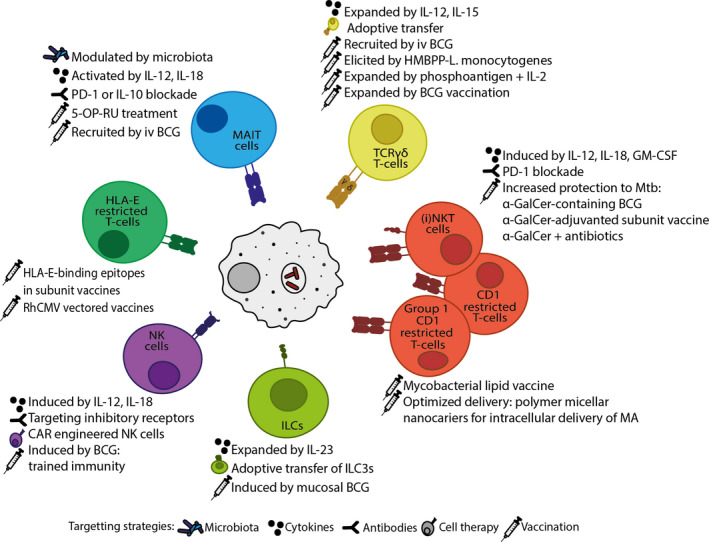
Vaccination strategies against mycobacteria, focusing mostly on classical T- and B-cells, have shown limited success, encouraging the addition of alternative targets. Classically restricted T-cells recognize antigens presented via highly polymorphic HLA class Ia and class II molecules, while donor-unrestricted T-cells (DURTs), with few exceptions, recognize ligands via genetically conserved antigen presentation molecules. Consequently, DURTs can respond to the same ligands across diverse human populations. DURTs can be activated either through cognate TCR ligation or via bystander cytokine signaling. TCR-driven antigen-specific activation of DURTs occurs upon antigen presentation via non-polymorphic molecules such as HLA-E, CD1, MR1, and butyrophilin, leading to the activation of HLA-E-restricted T-cells, CD1-restricted T-cells, mucosal-associated invariant T-cells (MAITs), and TCRγδ T-cells, respectively. NK cells and innate lymphoid cells (ILCs), which lack rearranged TCRs, are activated through other receptor-triggering pathways, or can be engaged through bystander cytokines, produced, for example, by activated antigen-specific T-cells or phagocytes. NK cells can also develop trained immune memory and thus could represent cells of interest to mobilize by novel vaccines. In this review, we summarize the latest findings regarding the contributions of DURTs, NK cells, and ILCs in anti-M tuberculosis, M leprae, and non-tuberculous mycobacterial immunity and explore possible ways in which they could be harnessed through vaccines and immunotherapies to improve protection against Mtb.
针对分枝杆菌的疫苗接种策略主要集中在经典的 T 细胞和 B 细胞上,但收效甚微,这促使人们加入了替代靶点。经典受限的 T 细胞识别通过高度多态性 HLA 类 I 和 II 分子呈递的抗原,而供体不受限制的 T 细胞(DURTs)除了少数例外,通过遗传上保守的抗原呈递分子识别配体。因此,DURTs 可以在不同的人群中对相同的配体做出反应。DURTs 可以通过同源 TCR 交联或通过旁观者细胞因子信号被激活。TCR 驱动的 DURTs 的抗原特异性激活发生在通过非多态性分子(如 HLA-E、CD1、MR1 和 BTN3A1)呈递抗原时,导致 HLA-E 受限的 T 细胞、CD1 受限的 T 细胞、粘膜相关不变 T 细胞(MAIT 细胞)和 TCRγδ T 细胞的激活。缺乏重排 TCR 的 NK 细胞和先天淋巴细胞(ILCs)通过其他受体触发途径被激活,或者通过旁观者细胞因子被募集,例如通过激活的抗原特异性 T 细胞或吞噬细胞产生的细胞因子。NK 细胞还可以发展出训练有素的免疫记忆,因此可以成为通过新型疫苗动员的感兴趣的细胞。在这篇综述中,我们总结了关于 DURTs、NK 细胞和 ILCs 在抗结核分枝杆菌、麻风分枝杆菌和非结核分枝杆菌免疫中的最新发现,并探讨了通过疫苗和免疫疗法利用它们的可能途径,以改善对 Mtb 的保护。