Istituti Clinici Scientifici Maugeri IRCCS, Respiratory Rehabilitation of the Institute of Lumezzane, Brescia, Italy.
Faculty of Health and Life Sciences, Department of Sport, Exercise and Rehabilitation, Northumbria University Newcastle, Newcastle, United Kingdom.
Arch Phys Med Rehabil. 2021 Jun;102(6):1228-1231. doi: 10.1016/j.apmr.2020.12.021. Epub 2021 Jan 30.
To document the level of physical function in patients with coronavirus disease 2019 (COVID-19) recovering from acute respiratory failure and investigate which patient clinical characteristics could predict physical function assessed by the Short Physical Performance Battery (SPPB) test.
Cross-sectional study.
Subacute unit of a Rehabilitation Institute.
Patients with COVID-19 (N=184; aged 18 years or older) who were admitted to a subacute unit to stabilize their condition and recover from acute respiratory failure due to COVID-19.
Not applicable.
At admission patients underwent the SPPB test, represented by the sum of 3 functional tests, standing balance, 4-meter gait speed, and 5-repetition sit-to-stand motion. Comparisons between 2 SPPB score groups were performed by an unpaired t test; multivariate stepwise linear regression analysis was employed to detect predictors of the SPPB score considering several clinical parameters.
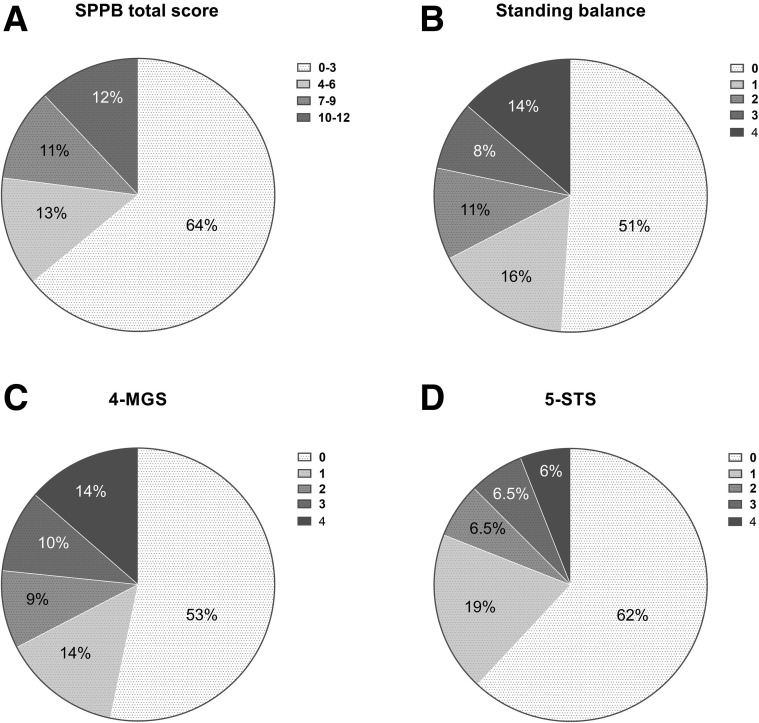
Participants were 74±12 years old, 52% were men and with more than 2 comorbidities in 43% of cases. SPPB score was 3.02±3.87 denoting patients' profound physical dysfunction. Normal physical function was detected in only 12% of patients, whereas low, intermediate, and severe impairment was found in 65%, 13%, and 10%, respectively. Age, both invasive and noninvasive ventilation use, and the presence of previous disability were significant predictors of SPPB. Patients without any comorbidities (8%) also exhibited low function (SPPB: 5.67±1.12).
The majority of survivors after COVID-19 experienced acute respiratory failure due to pneumonia and exhibited substantial physical dysfunction influenced by age, mechanical ventilation need, and previous disability. Further studies are needed to evaluate the role of rehabilitation to promote recovery and community reintegration in this population.
记录新冠肺炎(COVID-19)急性呼吸衰竭恢复期患者的身体功能水平,并探讨哪些患者的临床特征可以预测短体适能测试(SPPB)评估的身体功能。
横断面研究。
康复研究所的亚急性病房。
184 名年龄在 18 岁及以上的 COVID-19 患者,他们因 COVID-19 而急性呼吸衰竭入住亚急性病房以稳定病情并恢复。
无。
入院时,患者接受 SPPB 测试,由 3 项功能测试(站立平衡、4 米步行速度和 5 次重复坐立站起动作)的总和表示。通过未配对 t 检验比较 2 个 SPPB 评分组之间的差异;采用多元逐步线性回归分析,考虑多个临床参数,检测 SPPB 评分的预测因素。
参与者的年龄为 74±12 岁,52%为男性,43%的患者有 2 种以上合并症。SPPB 评分为 3.02±3.87,表明患者有严重的身体功能障碍。仅有 12%的患者存在正常的身体功能,而低、中、重度障碍分别占 65%、13%和 10%。年龄、有创和无创通气的使用以及既往残疾是 SPPB 的显著预测因素。无合并症的患者(8%)也表现出较低的功能(SPPB:5.67±1.12)。
大多数 COVID-19 幸存者因肺炎而经历急性呼吸衰竭,表现出明显的身体功能障碍,这与年龄、机械通气需求和既往残疾有关。需要进一步研究来评估康复在促进该人群恢复和重返社区方面的作用。