Meng Long, Zhang Anjing, Chen Chen, Wang Xingwei, Jiang Xinyu, Tao Linkai, Fan Jiahao, Wu Xuejiao, Dai Chenyun, Zhang Yiyuan, Vanrumste Bart, Tamura Toshiyo, Chen Wei
Department of Electronic Engineering, School of Information Science and Technology, Fudan University, Shanghai 200438, China.
Department of Neurological Rehabilitation Medicine, The First Rehabilitation Hospital of Shanghai, Kongjiang Branch, Shanghai 200093, China.
Sensors (Basel). 2021 Jan 26;21(3):799. doi: 10.3390/s21030799.
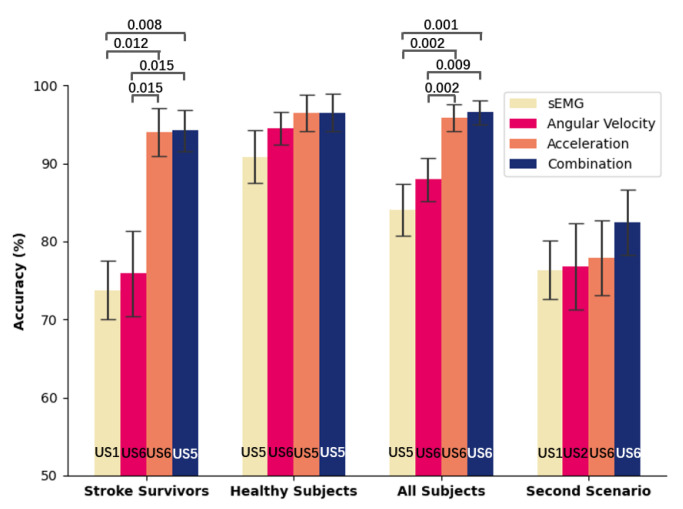
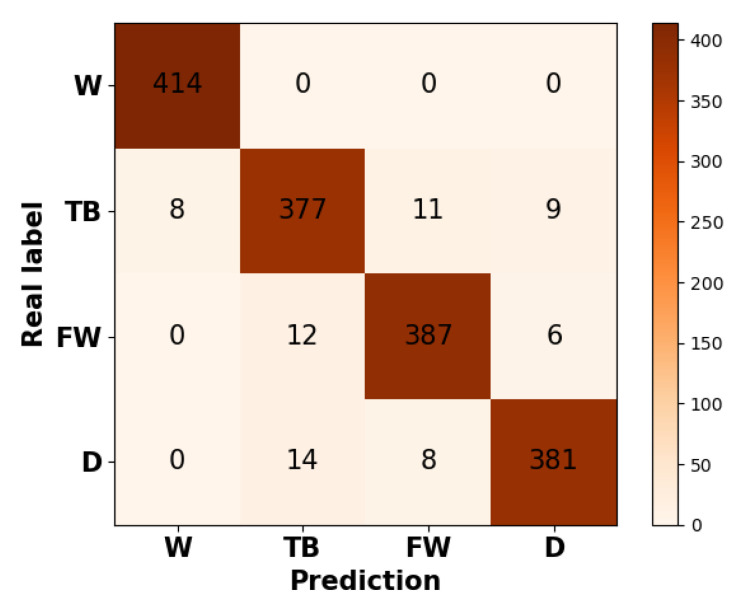
Commonly used sensors like accelerometers, gyroscopes, surface electromyography sensors, etc., which provide a convenient and practical solution for human activity recognition (HAR), have gained extensive attention. However, which kind of sensor can provide adequate information in achieving a satisfactory performance, or whether the position of a single sensor would play a significant effect on the performance in HAR are sparsely studied. In this paper, a comparative study to fully investigate the performance of the aforementioned sensors for classifying four activities (walking, tooth brushing, face washing, drinking) is explored. Sensors are spatially distributed over the human body, and subjects are categorized into three groups (able-bodied people, stroke survivors, and the union of both). Performances of using accelerometer, gyroscope, sEMG, and their combination in each group are evaluated by adopting the Support Vector Machine classifier with the Leave-One-Subject-Out Cross-Validation technique, and the optimal sensor position for each kind of sensor is presented based on the accuracy. Experimental results show that using the accelerometer could obtain the best performance in each group. The highest accuracy of HAR involving stroke survivors was 95.84 ± 1.75% (mean ± standard error), achieved by the accelerometer attached to the extensor carpi ulnaris. Furthermore, taking the practical application of HAR into consideration, a novel approach to distinguish various activities of stroke survivors based on a pre-trained HAR model built on healthy subjects is proposed, the highest accuracy of which is 77.89 ± 4.81% (mean ± standard error) with the accelerometer attached to the extensor carpi ulnaris.
常用的传感器,如加速度计、陀螺仪、表面肌电图传感器等,为人类活动识别(HAR)提供了便捷实用的解决方案,受到了广泛关注。然而,哪种传感器能在实现令人满意的性能方面提供足够的信息,或者单个传感器的位置是否会对HAR的性能产生显著影响,这些方面的研究还很少。本文进行了一项比较研究,以全面探究上述传感器对四种活动(行走、刷牙、洗脸、喝水)进行分类的性能。传感器在人体上进行空间分布,受试者分为三组(健全人、中风幸存者以及两者的组合)。采用支持向量机分类器和留一法交叉验证技术,评估了每组中使用加速度计、陀螺仪、表面肌电图及其组合的性能,并根据准确率给出了每种传感器的最佳位置。实验结果表明,使用加速度计在每组中都能获得最佳性能。对于涉及中风幸存者的HAR,最高准确率为95.84±1.75%(平均值±标准误差),是通过附着在尺侧腕伸肌上的加速度计实现的。此外,考虑到HAR的实际应用,提出了一种基于在健康受试者上建立的预训练HAR模型来区分中风幸存者各种活动的新方法,当加速度计附着在尺侧腕伸肌上时,其最高准确率为77.89±4.81%(平均值±标准误差)。