Chiu Chong-Chi, Wang Jhi-Joung, Hung Chao-Ming, Lin Hsiu-Fen, Hsien Hong-Hsi, Hung Kuo-Wei, Chiu Herng-Chia, Jennifer Yeh Shu-Chuan, Shi Hon-Yi
Department of General Surgery, E-Da Cancer Hospital, Kaohsiung 82445, Taiwan.
School of Medicine, College of Medicine, I-Shou University, Kaohsiung 82445, Taiwan.
Brain Sci. 2021 Jan 26;11(2):161. doi: 10.3390/brainsci11020161.
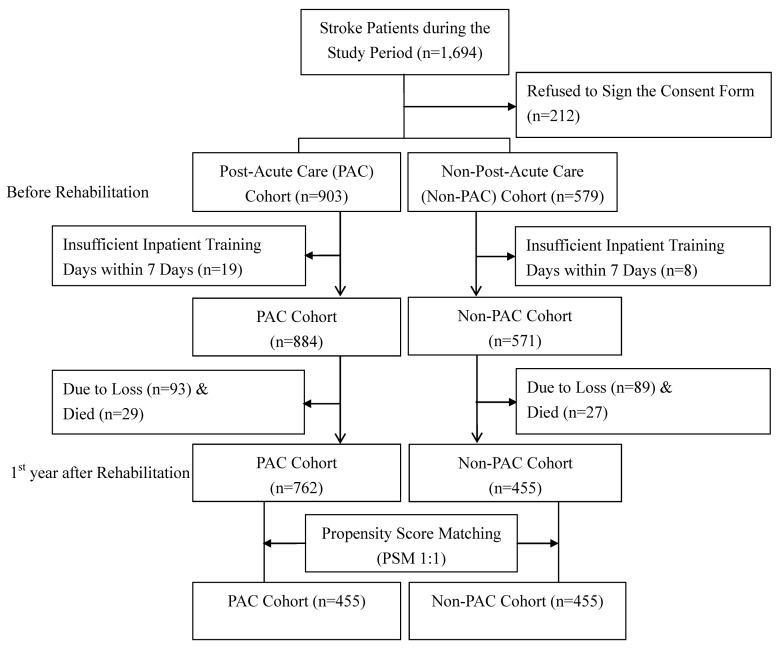
Few papers discuss how the economic burden of patients with stroke receiving rehabilitation courses is related to post-acute care (PAC) programs. This is the first study to explore the economic burden of stroke patients receiving PAC rehabilitation and to evaluate the impact of multidisciplinary PAC programs on cost and functional status simultaneously. A total of 910 patients with stroke between March 2014 and October 2018 were separated into a PAC group (at two medical centers) and a non-PAC group (at three regional hospitals and one district hospital) by using propensity score matching (1:1). A cost-illness approach was employed to identify the cost categories for analysis in this study according to various perspectives. Total direct medical cost in the per-diem-based PAC cohort was statistically lower than that in the fee-for-service-based non-PAC cohort ( < 0.001) and annual per-patient economic burden of stroke patients receiving PAC rehabilitation is approximately US $354.3 million (in 2019, NT $30.5 = US $1). Additionally, the PAC cohort had statistical improvement in functional status vis-à-vis the non-PAC cohort and total score of each functional status before rehabilitation and was also statistically significant with its total score after one-year rehabilitation training ( < 0.001). Early stroke rehabilitation is important for restoring health, confidence, and safe-care abilities in these patients. Compared to the current stroke rehabilitation system, PAC rehabilitation shortened the waiting time for transfer to the rehabilitation ward and it was indicated as an efficient policy for treatment of stroke in saving medical cost and improving functional status.
很少有论文讨论接受康复课程的中风患者的经济负担与急性后期护理(PAC)项目之间的关系。这是第一项探讨接受PAC康复的中风患者经济负担,并同时评估多学科PAC项目对成本和功能状态影响的研究。通过倾向得分匹配(1:1),将2014年3月至2018年10月期间的910名中风患者分为PAC组(在两个医疗中心)和非PAC组(在三个地区医院和一个区医院)。本研究采用成本-疾病方法,从不同角度确定分析的成本类别。按日计费的PAC队列中的总直接医疗成本在统计学上低于按服务收费的非PAC队列(<0.001),接受PAC康复的中风患者的年度人均经济负担约为3.543亿美元(2019年,新台币30.5元=1美元)。此外,与非PAC队列相比,PAC队列在功能状态方面有统计学上的改善,康复前各功能状态的总分也有统计学意义,与一年康复训练后的总分相比也有统计学意义(<0.001)。早期中风康复对于恢复这些患者的健康、信心和安全护理能力很重要。与目前的中风康复系统相比,PAC康复缩短了转至康复病房的等待时间,被认为是一种在节省医疗成本和改善功能状态方面治疗中风的有效政策。