Department of Materials Science and Engineering, University of Illinois at Urbana-Champaign, Urbana, IL, 61801, USA.
Institute of Polymer Science, College of Chemistry & Chemical Engineering, Hunan University, 410082, Changsha, China.
Nat Commun. 2021 Feb 2;12(1):732. doi: 10.1038/s41467-020-20724-w.
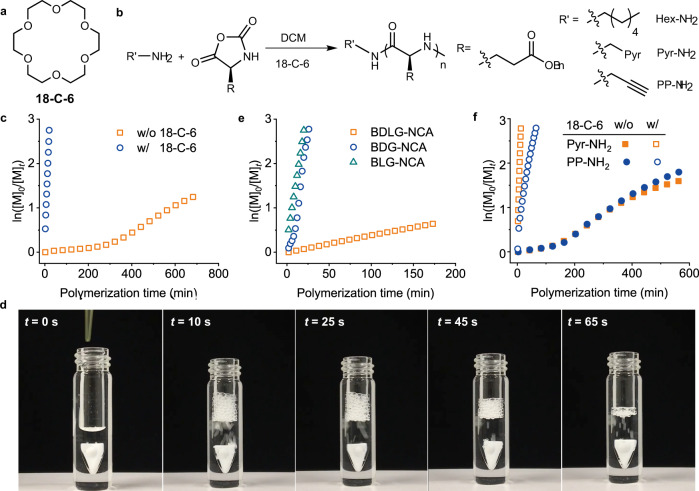
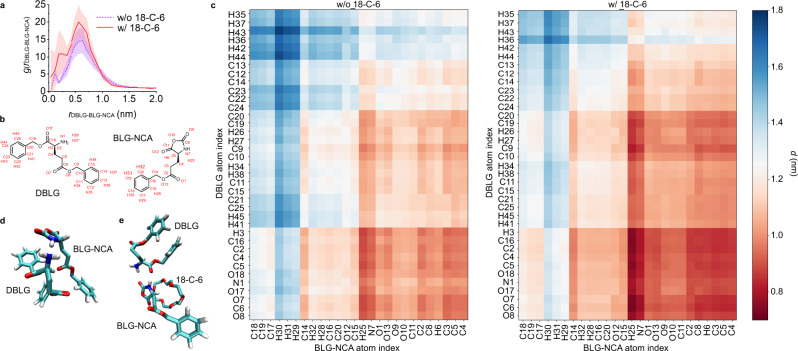
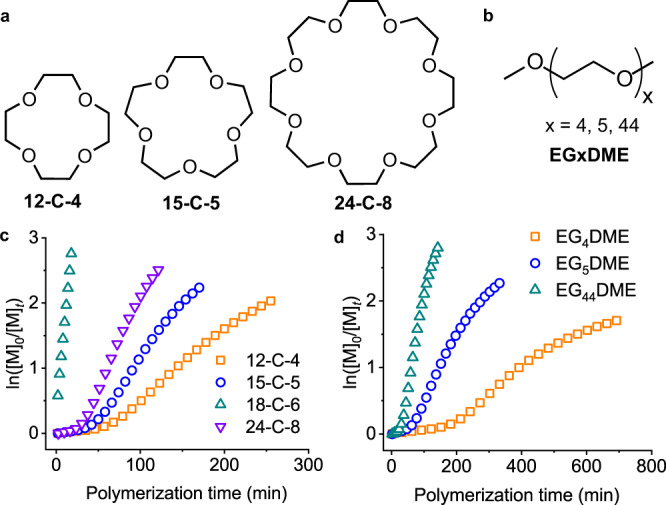
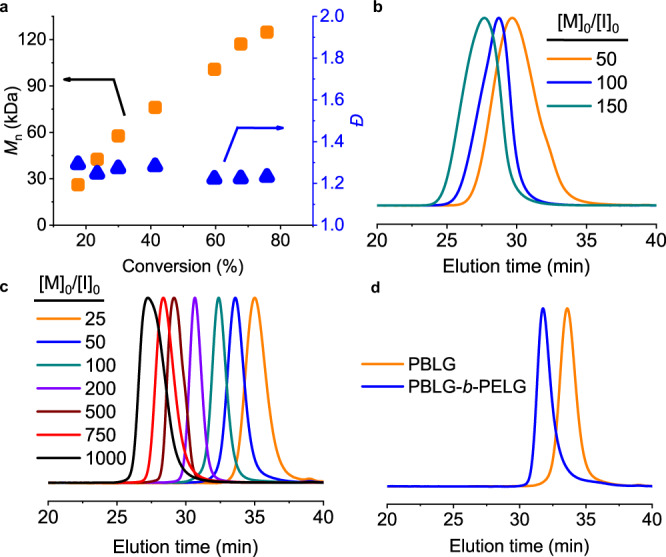
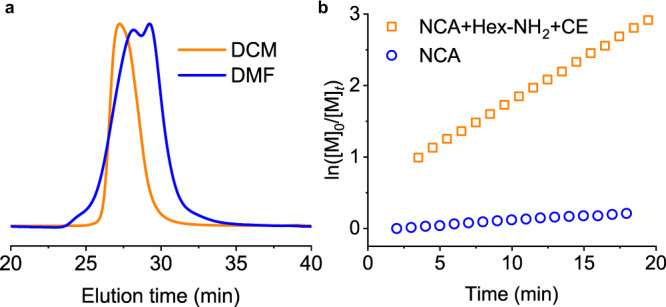
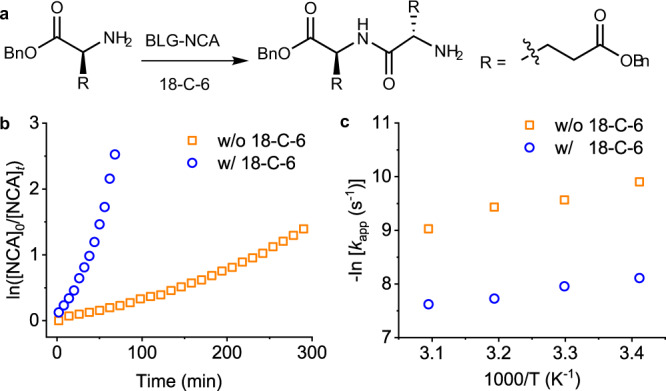
The recent advances in accelerated polymerization of N-carboxyanhydrides (NCAs) enriched the toolbox to prepare well-defined polypeptide materials. Herein we report the use of crown ether (CE) to catalyze the polymerization of NCA initiated by conventional primary amine initiators in solvents with low polarity and low hydrogen-bonding ability. The cyclic structure of the CE played a crucial role in the catalysis, with 18-crown-6 enabling the fastest polymerization kinetics. The fast polymerization kinetics outpaced common side reactions, enabling the preparation of well-defined polypeptides using an α-helical macroinitiator. Experimental results as well as the simulation methods suggested that CE changed the binding geometry between NCA and propagating amino chain-end, which promoted the molecular interactions and lowered the activation energy for ring-opening reactions of NCAs. This work not only provides an efficient strategy to prepare well-defined polypeptides with functionalized C-termini, but also guides the design of catalysts for NCA polymerization.
最近在 N-羧酸酐(NCAs)的加速聚合方面的进展丰富了工具包,以制备具有明确结构的多肽材料。本文报道了在极性和氢键供体能力低的溶剂中,使用冠醚(CE)来催化由传统仲胺引发剂引发的 NCA 的聚合。CE 的环状结构在催化中起着关键作用,其中 18-冠-6 能够实现最快的聚合动力学。快速的聚合动力学超过了常见的副反应,使得使用α-螺旋大分子引发剂制备具有明确结构的多肽成为可能。实验结果和模拟方法表明,CE 改变了 NCA 和增长的氨基链末端之间的结合几何形状,这促进了分子相互作用,并降低了 NCAs 开环反应的活化能。这项工作不仅提供了一种有效的策略来制备具有官能化 C 末端的明确结构的多肽,而且还为 NCA 聚合的催化剂设计提供了指导。