Pease Leonard F, Wang Na, Salsbury Timothy I, Underhill Ronald M, Flaherty Julia E, Vlachokostas Alex, Kulkarni Gourihar, James Daniel P
902 Battelle Boulevard, P.O. Box 999, MSIN K9-89, Pacific Northwest National Laboratory (PNNL), Richland, WA, 99352, USA.
Build Environ. 2021 Jun 15;197:107633. doi: 10.1016/j.buildenv.2021.107633. Epub 2021 Jan 29.
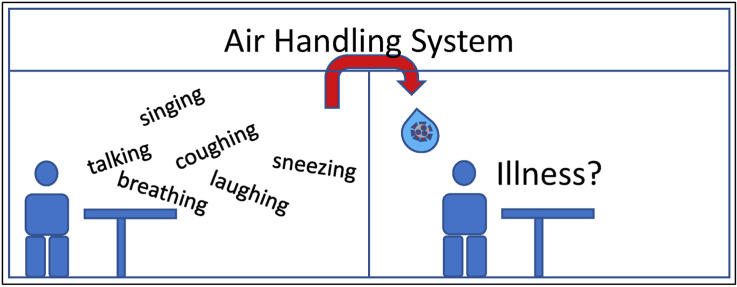
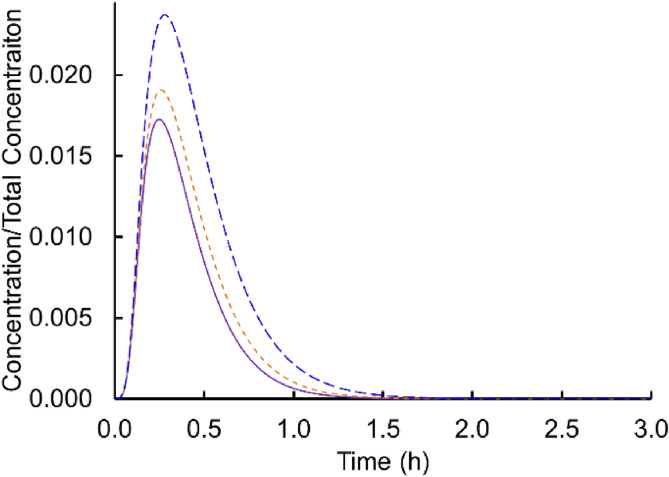
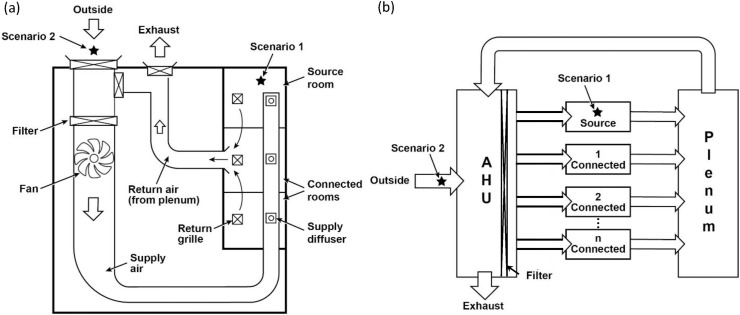
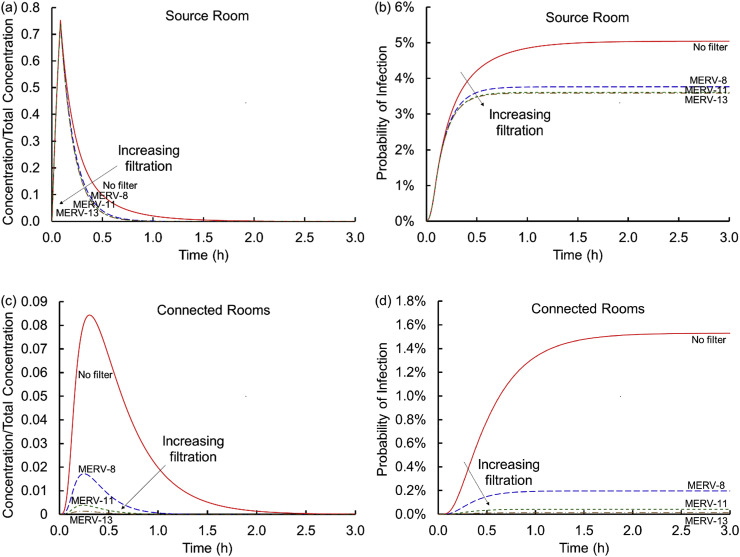
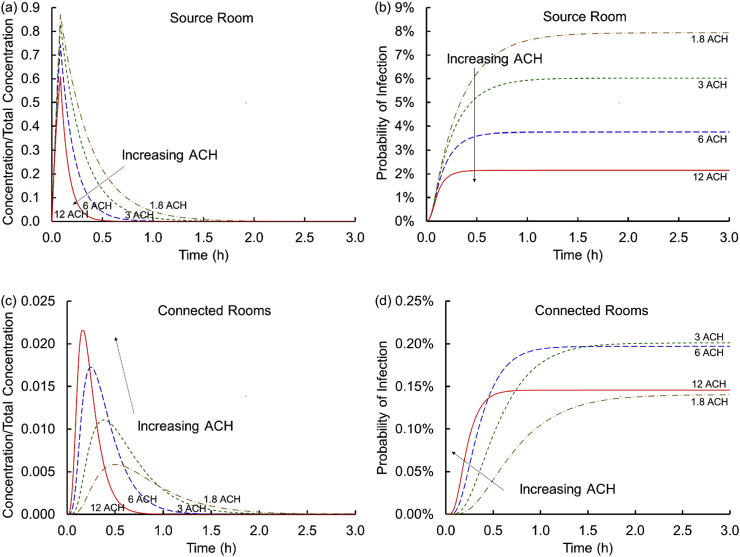
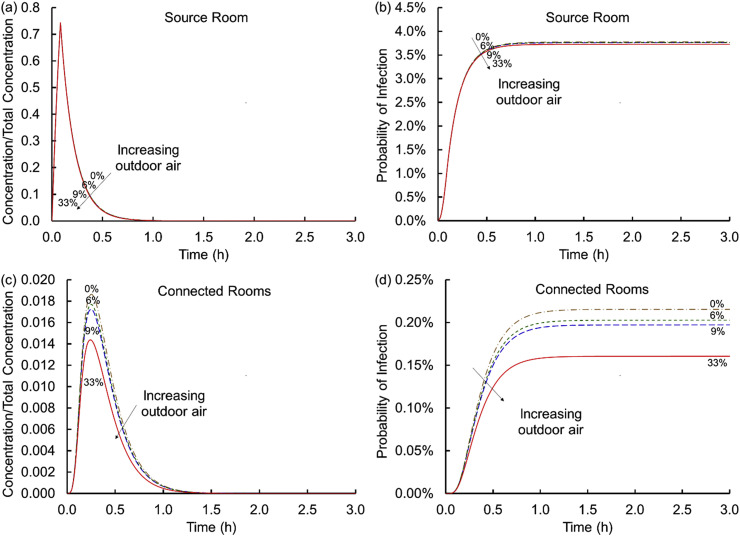
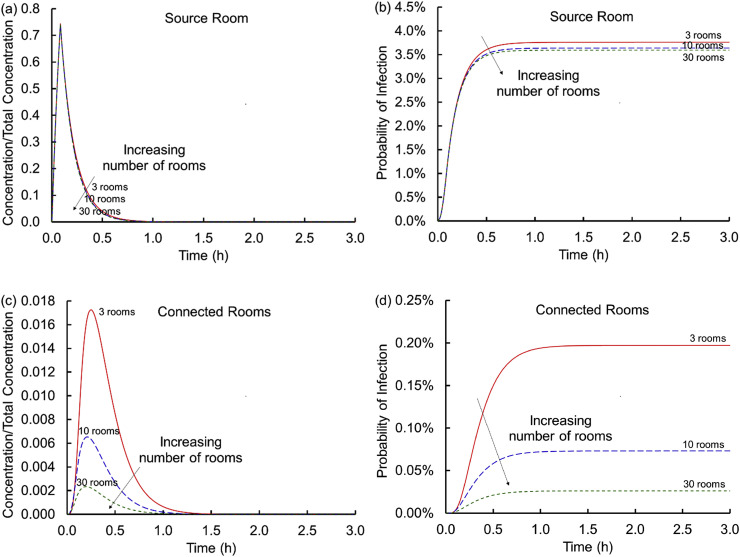
The COVID-19 pandemic has raised concern of viral spread within buildings. Although near-field transmission and infectious spread within individual rooms are well studied, the impact of aerosolized spread of SARS-CoV-2 via air handling systems within multiroom buildings remains unexplored. This study evaluates the concentrations and probabilities of infection for both building interior and exterior exposure sources using a well-mixed model in a multiroom building served by a central air handling system (without packaged terminal air conditioning). In particular, we compare the influence of filtration, air change rates, and the fraction of outdoor air. When the air supplied to the rooms comprises both outdoor air and recirculated air, we find filtration lowers the concentration and probability of infection the most in connected rooms. We find that increasing the air change rate removes virus from the source room faster but also increases the rate of exposure in connected rooms. Therefore, slower air change rates reduce infectivity in connected rooms at shorter durations. We further find that increasing the fraction of virus-free outdoor air is helpful, unless outdoor air is infective in which case pathogen exposure inside persists for hours after a short-term release. Increasing the outdoor air to 33% or the filter to MERV-13 decreases the infectivity in the connected rooms by 19% or 93% respectively, relative to a MERV-8 filter with 9% outdoor air based on 100 quanta/h of 5 μm droplets, a breathing rate of 0.48 m/h, and the building dimensions and air handling system considered.
新冠疫情引发了人们对建筑物内病毒传播的担忧。尽管对近场传播以及单个房间内的感染传播已有充分研究,但严重急性呼吸综合征冠状病毒2(SARS-CoV-2)通过多房间建筑内空气处理系统的气溶胶传播影响仍未得到探索。本研究使用一个由中央空气处理系统(无终端组合式空调)服务的多房间建筑中的充分混合模型,评估建筑物内部和外部暴露源的感染浓度及概率。特别是,我们比较了过滤、换气率和室外空气比例的影响。当供应到房间的空气包括室外空气和回风时,我们发现过滤在相连房间中对降低感染浓度和概率的作用最大。我们发现,提高换气率能更快地从源房间去除病毒,但也会增加相连房间的暴露率。因此,较低的换气率在较短时间内可降低相连房间中的传染性。我们还发现,增加无病毒室外空气的比例是有帮助的,除非室外空气具有传染性,在这种情况下,短期释放后室内病原体暴露会持续数小时。相对于基于每小时100个量子的5微米液滴、呼吸速率为0.48米/小时以及所考虑的建筑尺寸和空气处理系统,使用9%室外空气的MERV-8过滤器而言,将室外空气增加到33%或使用MERV-13过滤器可分别使相连房间中的传染性降低19%或93%。