Immunization Systems Branch, Global Immunization Division, Centers for Disease Control and Prevention, Atlanta, GA, USA.
Oak Ridge Institute for Science and Education, Oak ridge, TN, USA.
Hum Vaccin Immunother. 2021 Jul 3;17(7):2001-2007. doi: 10.1080/21645515.2020.1859319. Epub 2021 Feb 3.
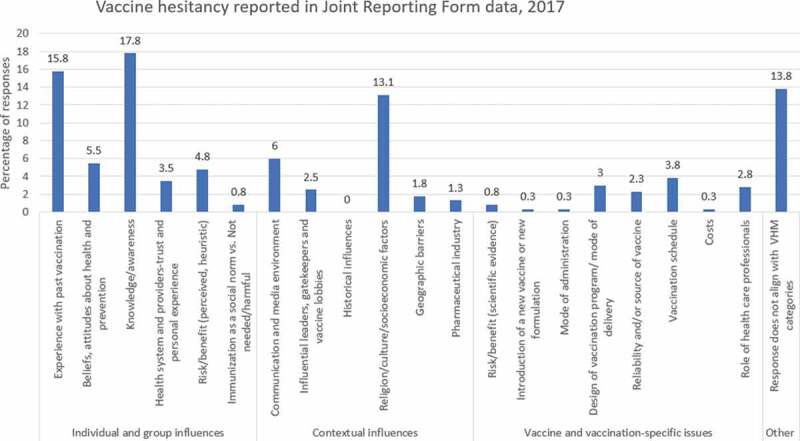
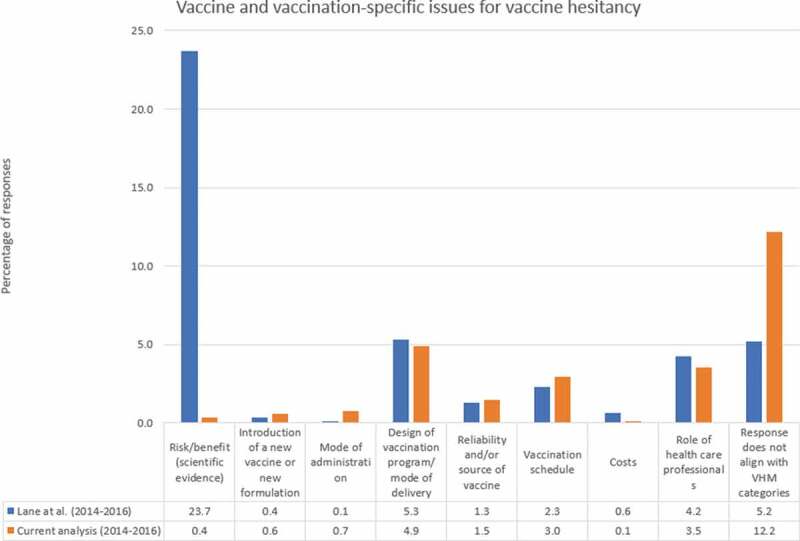
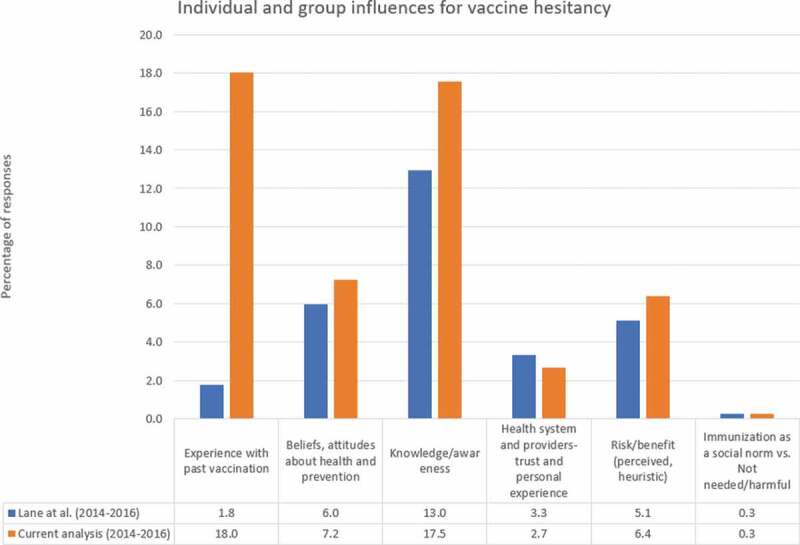
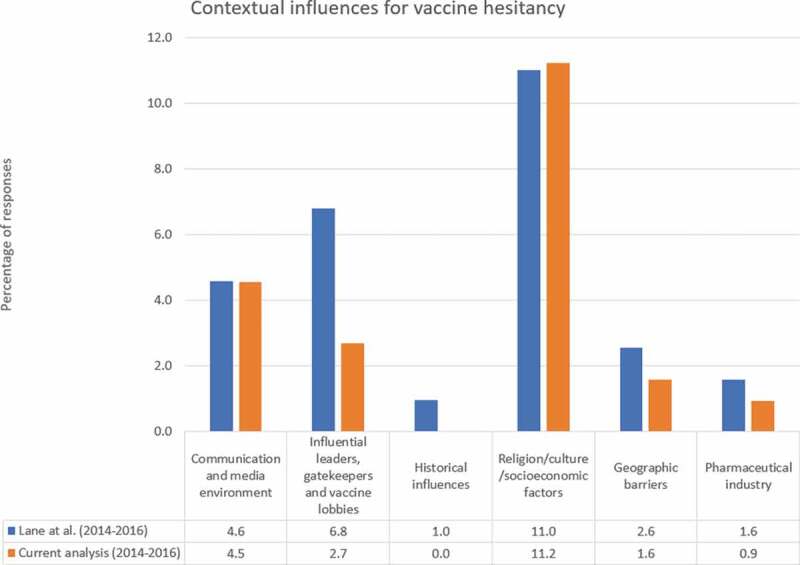
Since 2014, the World Health Organization (WHO) member states have been annually reporting vaccine hesitancy reasons, using the WHO/UNICEF Joint Reporting Form (JRF). The Vaccine Hesitancy Matrix (VHM), developed by a WHO strategic advisory group of experts, can serve as an important tool to categorize vaccine hesitancy reasons reported in the JRF. We aimed to describe the reasons for vaccine hesitancy reported globally from 2014 to 2017 to ascertain trends over time and understand the comparability of using the VHM to classify hesitancy reasons from 2014 to 2016 based on previously published literature. We conducted a quantitative content analysis to code and categorize vaccine hesitancy reasons reported in the JRF from 2014 to 2017. Vaccine hesitancy trends were consistent from 2014 to 2017, where vaccine hesitancy reasons were mainly related to "individual and group level influences" (59%) followed by "contextual influences" (25%), and "vaccine- or vaccination-specific issues" (16%). Comparability of our approach to categorize vaccine hesitancy to the previously published JRF data showed that results were mostly but not entirely consistent. Major differences in categorizing vaccine hesitancy were noted between two specific reasons - "experience with past vaccination" (under "individual and group influences") and "risk/benefit- scientific evidence" (under "vaccine and vaccination-specific issues"); this was usually due to lack of clear definitions in some sub-categories and generic responses reported in the JRF. The JRF hesitancy module may benefit from modifications to improve the data quality. Understanding global vaccine hesitancy is crucial and JRF can serve as an important tool, especially with the potential introduction of a COVID-19 vaccine.
自 2014 年以来,世界卫生组织(世卫组织)成员国每年都使用世卫组织/联合国儿童基金会联合报告表(JRF)报告疫苗犹豫原因。世卫组织专家战略咨询小组制定的疫苗犹豫矩阵(VHM)可作为一种重要工具,用于对 JRF 中报告的疫苗犹豫原因进行分类。我们旨在描述 2014 年至 2017 年全球报告的疫苗犹豫原因,以确定随时间推移的趋势,并根据之前发表的文献,了解使用 VHM 对 2014 年至 2016 年的犹豫原因进行分类的可比性。我们进行了一项定量内容分析,对 JRF 中报告的疫苗犹豫原因进行编码和分类。2014 年至 2017 年,疫苗犹豫趋势保持一致,疫苗犹豫原因主要与“个人和群体层面的影响”(59%)相关,其次是“背景影响”(25%)和“疫苗或接种特定问题”(16%)。我们对 JRF 数据进行分类的方法与之前发表的 JRF 数据的可比性表明,结果大多是一致的,但并非完全一致。在对疫苗犹豫进行分类时,注意到两个具体原因之间存在重大差异 - “过去接种经验”(“个人和群体影响”下)和“风险/收益-科学证据”(“疫苗和接种特定问题”下);这通常是由于 JRF 中某些子类别缺乏明确的定义和通用报告。JRF 犹豫模块可能会受益于修改以提高数据质量。了解全球疫苗犹豫情况至关重要,JRF 可以作为一种重要工具,尤其是在可能引入 COVID-19 疫苗的情况下。