Institute of Psychology, University of Lausanne, Lausanne, Switzerland.
School of Computer and Communication Sciences, Ecole Polytechnique Fédérale de Lausanne, Lausanne, Switzerland.
PLoS One. 2021 Feb 3;16(2):e0245100. doi: 10.1371/journal.pone.0245100. eCollection 2021.
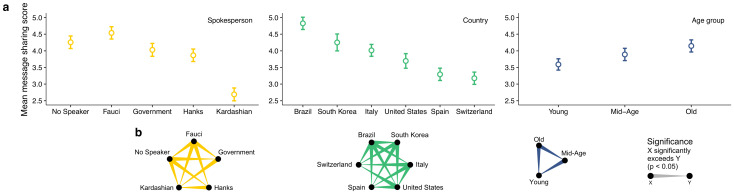
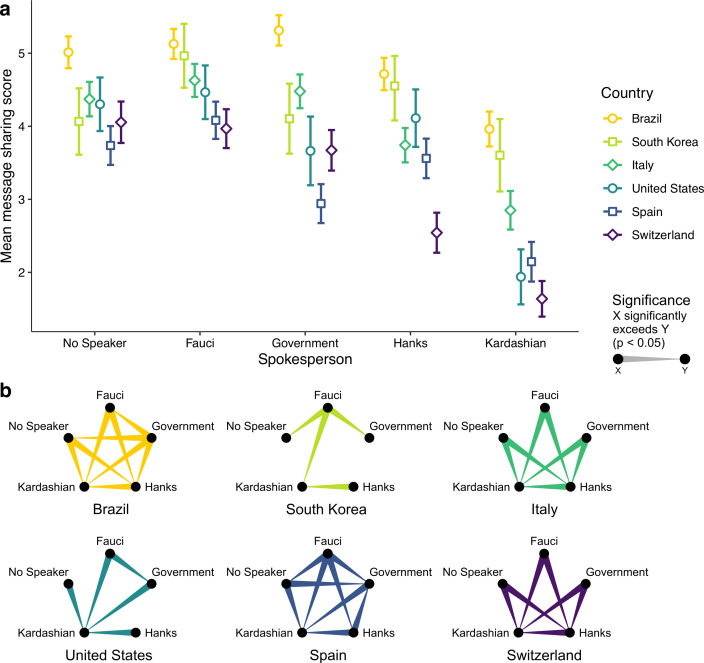
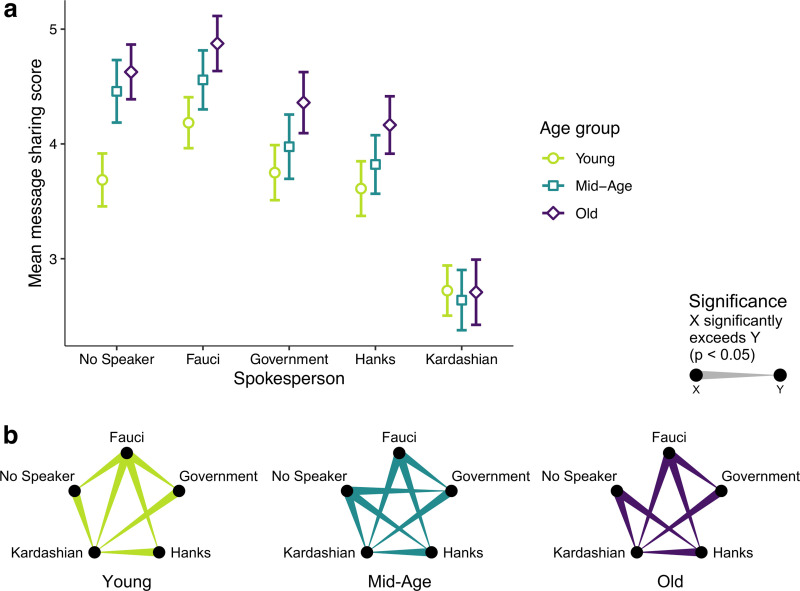
It is urgent to understand how to effectively communicate public health messages during the COVID-19 pandemic. Previous work has focused on how to formulate messages in terms of style and content, rather than on who should send them. In particular, little is known about the impact of spokesperson selection on message propagation during times of crisis. We report on the effectiveness of different public figures at promoting social distancing among 12,194 respondents from six countries that were severely affected by the COVID-19 pandemic at the time of data collection. Across countries and demographic strata, immunology expert Dr. Anthony Fauci achieved the highest level of respondents' willingness to reshare a call to social distancing, followed by a government spokesperson. Celebrity spokespersons were least effective. The likelihood of message resharing increased with age and when respondents expressed positive sentiments towards the spokesperson. These results contribute to the development of evidence-based knowledge regarding the effectiveness of prominent official and non-official public figures in communicating public health messaging in times of crisis. Our findings serve as a reminder that scientific experts and governments should not underestimate their power to inform and persuade in times of crisis and underscore the crucial importance of selecting the most effective messenger in propagating messages of lifesaving information during a pandemic.
在 COVID-19 大流行期间,迫切需要了解如何有效地传达公共卫生信息。以前的工作主要集中在如何从风格和内容方面来制定信息,而不是关注应该由谁来发送信息。特别是,在危机时期,发言人的选择对信息传播的影响知之甚少。我们报告了在数据收集时受到 COVID-19 大流行严重影响的六个国家的 12194 名受访者中,不同公众人物在促进社交距离方面的有效性。在不同国家和人口阶层中,免疫学专家安东尼·福奇(Anthony Fauci)博士在促使受访者更愿意转发呼吁保持社交距离的信息方面的效果最高,其次是政府发言人。名人代言人的效果最差。信息转发的可能性随着年龄的增长以及受访者对发言人的积极态度而增加。这些结果有助于为在危机时期,知名官方和非官方公众人物传达公共卫生信息的有效性提供基于证据的知识。我们的研究结果提醒人们,科学专家和政府不应低估他们在危机时期告知和说服的能力,并强调在大流行期间传播救生信息时选择最有效的信息传递者至关重要。