Mormile Ilaria, Granata Francescopaolo, Punziano Alessandra, de Paulis Amato, Rossi Francesca Wanda
Department of Translational Medical Sciences, University of Naples Federico II, Via S. Pansini 5, 80131 Naples, Italy.
Center for Basic and Clinical Immunology Research (CISI), WAO Center of Excellence, University of Naples Federico II, 80131 Naples, Italy.
Biomedicines. 2021 Feb 1;9(2):132. doi: 10.3390/biomedicines9020132.
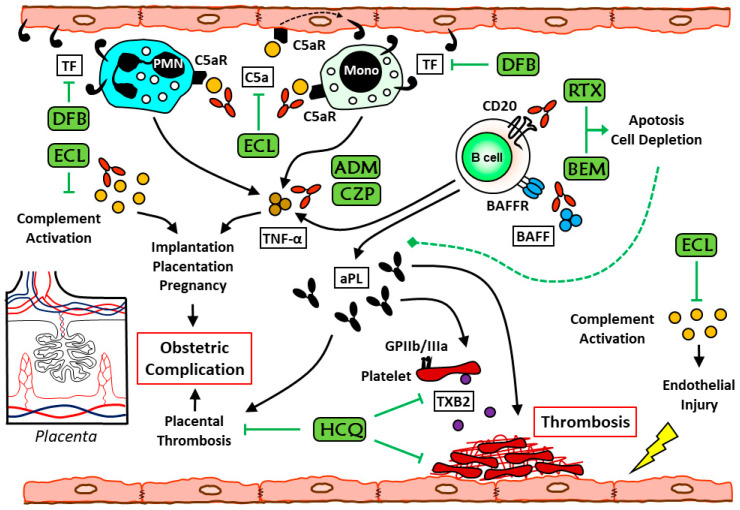
The antiphospholipid syndrome (APS) is characterized by the development of venous and/or arterial thrombosis and pregnancy morbidity in patients with persistent antiphospholipid antibodies (aPL). Catastrophic antiphospholipid syndrome (CAPS) is a life-threatening form of APS occurring in about 1% of cases. Lifelong anticoagulation with vitamin K antagonists remains the cornerstone of the therapy for thrombotic APS, but frequently the use of anticoagulation may be problematic due to the increased risk of bleeding, drug interactions, or comorbidities. Immunosuppressant drugs are widely used to treat several autoimmune conditions, in which their safety and effectiveness have been largely demonstrated. Similar evidence in the treatment of primary APS is limited to case reports or case series, and studies on a large scale lack. Immunomodulatory drugs may be an emerging tool in managing such particular situations, like refractory obstetrical complications, CAPS, or so-called APS non-criteria manifestations. In addition, immunomodulatory drugs may be useful in patients experiencing recurrent thromboembolic events despite optimized anticoagulant therapy. We did a comprehensive review of literature analyzing the possible role of immunomodulation in primary APS to provide a broad overview of potentially safe and effective target treatments for managing this devastating disease.
抗磷脂综合征(APS)的特征是,持续存在抗磷脂抗体(aPL)的患者会出现静脉和/或动脉血栓形成以及妊娠并发症。灾难性抗磷脂综合征(CAPS)是APS的一种危及生命的形式,约1%的病例会发生。使用维生素K拮抗剂进行终身抗凝仍然是血栓性APS治疗的基石,但由于出血风险增加、药物相互作用或合并症,抗凝治疗的使用常常存在问题。免疫抑制药物被广泛用于治疗多种自身免疫性疾病,其安全性和有效性已在很大程度上得到证实。在原发性APS治疗方面,类似的证据仅限于病例报告或病例系列,缺乏大规模研究。免疫调节药物可能是应对此类特殊情况(如难治性产科并发症、CAPS或所谓的APS非标准表现)的一种新兴工具。此外,对于尽管接受了优化抗凝治疗仍发生复发性血栓栓塞事件的患者,免疫调节药物可能也有用。我们对文献进行了全面综述,分析免疫调节在原发性APS中的可能作用,以全面概述治疗这种破坏性疾病的潜在安全有效的靶向治疗方法。