Gebru Yoseph Asmelash, Choi Mi Ran, Raja Ganesan, Gupta Haripriya, Sharma Satya Priya, Choi Ye Rin, Kim Hyeong Seop, Yoon Sang Jun, Kim Dong Joon, Suk Ki Tae
Institute for Liver and Digestive Diseases, Hallym University, Chuncheon 24252, Korea.
Microorganisms. 2021 Feb 1;9(2):296. doi: 10.3390/microorganisms9020296.
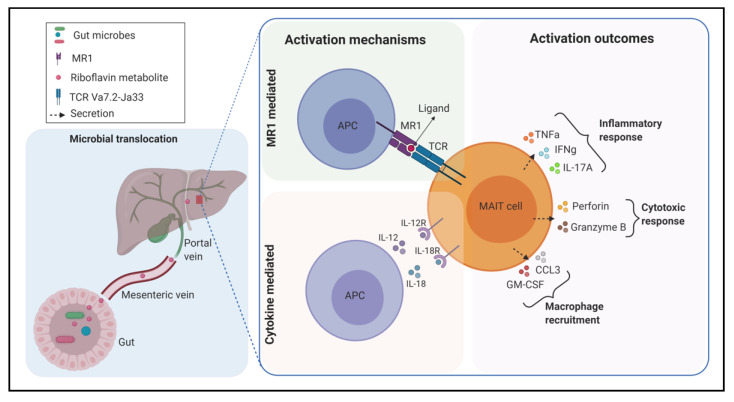
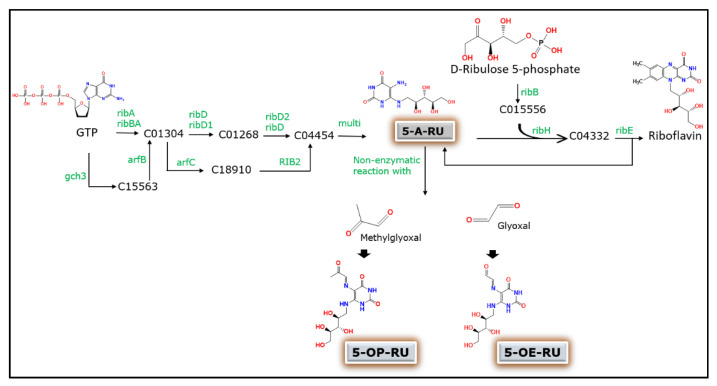
Mucosal-associated invariant T (MAIT) cells are a subset of T lymphocytes expressing a semi-invariant T-cell receptor (TCR) present as TCR α7.2-α33 in humans and TCR α19-α33 in mice. They are activated by ligands produced during microbial biosynthesis of riboflavin that is presented by major histocompatibility complex class I-related (MR1) molecules on antigen-presenting cells. MAIT cells also possess interleukin (IL)-12 and IL-18 receptors and can be activated by the respective cytokines released from microbially stimulated antigen-presenting cells. Therefore, MAIT cells can be involved in bacterial and viral defenses and are a significant part of the human immune system. They are particularly abundant in the liver, an organ serving as the second firewall of gut microbes next to the intestinal barrier. Therefore, the immune functions of MAIT cells are greatly impacted by changes in the gut-microbiota and play important roles in the gut-liver pathogenesis axis. In this review, we discuss the nature and mechanisms of MAIT cell activation and their dynamics during different types of liver pathogenesis conditions. We also share our perspectives on important aspects that should be explored further to reveal the exact roles that MAIT cells play in liver pathogenesis in the context of the gut microbiota.
黏膜相关恒定T(MAIT)细胞是表达半恒定T细胞受体(TCR)的T淋巴细胞亚群,在人类中该受体为TCR α7.2-α33,在小鼠中为TCR α19-α33。它们被抗原呈递细胞上的主要组织相容性复合体I类相关(MR1)分子呈递的核黄素微生物生物合成过程中产生的配体激活。MAIT细胞还拥有白细胞介素(IL)-12和IL-18受体,并且可以被微生物刺激的抗原呈递细胞释放的相应细胞因子激活。因此,MAIT细胞可参与细菌和病毒防御,是人类免疫系统的重要组成部分。它们在肝脏中特别丰富,肝脏是仅次于肠道屏障的肠道微生物的第二道防火墙。因此,MAIT细胞的免疫功能受到肠道微生物群变化的极大影响,并在肠-肝发病机制轴中发挥重要作用。在这篇综述中,我们讨论了MAIT细胞激活的性质和机制及其在不同类型肝脏发病机制条件下的动态变化。我们还分享了关于在肠道微生物群背景下进一步探索以揭示MAIT细胞在肝脏发病机制中的确切作用的重要方面的观点。