Terova Genciana, Gini Elisabetta, Gasco Laura, Moroni Federico, Antonini Micaela, Rimoldi Simona
Department of Biotechnology and Life Sciences, University of Insubria, Via J.H. Dunant, 3, 21100, Varese, Italy.
Department of Agricultural, Forest and Food Sciences, University of Turin, Largo P. Braccini 2- 10095 Grugliasco, Torino, Italy.
J Anim Sci Biotechnol. 2021 Feb 3;12(1):30. doi: 10.1186/s40104-021-00551-9.
Aquaculture must continue to reduce dependence on fishmeal (FM) and fishoil in feeds to ensure sustainable sector growth. Therefore, the use of novel aquaculture feed ingredients is growing. In this regard, insects can represent a new world of sustainable and protein-rich ingredients for farmed fish feeds. Accordingly, we investigated the effects of full replacement of FM with Tenebrio molitor (TM) larvae meal in the diet of rainbow trout (Oncorhynchus mykiss) on fish gut and skin microbiota.
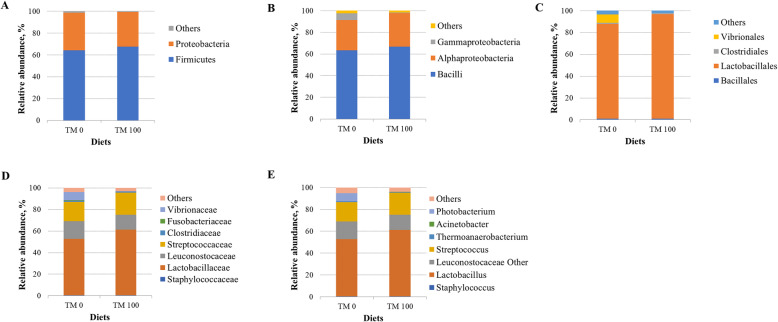
A feeding trial was conducted with 126 trout of about 80 g mean initial weight that were fed for 22 weeks with two isonitrogenous, isolipidic, and isoenergetic extruded experimental diets. Partially defatted TM meal was included in one of the diets to replace 100% (TM 100) of FM, whereas the other diet (TM 0) was without TM. To analyse the microbial communities, the Illumina MiSeq platform for sequencing of 16S rRNA gene and Qiime pipeline were used to identify bacteria in the gut and skin mucosa, and in the diets.
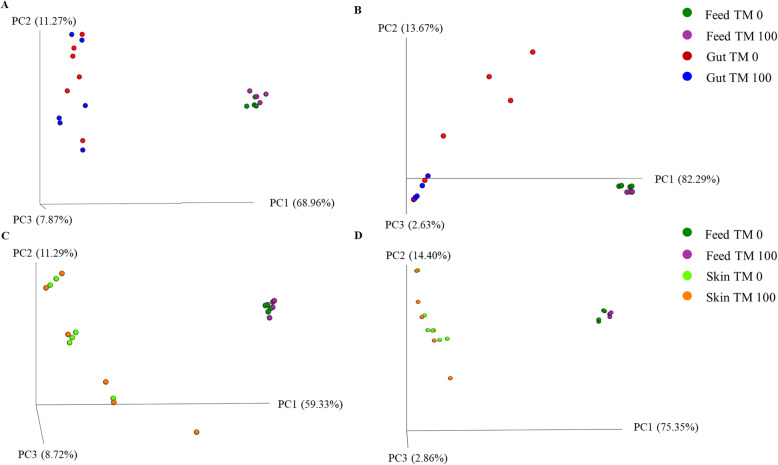
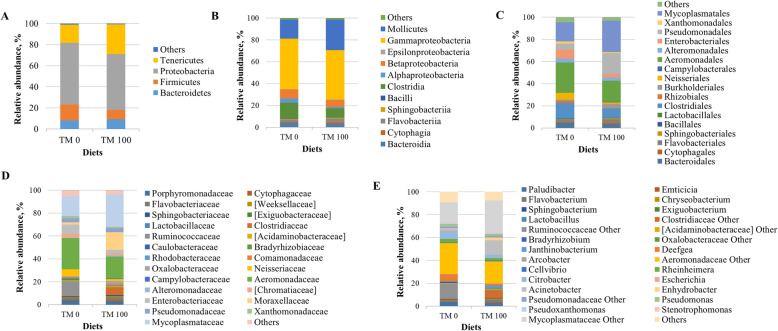
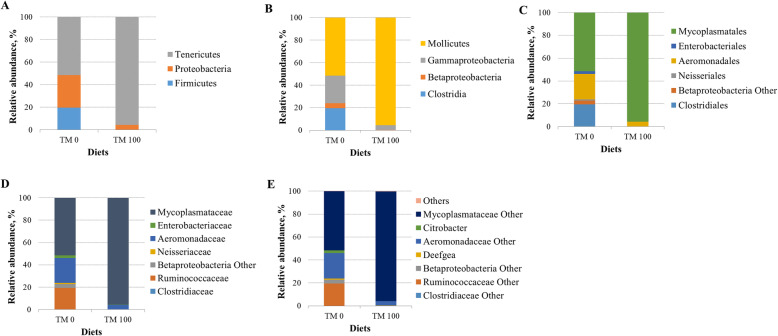
The data showed no major effects of full FM substitution with TM meal on bacterial species richness and diversity in both, gut mucosa- and skin mucus-associated microbiome. Skin microbiome was dominated by phylum Proteobacteria and especially by Gammaproteobacteria class that constituted approximately half of the bacterial taxa found. The two dietary fish groups did not display distinctive features, except for a decrease in the relative abundance of Deefgea genus (family Neisseriaceae) in trout fed with insect meal. The metagenomic analysis of the gut mucosa indicated that Tenericutes was the most abundant phylum, regardless of the diet. Specifically, within this phylum, the Mollicutes, mainly represented by Mycoplasmataceae family, were the dominant class. However, we observed only a weak dietary modulation of intestinal bacterial communities. The only changes due to full FM replacement with TM meal were a decreased number of Proteobacteria and a reduced number of taxa assigned to Ruminococcaceae and Neisseriaceae families.
The data demonstrated that TM larvae meal is a valid alternative animal protein to replace FM in the aquafeeds. Only slight gut and skin microbiota changes occurred in rainbow trout after total FM replacement with insect meal. The mapping of the trout skin microbiota represents a novel contribution of the present study. Indeed, in contrast to the increasing knowledge on gut microbiota, the skin microbiota of major farmed fish species remains largely unmapped but it deserves thorough consideration.
水产养殖必须继续减少饲料中对鱼粉(FM)和鱼油的依赖,以确保该行业的可持续增长。因此,新型水产养殖饲料成分的使用正在增加。在这方面,昆虫可为养殖鱼类饲料提供可持续且富含蛋白质的新成分来源。因此,我们研究了用黄粉虫(TM)幼虫粉完全替代虹鳟(Oncorhynchus mykiss)日粮中的鱼粉对鱼肠道和皮肤微生物群的影响。
对126条平均初始体重约80克的虹鳟进行饲养试验,用两种等氮、等脂、等能量的挤压实验日粮喂养22周。其中一种日粮包含部分脱脂的TM粉,以替代100%(TM 100)的鱼粉,而另一种日粮(TM 0)不含TM。为分析微生物群落,使用Illumina MiSeq平台对16S rRNA基因进行测序,并通过Qiime管道来鉴定肠道、皮肤黏膜以及日粮中的细菌。
数据显示,用TM粉完全替代鱼粉对肠道黏膜和皮肤黏液相关微生物群中的细菌种类丰富度和多样性没有重大影响。皮肤微生物群以变形菌门为主,尤其是γ-变形菌纲,约占所发现细菌分类群的一半。除了喂食昆虫粉的虹鳟中Deefgea属(奈瑟菌科)的相对丰度有所下降外,两个日粮组的鱼类未表现出明显特征。肠道黏膜的宏基因组分析表明,柔膜菌门是最丰富的门,与日粮无关。具体而言,在这个门中,主要由支原体科代表的柔膜菌纲是优势纲。然而,我们仅观察到肠道细菌群落有微弱的日粮调节作用。用TM粉完全替代鱼粉导致的唯一变化是变形菌数量减少,以及属于瘤胃球菌科和奈瑟菌科的分类群数量减少。
数据表明,TM幼虫粉是水产饲料中替代鱼粉的有效动物蛋白来源。用昆虫粉完全替代鱼粉后,虹鳟的肠道和皮肤微生物群仅发生了轻微变化。虹鳟皮肤微生物群的图谱是本研究的一项新贡献。事实上,与对肠道微生物群的了解不断增加形成对比的是,主要养殖鱼类的皮肤微生物群在很大程度上仍未被研究,但值得深入研究。