CIBIO-InBIO, Centro de Investigação em Biodiversidade e Recursos Genéticos, Universidade do Porto, Campus Agrário de Vairão, 4485-661, Vairão, Portugal.
Piscicultura Vale da Lama, Sapal do Vale da Lama, Odiáxere, 8600-258, Lagos, Portugal.
Sci Rep. 2019 Dec 12;9(1):18946. doi: 10.1038/s41598-019-55314-4.
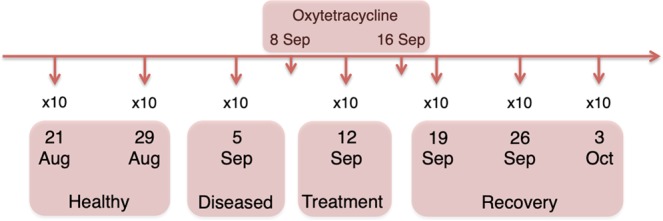
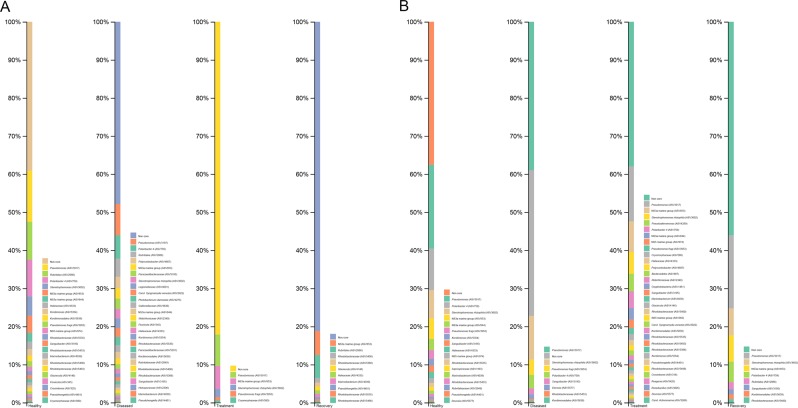
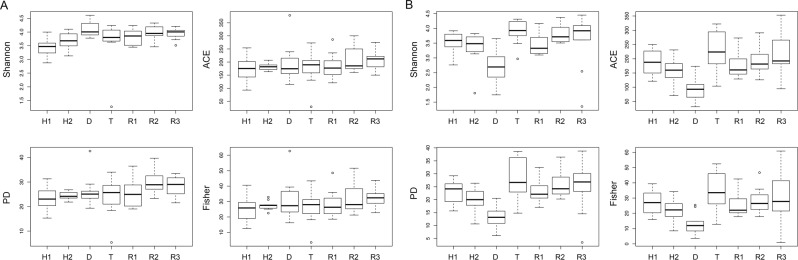
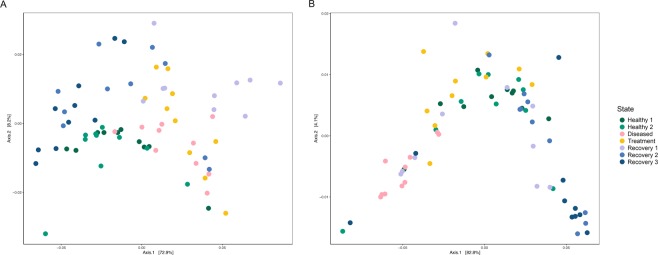
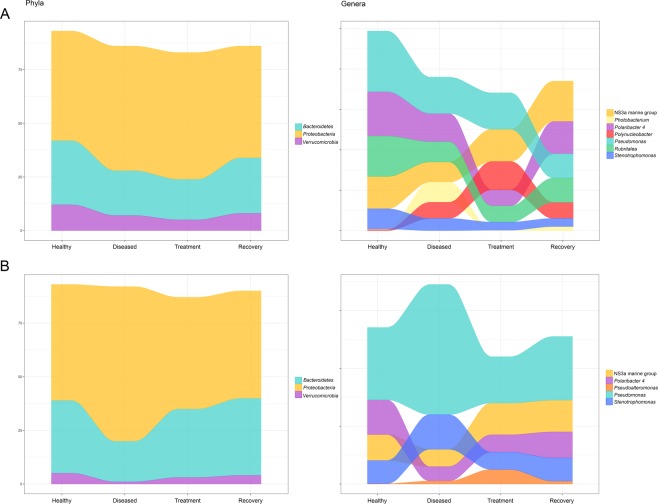
The mucosal surfaces of fish harbour microbial communities that can act as the first-line of defense against pathogens. Infectious diseases are one of the main constraints to aquaculture growth leading to huge economic losses. Despite their negative impacts on microbial diversity and overall fish health, antibiotics are still the method of choice to treat many such diseases. Here, we use 16 rRNA V4 metataxonomics to study over a 6 week period the dynamics of the gill and skin microbiomes of farmed seabass before, during and after a natural disease outbreak and subsequent antibiotic treatment with oxytetracycline. Photobacterium damselae was identified as the most probable causative agent of disease. Both infection and antibiotic treatment caused significant, although asymmetrical, changes in the microbiome composition of the gills and skin. The most dramatic changes in microbial taxonomic abundance occurred between healthy and diseased fish. Disease led to a decrease in the bacterial core diversity in the skin, whereas in the gills there was both an increase and a shift in core diversity. Oxytetracycline caused a decrease in core diversity in the gill and an increase in the skin. Severe loss of core diversity in fish mucosae demonstrates the disruptive impact of disease and antibiotic treatment on the microbial communities of healthy fish.
鱼类的黏膜表面栖息着微生物群落,它们可以作为抵御病原体的第一道防线。传染病是水产养殖发展的主要制约因素之一,导致了巨大的经济损失。尽管抗生素对微生物多样性和鱼类整体健康有负面影响,但它们仍然是治疗许多此类疾病的首选方法。在这里,我们使用 16 rRNA V4 宏基因组学技术,在自然疾病爆发和随后使用土霉素进行抗生素治疗之前、期间和之后,研究了养殖鲈鱼的鳃和皮肤微生物组在 6 周内的动态。发光杆菌被确定为疾病的最可能病原体。感染和抗生素治疗都导致了鳃和皮肤微生物组组成的显著但不对称的变化。在健康和患病鱼类之间,微生物分类群丰度的变化最为明显。疾病导致皮肤中细菌核心多样性减少,而在鳃中则既有增加又有核心多样性的转移。土霉素导致鳃中核心多样性减少,皮肤中核心多样性增加。鱼类黏液中核心多样性的严重丧失表明疾病和抗生素治疗对健康鱼类微生物群落的破坏性影响。