Straka Kelci, Tran Mai-Lan, Millwood Summer, Swanson James, Kuhlman Kate Ryan
Department of Psychological Science, University of California, Irvine, Irvine, CA, United States.
Cousins Center for Psychoneuroimmunology, Semel Institute for Neuroscience and Human Behavior, University of California, Los Angeles, Los Angeles, CA, Unites States.
Front Psychiatry. 2021 Jan 18;11:605347. doi: 10.3389/fpsyt.2020.605347. eCollection 2020.
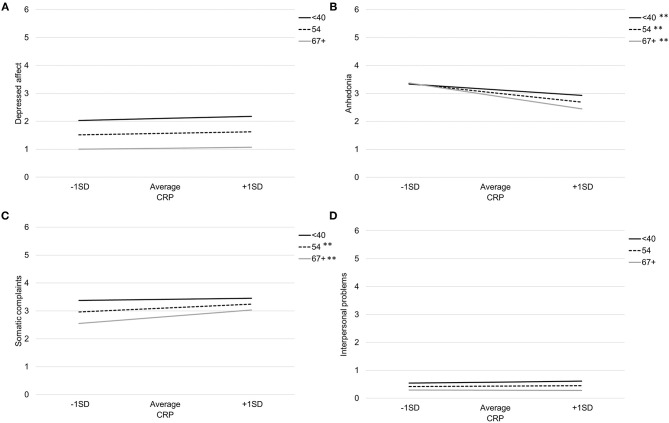
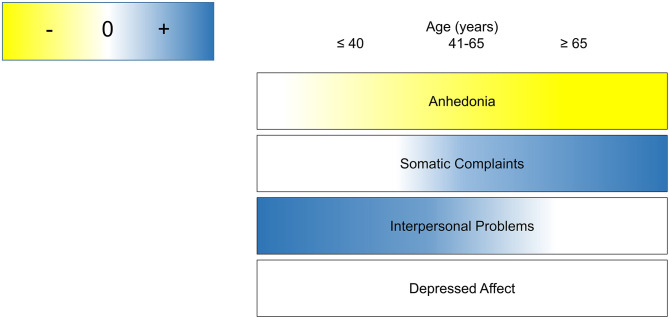
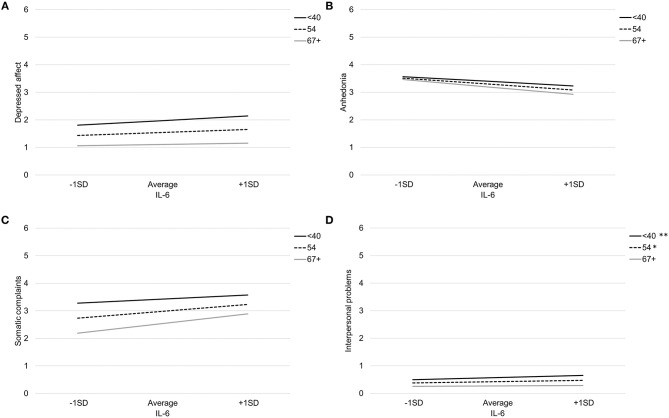
Inflammation has been implicated in the pathogenesis and maintenance of depressive symptoms. The role of inflammation in depressive symptomatology may be complex, varying within endophenotypes and across the lifespan. Aging is associated with myriad changes in the structure and function of the brain. Yet, little attention has been given to the role of inflammation in depressive symptoms within a lifespan developmental framework. In this study, we examined whether the association between inflammation and depressive symptom domains varied by age. Participants were a community sample of individuals ( = 2,077, Range = 30-84) who participated in the Biomarker projects of the MIDUS2, MIDUS Refresher, or the MIDJA study. Inflammation was indexed by two inflammatory markers consistently implicated in depressed individuals, interleukin 6 (IL-6) and C-reactive protein (CRP), measured in blood. Depressive symptom domains, including depressed affect, anhedonia, somatic complaints, and interpersonal problems, were reported the Center for Epidemiologic Studies-Depression Scale (CES-D). Inflammatory markers were associated with more somatic complaints, more interpersonal problems, and less anhedonia. Age moderated the relationship between inflammatory markers and two depressive symptom subscales. Specifically, the positive association between inflammation and somatic complaints and the negative association between inflammation and anhedonia increased with age. These observations offer preliminary evidence from a large community sample that aging may be an important context for the role of inflammatory signaling in different aspects of psychological and behavioral well-being.
炎症已被认为与抑郁症状的发病机制及持续存在有关。炎症在抑郁症状学中的作用可能很复杂,在内表型之间以及整个生命周期中都会有所不同。衰老与大脑结构和功能的无数变化相关。然而,在生命周期发展框架内,炎症在抑郁症状中的作用却很少受到关注。在本研究中,我们考察了炎症与抑郁症状领域之间的关联是否因年龄而异。参与者是来自社区的个体样本(n = 2077,年龄范围 = 30 - 84岁),他们参与了MIDUS2、MIDUS Refresher或MIDJA研究的生物标志物项目。炎症通过血液中测量的两种一直与抑郁症患者相关的炎症标志物来衡量,即白细胞介素6(IL - 6)和C反应蛋白(CRP)。抑郁症状领域,包括抑郁情绪、快感缺失、躯体不适和人际问题,通过流行病学研究中心抑郁量表(CES - D)进行报告。炎症标志物与更多的躯体不适、更多的人际问题以及更少的快感缺失相关。年龄调节了炎症标志物与两个抑郁症状子量表之间的关系。具体而言,炎症与躯体不适之间的正相关以及炎症与快感缺失之间的负相关随着年龄的增长而增加。这些观察结果从一个大型社区样本中提供了初步证据,表明衰老可能是炎症信号在心理和行为幸福感不同方面发挥作用的重要背景。