Holmer Jacob, Aho Velma, Eriksdotter Maria, Paulin Lars, Pietiäinen Milla, Auvinen Petri, Schultzberg Marianne, Pussinen Pirkko J, Buhlin Kåre
Unit of Periodontology, Department of Dental Medicine, Karolinska Institutet, Huddinge, Sweden.
DNA Sequencing and Genomics Laboratory, Institute of Biotechnology, University of Helsinki, Helsinki, Finland.
J Oral Microbiol. 2021 Jan 15;13(1):1854552. doi: 10.1080/20002297.2020.1854552.
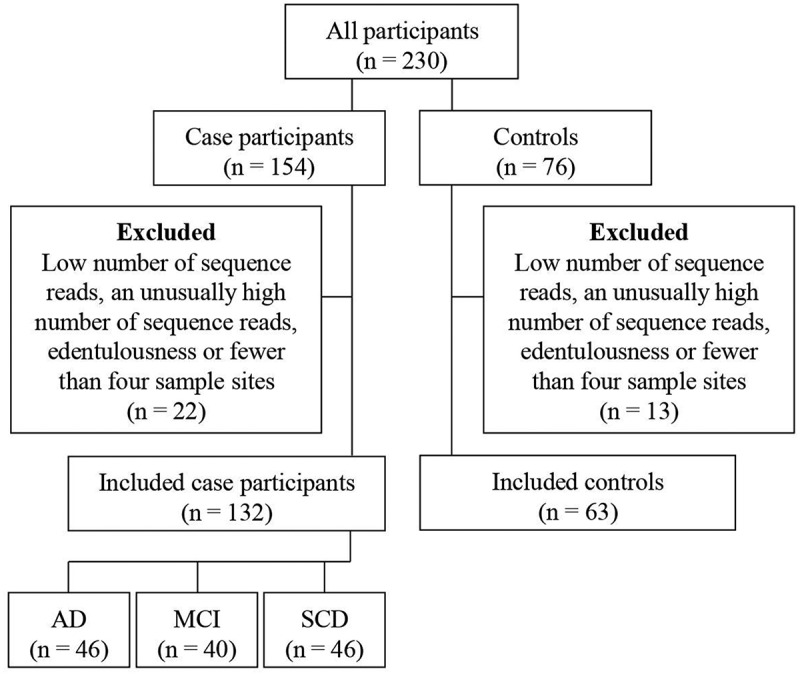
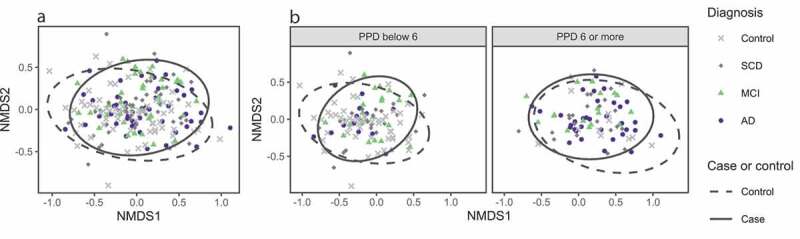
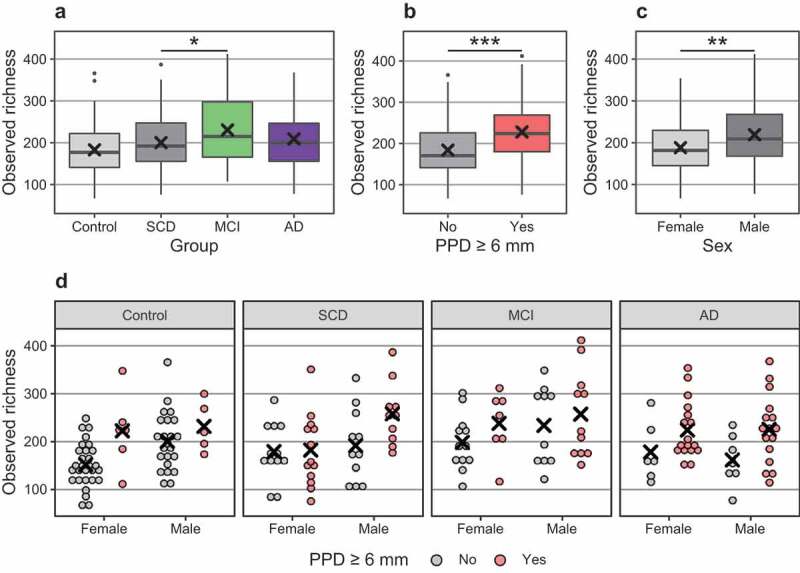
: The aim of this study was to compare the subgingival microbiota of people with Alzheimer´s disease (AD), mild cognitive impairment (MCI), subjective cognitive decline (SCD) and cognitively healthy individuals. : The study population was recruited from 2013 to 2017 and comprised 132 cases recently diagnosed with AD (n = 46), MCI (n = 40) or SCD (n = 46), and 63 cognitively healthy controls. Subgingival samples were collected, and the microbiotas were characterized by gene sequencing. : The relative abundance of the ten most common genera did not differ between the cases and control groups. However, the microbial richness and evenness were higher in cases than in controls and differed across the four groups. The variables with the greatest influence on the microbial community composition were related to periodontal disease followed by body mass index, study group affiliation and smoking. Ten taxa exhibited significant differences between case participants and controls. Two Operational Taxonomic Units were particularly abundant in AD compared to controls: , which was also associated with deep periodontal pockets, and a [G-7] bacterium. : It is concluded that in individuals with cognitive impairment or AD, the subgingival microbiota exhibits shifts typical of periodontal disease.
本研究的目的是比较阿尔茨海默病(AD)、轻度认知障碍(MCI)、主观认知衰退(SCD)患者以及认知健康个体的龈下微生物群。研究人群于2013年至2017年招募,包括132例近期诊断为AD(n = 46)、MCI(n = 40)或SCD(n = 46)的患者,以及63名认知健康对照者。收集龈下样本,并通过基因测序对微生物群进行表征。病例组和对照组中十种最常见菌属的相对丰度没有差异。然而,病例组的微生物丰富度和均匀度高于对照组,且在四组之间存在差异。对微生物群落组成影响最大的变量与牙周疾病有关,其次是体重指数、研究组归属和吸烟。十个分类单元在病例参与者和对照组之间表现出显著差异。与对照组相比,两个操作分类单元在AD中特别丰富: ,其也与深牙周袋有关,以及一种[G-7]细菌。结论是,在认知障碍或AD患者中,龈下微生物群表现出牙周疾病的典型变化。