Zhang Nan, Wang Jiaxing, Chen Biyue, Li Ying, Jiang Bing
Department of Ophthalmology of Second Xiangya Hospital, Central South University, Changsha, China.
Department of Ophthalmology, School of Medicine, Emory University, Atlanta, GA, United States.
Front Med (Lausanne). 2021 Jan 18;7:624179. doi: 10.3389/fmed.2020.624179. eCollection 2020.
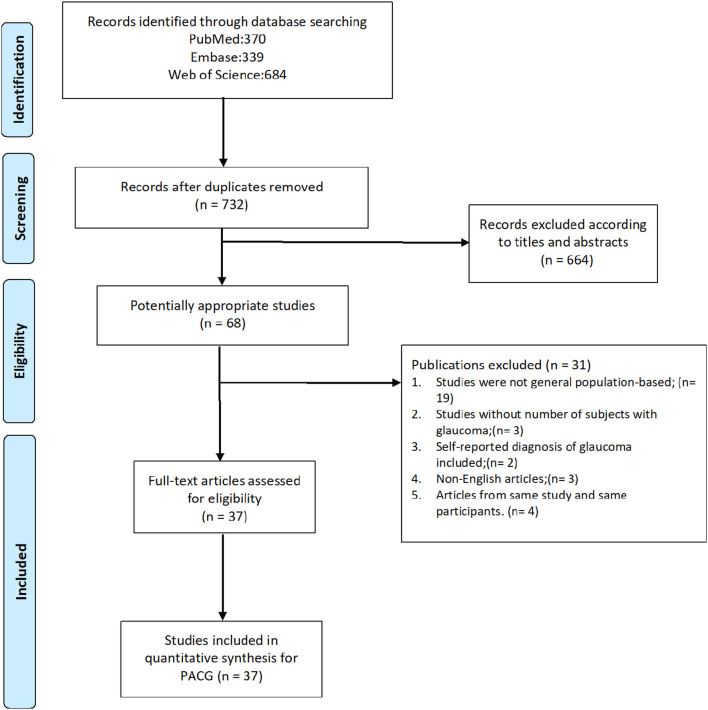
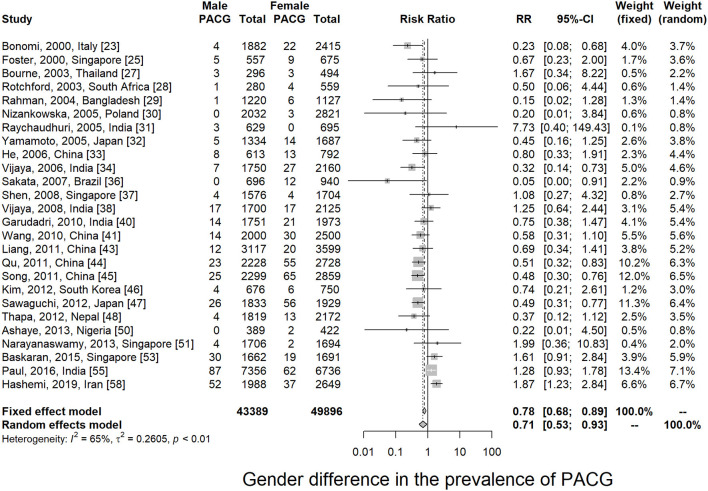
This meta-analysis aims to investigate the worldwide prevalence of primary angle-closure glaucoma (PACG) and its risk factors in the last 20 years. We conducted a systematic review and meta-analysis of 37 population-based studies and 144,354 subjects. PubMed, Embase, and Web of Science databases were searched for cross-sectional or cohort studies published in the last 20 years (2000-2020) that reported the prevalence of PACG. The prevalence of PACG was analyzed according to various risk factors. A random-effects model was used for the meta-analysis. The global pooled prevalence of PACG was 0.6% [95% confidence interval (CI) = 0.5-0.8%] for the last 20 years. The prevalence of PACG increases with age. Men are found less likely to have PACG than women (risk ratio = 0.71, 95% CI = 0.53-0.93, < 0.01). Asia is found to have the highest prevalence of PACG (0.7%, 95% CI = 0.6-1.0%). The current estimated population with PACG is 17.14 million (95% CI = 14.28-22.85) for people older than 40 years old worldwide, with 12.30 million (95% CI = 10.54-17.57) in Asia. It is estimated that by 2050, the global population with PACG will be 26.26 million, with 18.47 million in Asia. PACG affects more than 17 million people worldwide, especially leading a huge burden to Asia. The prevalence of PACG varies widely across different ages, sex, and population geographic variation. Asian, female sex, and age are risk factors of PACG.
本荟萃分析旨在调查过去20年全球原发性闭角型青光眼(PACG)的患病率及其危险因素。我们对37项基于人群的研究和144354名受试者进行了系统评价和荟萃分析。检索了PubMed、Embase和Web of Science数据库,查找过去20年(2000 - 2020年)发表的报告PACG患病率的横断面或队列研究。根据各种危险因素分析PACG的患病率。荟萃分析采用随机效应模型。过去20年全球PACG的合并患病率为0.6%[95%置信区间(CI)= 0.5 - 0.8%]。PACG的患病率随年龄增长而增加。发现男性患PACG的可能性低于女性(风险比 = 0.71,95% CI = 0.53 - 0.93,P < 0.01)。发现亚洲PACG的患病率最高(0.7%,95% CI = 0.6 - 1.0%)。目前估计全球40岁以上人群中患PACG的人数为1714万(95% CI = 1428 - 2285万),亚洲为1230万(95% CI = 1054 - 1757万)。据估计,到2050年,全球患PACG的人数将达到2626万,亚洲为1847万。PACG影响全球超过1700万人,给亚洲带来了巨大负担。PACG的患病率在不同年龄(组)、性别和人群地理差异中差异很大。亚洲人、女性和年龄是PACG的危险因素。