Jiangxi Provincial Key Laboratory of Tumor Pathogenesis and Molecular Pathology, Department of Pathophysiology, School of Basic Medical Sciences, Nanchang University, Nanchang, China.
Institute of Urology, the First Affiliated Hospital of Gannan Medical University, Ganzhou, China.
J Cell Mol Med. 2021 Mar;25(6):2806-2815. doi: 10.1111/jcmm.16308. Epub 2021 Feb 3.
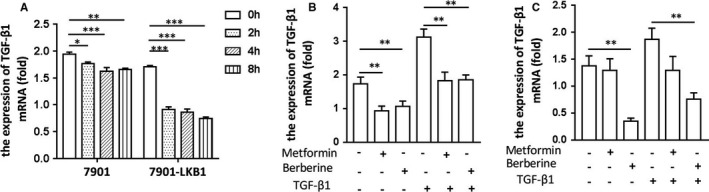
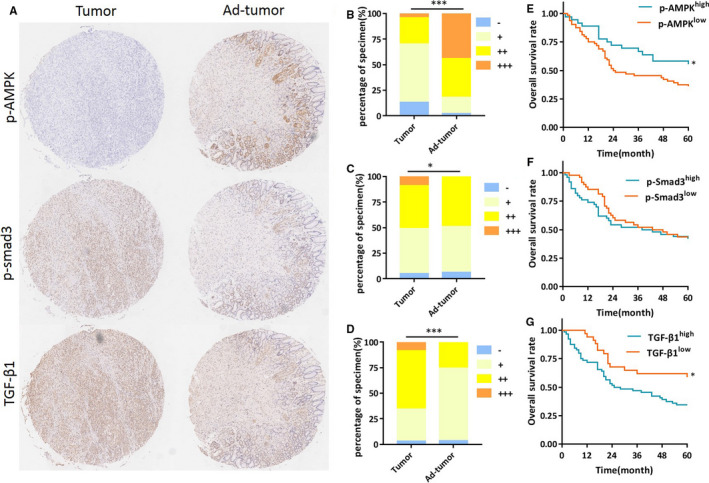
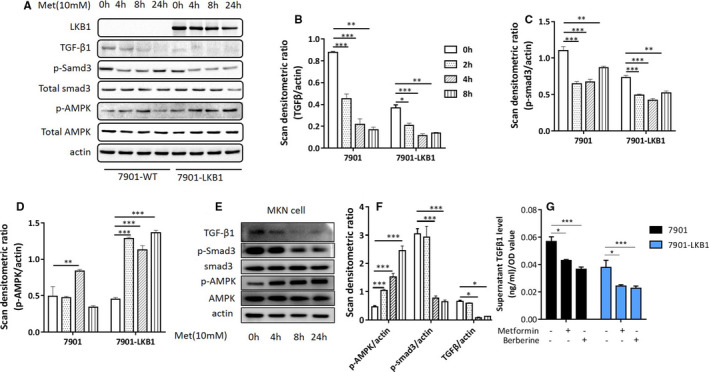
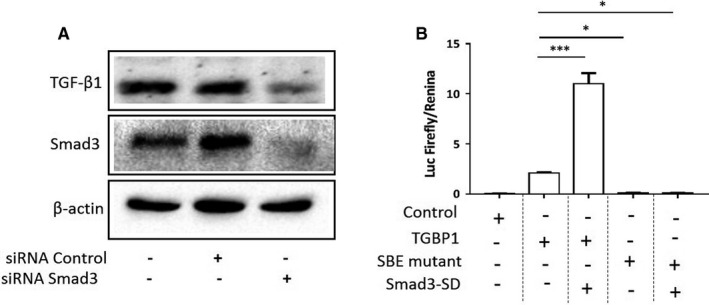
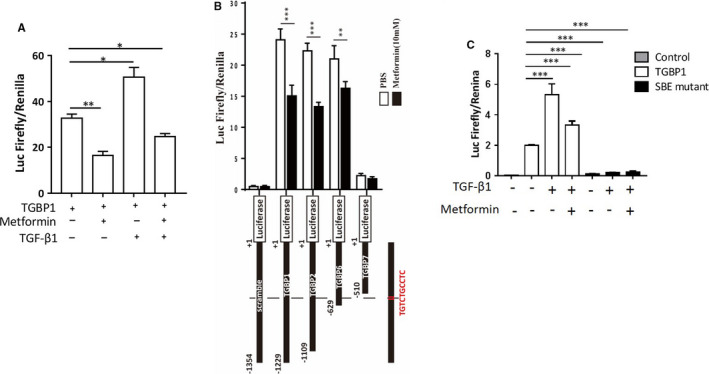
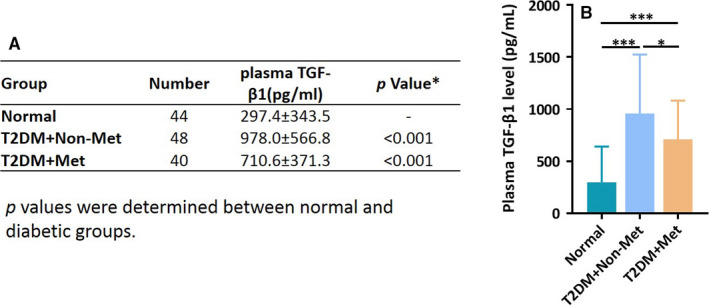
We have previously shown that adenine monophosphate-activated protein kinase (AMPK) regulates transforming growth factor β (TGF-β)-triggered Smad3 phosphorylation. Here we report that AMPK inhibits TGF-β1 production. First, metformin reduced mRNA levels of TGF-β1 in gastric cancer cells, in parallel to the decrease of its protein abundance. The effects were more prominent in the cells containing LKB1, an upstream kinase of AMPK. Second, knockdown of Smad3 by siRNA abrogated the expression of TGF-β1. Third, metformin suppressed firefly luciferase activity whose transcription was driven by TGF-β1 promoter. In accordance, deletion of the putative binding site of Smad3 in the TGF-β1 promoter region severely impaired the promoter activity and response to metformin. Fourth, in support of our in vitro study, clinical treatment of type 2 diabetes with metformin significantly reduced the plasma level of TGF-β1. Finally, immunohistochemical studies revealed that TGF-β1 was highly expressed in human gastric cancer tissues as compared with adjacent normal tissues. In contrast, p-AMPK exhibited opposite changes. Furthermore, the survival rate of gastric cancer patients was positively correlated with p-AMPK and negative with TGF-β1. Therefore, our present studies depict a mechanism underlying AMPK suppression of TGF-β1 autoinduction, which is mediated through inhibition of Smad3 phosphorylation and activation. Collectively, our study sheds a light on the potential usage of AMPK activators in the treatment of TGF-β1-mediated gastric cancer progression.
我们之前已经表明,一磷酸腺苷激活的蛋白激酶(AMPK)调节转化生长因子 β(TGF-β)触发的 Smad3 磷酸化。在这里,我们报告 AMPK 抑制 TGF-β1 的产生。首先,二甲双胍降低了胃癌细胞中 TGF-β1 的 mRNA 水平,与其蛋白丰度的降低平行。在含有 AMPK 的上游激酶 LKB1 的细胞中,这些作用更为明显。其次,Smad3 的 siRNA 敲低消除了 TGF-β1 的表达。第三,二甲双胍抑制了由 TGF-β1 启动子驱动的萤火虫荧光素酶活性。相应地,Smad3 在 TGF-β1 启动子区域的假定结合位点缺失严重损害了启动子活性和对二甲双胍的反应。第四,支持我们的体外研究,用二甲双胍治疗 2 型糖尿病显著降低了 TGF-β1 的血浆水平。最后,免疫组织化学研究表明,与相邻正常组织相比,TGF-β1 在人胃癌组织中高度表达。相反,p-AMPK 则表现出相反的变化。此外,胃癌患者的生存率与 p-AMPK 呈正相关,与 TGF-β1 呈负相关。因此,我们目前的研究描绘了 AMPK 抑制 TGF-β1 自动诱导的机制,该机制通过抑制 Smad3 磷酸化和激活来介导。总之,我们的研究为 AMPK 激活剂在治疗 TGF-β1 介导的胃癌进展中的潜在用途提供了依据。