Department of Family and Preventive Medicine, Emory University School of Medicine, Atlanta, Georgia.
Nell Hodgson Woodruff School of Nursing, Emory University, Atlanta, Georgia.
JAMA Netw Open. 2021 Feb 1;4(2):e2036469. doi: 10.1001/jamanetworkopen.2020.36469.
Clinician burnout is a major risk to the health of the US. Nurses make up most of the health care workforce, and estimating nursing burnout and associated factors is vital for addressing the causes of burnout.
To measure rates of nurse burnout and examine factors associated with leaving or considering leaving employment owing to burnout.
DESIGN, SETTING, AND PARTICIPANTS: This secondary analysis used cross-sectional survey data collected from April 30 to October 12, 2018, in the National Sample Survey of Registered Nurses in the US. All nurses who responded were included (N = 50 273). Data were analyzed from June 5 to October 1, 2020.
Age, sex, race and ethnicity categorized by self-reported survey question, household income, and geographic region. Data were stratified by workplace setting, hours worked, and dominant function (direct patient care, other function, no dominant function) at work.
The primary outcomes were the likelihood of leaving employment in the last year owing to burnout or considering leaving employment owing to burnout.
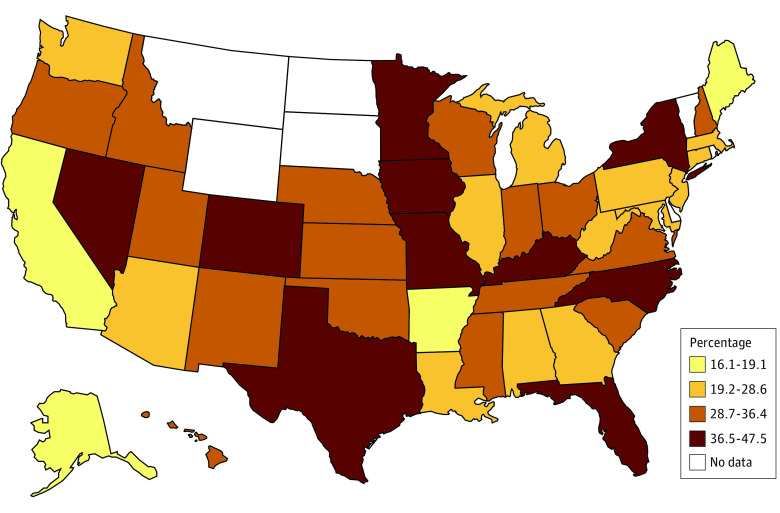
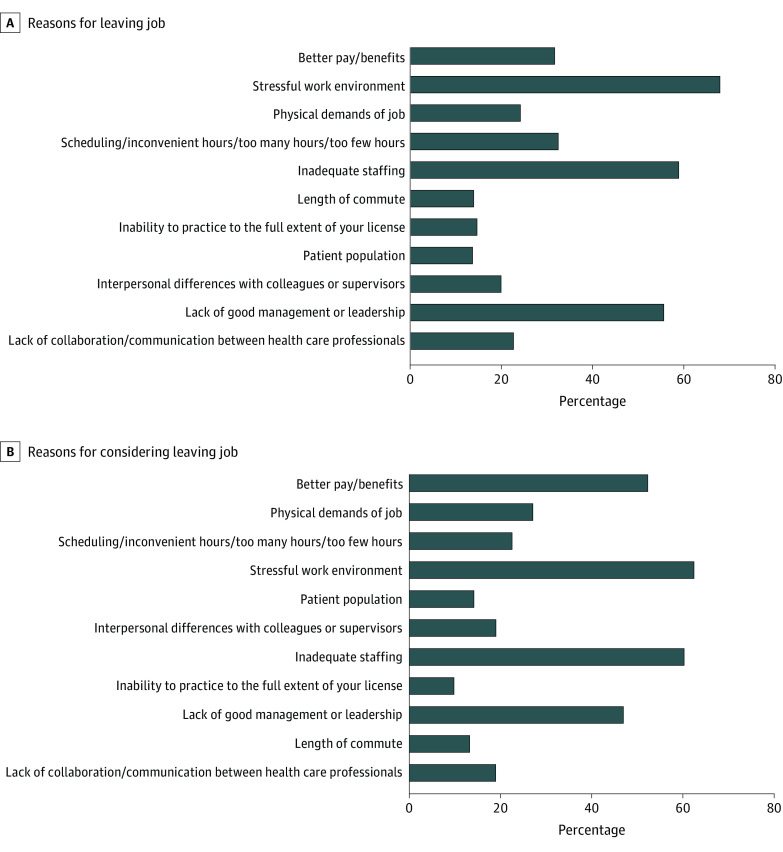
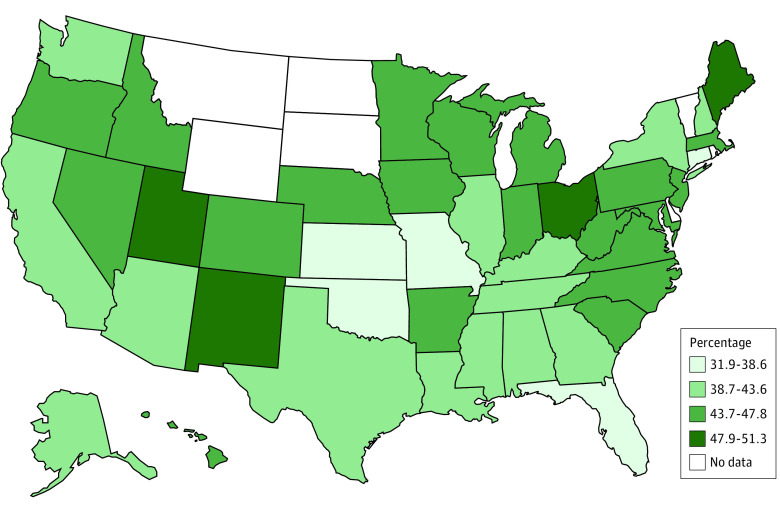
The weighted sample of 50 273 respondents (representing 3 957 661 nurses nationally) was predominantly female (90.4%) and White (80.7%); the mean (SD) age was 48.7 (0.04) years. Among nurses who reported leaving their job in 2017 (n = 418 769), 31.5% reported burnout as a reason, with lower proportions of nurses reporting burnout in the West (16.6%) and higher proportions in the Southeast (30.0%). Compared with working less than 20 h/wk, nurses who worked more than 40 h/wk had a higher likelihood identifying burnout as a reason they left their job (odds ratio, 3.28; 95% CI, 1.61-6.67). Respondents who reported leaving or considering leaving their job owing to burnout reported a stressful work environment (68.6% and 59.5%, respectively) and inadequate staffing (63.0% and 60.9%, respectively).
These findings suggest that burnout is a significant problem among US nurses who leave their job or consider leaving their job. Health systems should focus on implementing known strategies to alleviate burnout, including adequate nurse staffing and limiting the number of hours worked per shift.
临床医生倦怠是美国健康的主要风险。护士构成了大部分医疗保健劳动力,估计护理倦怠和相关因素对于解决倦怠的原因至关重要。
衡量护士倦怠率,并研究与因倦怠而离职或考虑离职相关的因素。
设计、设置和参与者:这是一项使用 2018 年 4 月 30 日至 10 月 12 日在美国全国注册护士抽样调查中收集的横断面调查数据进行的二次分析。所有回答的护士都被包括在内(N=50273)。数据于 2020 年 6 月 5 日至 10 月 1 日进行分析。
年龄、性别、按自我报告调查问题分类的种族和民族、家庭收入和地理区域。数据按工作场所设置、工作时间和工作时的主要职能(直接病人护理、其他职能、无主要职能)分层。
主要结果是过去一年因倦怠而离职或考虑因倦怠而离职的可能性。
加权样本为 50273 名受访者(代表全国 3957661 名护士),主要为女性(90.4%)和白人(80.7%);平均(SD)年龄为 48.7(0.04)岁。在 2017 年报告离职的护士中(n=418769),31.5%将倦怠作为离职的原因,报告倦怠的护士比例在西部地区较低(16.6%),在东南部较高(30.0%)。与每周工作少于 20 小时相比,每周工作超过 40 小时的护士更有可能将倦怠作为离职的原因(比值比,3.28;95%置信区间,1.61-6.67)。报告因倦怠而离职或考虑离职的受访者报告工作环境压力大(分别为 68.6%和 59.5%)和人手不足(分别为 63.0%和 60.9%)。
这些发现表明,倦怠是美国离职或考虑离职的护士的一个严重问题。卫生系统应重点实施已知的缓解倦怠策略,包括充足的护士配备和限制每班工作时间。