Ogawa Hironaga, Nakajima Toshiaki, Shibasaki Ikuko, Nasuno Takahisa, Kaneda Hiroyuki, Katayanagi Satoshi, Ishizaka Hayato, Mizushima Yuta, Uematsu Azusa, Yasuda Tomohiro, Yagi Hiroshi, Toyoda Shigeru, Hortobágyi Tibor, Mizushima Takashi, Inoue Teruo, Fukuda Hirotsugu
Department of Cardiovascular Surgery, School of Medicine, Dokkyo Medical University, Shimotsuga-gun, Tochigi 321-0293, Japan.
Department of Cardiovascular Medicine, School of Medicine, Dokkyo Medical University, Shimotsuga-gun, Tochigi 321-0293, Japan.
J Clin Med. 2021 Feb 2;10(3):547. doi: 10.3390/jcm10030547.
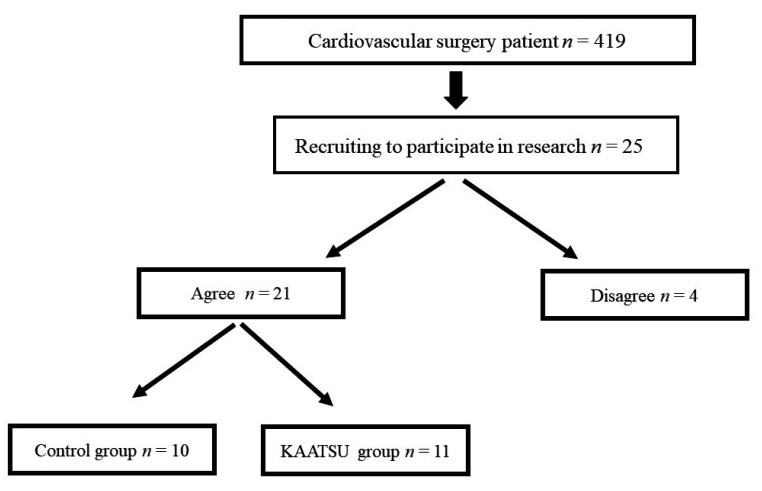
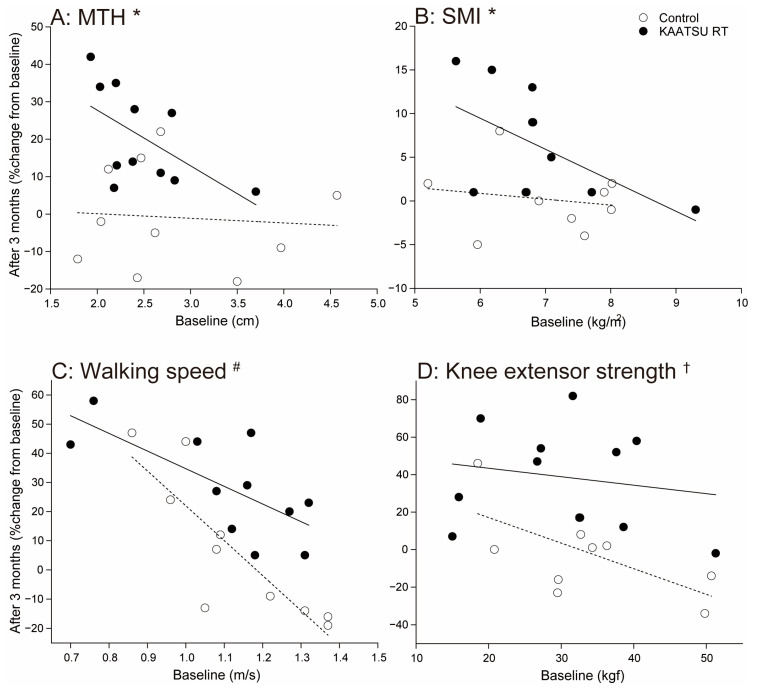
We examined the safety and the effects of low-intensity resistance training (RT) with moderate blood flow restriction (KAATSU RT) on muscle strength and size in patients early after cardiac surgery. Cardiac patients (age 69.6 ± 12.6 years, = 21, M = 18) were randomly assigned to the control ( = 10) and the KAATSU RT group ( = 11). All patients had received a standard aerobic cardiac rehabilitation program. The KAATSU RT group additionally executed low-intensity leg extension and leg press exercises with moderate blood flow restriction twice a week for 3 months. RT-intensity and volume were increased gradually. We evaluated the anterior mid-thigh thickness (MTH), skeletal muscle mass index (SMI), handgrip strength, knee extensor strength, and walking speed at baseline, 5-7 days after cardiac surgery, and after 3 months. A physician monitored the electrocardiogram, rate of perceived exertion, and the color of the lower limbs during KAATSU RT. Creatine phosphokinase (CPK) and D-dimer were measured at baseline and after 3 months. There were no side effects during KAATSU RT. CPK and D-dimer were normal after 3 months. MTH, SMI, walking speed, and knee extensor strength increased after 3 months with KAATSU RT compared with baseline. Relatively low vs. high physical functioning patients tended to increase physical function more after 3 months with KAATSU RT. Low-intensity KAATSU RT as an adjuvant to standard cardiac rehabilitation can safely increase skeletal muscle strength and size in cardiovascular surgery patients.
我们研究了低强度抗阻训练(RT)结合适度血流限制(KAATSU RT)对心脏手术后早期患者肌肉力量和肌肉量的安全性及影响。心脏疾病患者(年龄69.6±12.6岁,n = 21,男性 = 18)被随机分为对照组(n = 10)和KAATSU RT组(n = 11)。所有患者均接受了标准的有氧心脏康复计划。KAATSU RT组另外每周进行两次结合适度血流限制的低强度腿部伸展和腿部推举练习,持续3个月。抗阻训练的强度和量逐渐增加。我们在基线、心脏手术后5 - 7天以及3个月后评估了大腿前中部厚度(MTH)、骨骼肌质量指数(SMI)、握力、膝关节伸肌力量和步行速度。一名医生在KAATSU RT期间监测心电图、主观用力程度和下肢颜色。在基线和3个月后测量肌酸磷酸激酶(CPK)和D - 二聚体。KAATSU RT期间未出现副作用。3个月后CPK和D - 二聚体均正常。与基线相比,KAATSU RT组在3个月后MTH、SMI、步行速度和膝关节伸肌力量增加。与身体功能较高的患者相比,身体功能相对较低的患者在接受KAATSU RT 3个月后身体功能改善更为明显。作为标准心脏康复辅助手段的低强度KAATSU RT可安全增加心血管手术患者的骨骼肌力量和肌肉量。