Franz Alexander, Ji Sanghyeon, Bittersohl Bernd, Zilkens Christoph, Behringer Michael
Department of Orthopedics and Trauma Surgery, University Hospital Bonn, Bonn, Germany.
Department of Adult Reconstruction, ATOS Orthoparc Clinic Cologne, Cologne, Germany.
Front Physiol. 2022 Jun 14;13:881484. doi: 10.3389/fphys.2022.881484. eCollection 2022.
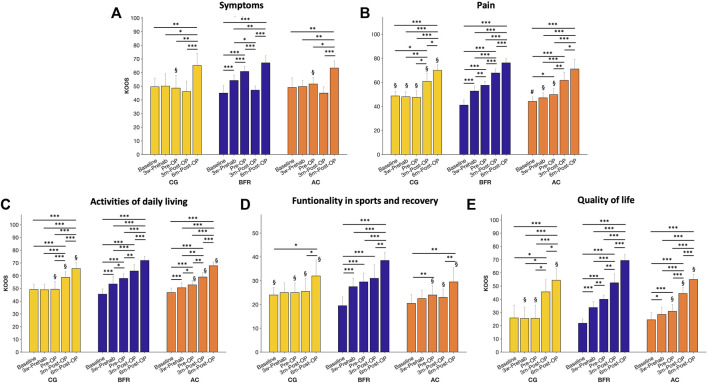
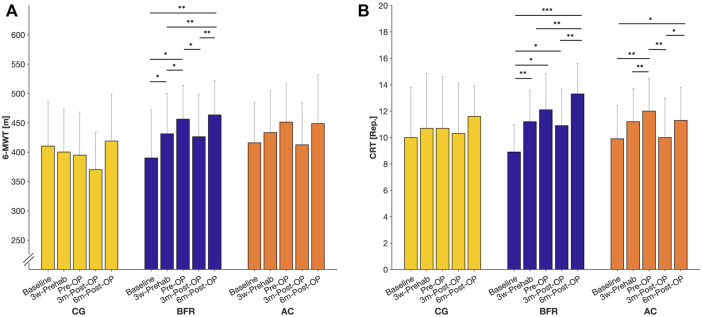
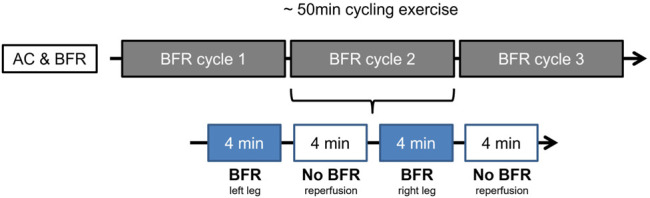
Total Knee Arthroplasty (TKA) is one of the most successful interventions in gonarthrosis, however the operation is leading to muscle atrophy and long-term muscular deficits. To enhance rehabilitation after TKA, exercise programs try to improve muscle function preoperatively, called prehabilitation. Blood-Flow-Restriction Exercises (BFRE) is a training method which is characterized by using tourniquets to reduce arterial and occlude venous blood flow simultaneously during the exercise to increase metabolic stress. The present study aimed to evaluate the effects of a 6-week prehabilitation with BFR on pre- and postoperative muscle mass, strength, and quality of life (QoL). 30 patients with end-stage gonarthrosis participated in this study. Patients were randomized into one of three groups: 1) Control-Group (CON): Standard clinical approach without prehabilitation. 2) Active-Control-Group (AC): Participation in a prehabilitation with sham-BFR. 3) BFR-Group (BFR): Participation in a prehabilitation with BFR. The prehabilitation protocol consist of a cycling-ergometer-based training performed twice per week over 6 weeks. During exercise, BFR was applied periodically three times per leg with a pressure of 40% of the individual-limb-occlusion-pressure. Measurement time points were six- (baseline), 3-weeks and 5-days before the surgery (Pre-OP), as well as three- and 6-months postoperatively. Outcome measures were muscular strength of the thigh muscles, thigh circumference as well as QoL and functional activity, examined by 6-min walking- and chair rising test. Both training groups indicated significantly improved leg muscle strength following the prehabilitation period with a superior effect for the BFR-group (BFR: ∼170% vs. AC: ∼91%, < 0.05). No significant changes in leg strength occurred in the CON (∼3%, = 0.100). Further, patients in BFR-group indicated significantly improved skeletal muscle mass assessed by femoral circumference following prehabilitation period (∼7%, < 0.05), while no significant changes occurred in the CON (-1.14%, = 0.131) and AC-group (∼3%, = 0.078). At 3-months Post-OP, the CON and BFR-group revealed a significant decrease in femoral circumference compared to the Pre-OP (CON: ∼3%, BFR: ∼4%; < 0.05), but BFR-group remained above the baseline level (∼3%, < 0.05). No significant change in femoral circumference was found for AC-group (∼2%, = 0.078). In addition, the prehabilitation with BFR provided notably improved Knee Injury and Osteoarthritis Outcome Scores (KOOS) especially in pain perception with significant higher effect compared to other groups (CON: -2%, AC: 13%, BFR: 41%; < 0.05). In long-term rehabilitation after 6-months, all groups showed significantly improved KOOS scores in all dimensions (CON: ∼110%, AC: ∼132%, BFR: ∼225%; < 0.01), and functional examinations (CON: ∼26%, AC: ∼16%, BFR: ∼53%; < 0.01). The present findings show that BFR-prehabilitation induce significant improvements in muscle function and QoL before TKA surgery. In addition, the supporting effect of prehabilitation on postoperative regeneration and QoL should be highlighted, illustrating prolonged beneficial effects of BFR on muscular and functional performance in a "better in, better out"-manner.
全膝关节置换术(TKA)是膝骨关节炎最成功的干预措施之一,然而该手术会导致肌肉萎缩和长期肌肉功能缺陷。为了加强TKA术后的康复,运动方案试图在术前改善肌肉功能,即所谓的预康复。血流限制训练(BFRE)是一种训练方法,其特点是在运动过程中使用止血带来同时减少动脉血流并阻断静脉血流,以增加代谢压力。本研究旨在评估为期6周的BFRE预康复对术前和术后肌肉质量、力量及生活质量(QoL)的影响。30例终末期膝骨关节炎患者参与了本研究。患者被随机分为三组之一:1)对照组(CON):采用标准临床方法,不进行预康复。2)主动对照组(AC):参与假BFRE预康复。3)BFRE组(BFR):参与BFRE预康复。预康复方案包括基于自行车测力计的训练,每周进行两次,共6周。运动期间,每条腿定期施加三次BFRE,压力为个体肢体阻断压力的40%。测量时间点为术前6周(基线)、术前3周和5天(术前)以及术后3个月和6个月。结果指标包括大腿肌肉力量、大腿围度以及QoL和功能活动,通过6分钟步行和从椅子上起身测试进行检查。两个训练组在预康复期后均显示腿部肌肉力量显著改善,BFR组效果更佳(BFR组:约170%,AC组:约91%,P<0.05)。CON组腿部力量无显著变化(约3%,P = 0.100)。此外,BFR组患者在预康复期后通过股骨围度评估的骨骼肌质量显著改善(约7%,P<0.05),而CON组(-1.14%,P = 0.131)和AC组(约3%,P = 0.078)无显著变化。术后3个月时,与术前相比,CON组和BFR组的股骨围度显著减小(CON组:约3%,BFR组:约4%;P<0.05),但BFR组仍高于基线水平(约3%,P<0.05)。AC组股骨围度无显著变化(约2%,P = 0.078)。此外,BFRE预康复显著改善了膝关节损伤和骨关节炎疗效评分(KOOS),尤其是在疼痛感知方面,与其他组相比效果显著更高(CON组:-2%,AC组:13%,BFR组:41%;P<0.05)。在6个月的长期康复中,所有组在所有维度上的KOOS评分均显著改善(CON组:约110%,AC组:约132%,BFR组:约225%;P<0.01),功能检查结果也如此(CON组:约26%,AC组:约16%,BFR组:约53%;P<0.01)。本研究结果表明,BFRE预康复在TKA手术前可显著改善肌肉功能和QoL。此外,应强调预康复对术后恢复和QoL的支持作用,以“更好地输入,更好地输出”的方式说明了BFRE对肌肉和功能表现的长期有益影响。