
颅脑危险器官勾画:放疗计划中的混杂实践。
Cranial organs at risk delineation: heterogenous practices in radiotherapy planning.
机构信息
Department of Radiation Oncology, Institut de Cancérologie de Lorraine, Vandoeuvre Les Nancy, France.
IMoPA, UMR 7365 CNRS-Université de Lorraine, Vandoeuvre Les Nancy, France.
出版信息
Radiat Oncol. 2021 Feb 4;16(1):26. doi: 10.1186/s13014-021-01756-y.
BACKGROUND
Segmentation is a crucial step in treatment planning that directly impacts dose distribution and optimization. The aim of this study was to evaluate the inter-individual variability of common cranial organs at risk (OAR) delineation in neurooncology practice.
METHODS
Anonymized simulation contrast-enhanced CT and MR scans of one patient with a solitary brain metastasis was used for delineation and analysis. Expert professionals from 16 radiotherapy centers involved in brain structures delineation were asked to segment 9 OAR on their own treatment planning system. As reference, two experts in neurooncology, produced a unique consensual contour set according to guidelines. Overlap ratio, Kappa index (KI), volumetric ratio, Commonly Contoured Volume, Supplementary Contoured Volume were evaluated using Artiview™ v 2.8.2-according to occupation, seniority and level of expertise of all participants.
RESULTS
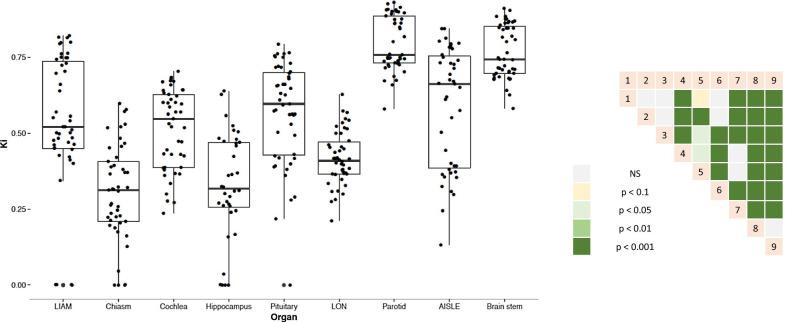
For the most frequently delineated and largest OAR, the mean KI are often good (0.8 for the parotid and the brainstem); however, for the smaller OAR, KI degrade (0.3 for the optic chiasm, 0.5% for the cochlea), with a significant discrimination (p < 0.01). The radiation oncologists, members of Association des Neuro-Oncologue d'Expression Française society performed better in all indicators compared to non-members (p < 0.01). Our exercise was effective in separating the different participating centers with 3 of the reported indicators (p < 0.01).
CONCLUSION
Our study illustrates the heterogeneity in normal structures contouring between professionals. We emphasize the need for cerebral OAR delineation harmonization-that is a major determinant of therapeutic ratio and clinical trials evaluation.
背景
分割是治疗计划中的一个关键步骤,直接影响剂量分布和优化。本研究旨在评估神经肿瘤学实践中常见的颅脑危及器官(OAR)勾画的个体间变异性。
方法
使用一名患有单发脑转移患者的匿名模拟对比增强 CT 和磁共振扫描进行勾画和分析。16 个参与脑结构勾画的放疗中心的专业人员被要求在自己的治疗计划系统上勾画 9 个 OAR。作为参考,两位神经肿瘤学专家根据指南生成了一套独特的共识轮廓。使用 Artiview™ v2.8.2 根据所有参与者的职业、资历和专业水平评估重叠比、Kappa 指数(KI)、体积比、共同勾画体积和补充勾画体积。
结果
对于最常勾画和最大的 OAR,平均 KI 通常较好(腮腺和脑干为 0.8);然而,对于较小的 OAR,KI 降低(视交叉为 0.3,耳蜗为 0.5%),具有显著的区分度(p<0.01)。与非成员相比,法国神经肿瘤学会的放射肿瘤学家在所有指标上的表现都更好(p<0.01)。我们的练习在 3 个报告指标中有效地将不同的参与中心区分开来(p<0.01)。
结论
我们的研究说明了专业人员之间正常结构勾画的异质性。我们强调需要协调脑 OAR 的勾画,这是治疗比和临床试验评估的主要决定因素。



 Zotero 插件