Department of Optometry and Vision Science, University of Waterloo, 200 University Avenue West, Waterloo, ON, N0B 2T0, Canada.
Department of Psychology, Concordia University, Montreal, Canada.
Sci Rep. 2021 Feb 4;11(1):3029. doi: 10.1038/s41598-020-80843-8.
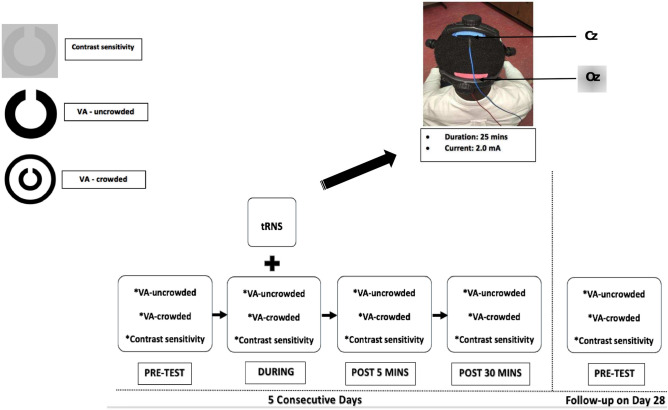
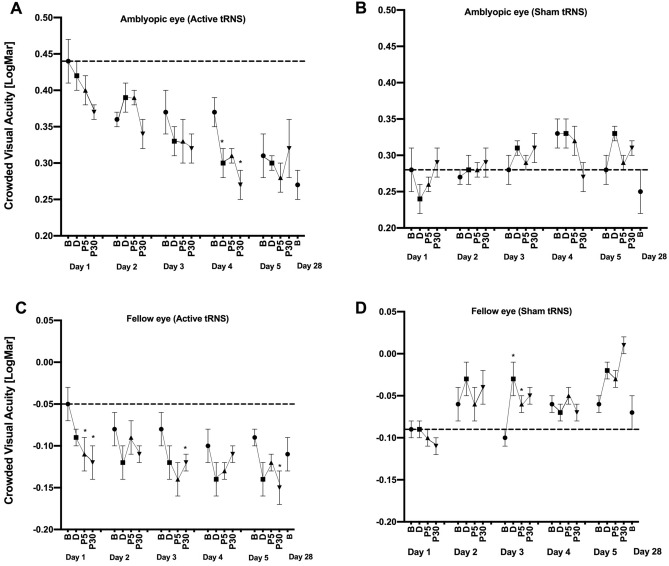
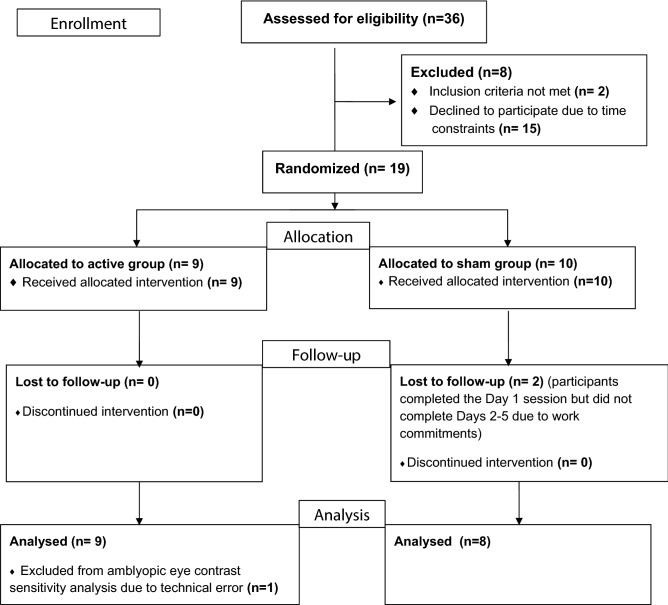
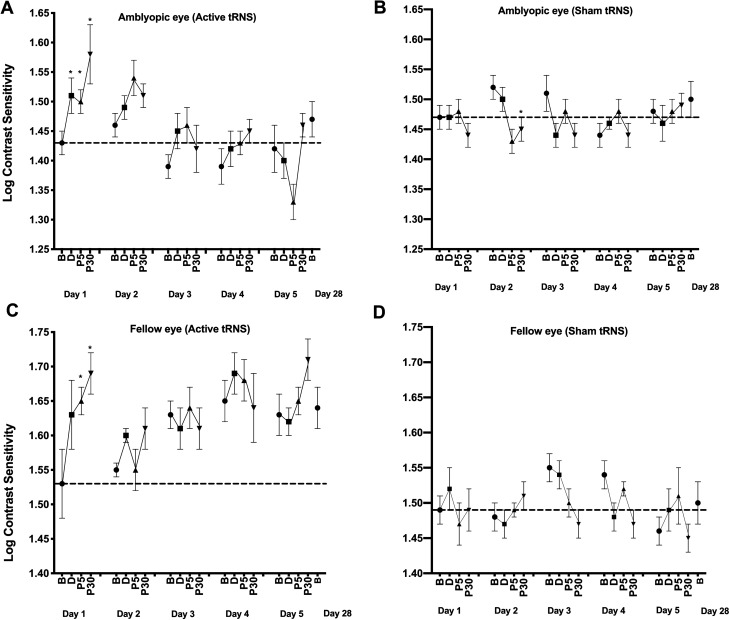
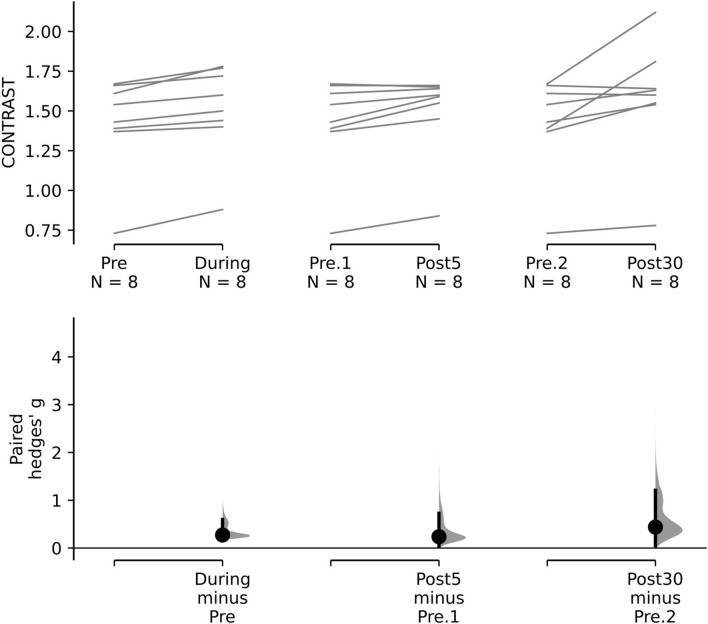
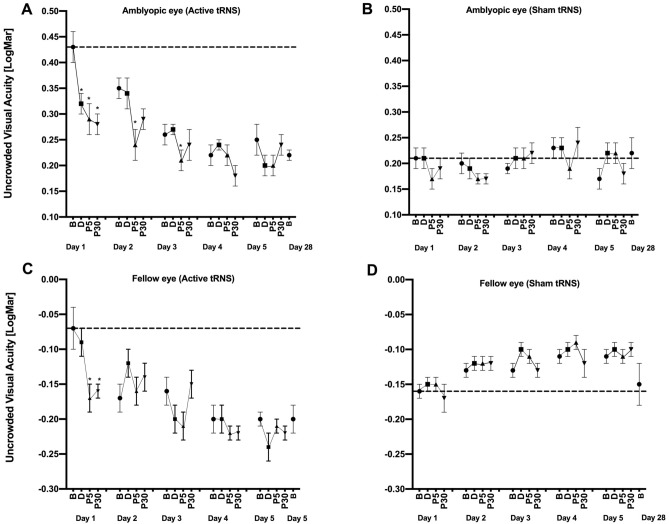
We tested the hypothesis that five daily sessions of visual cortex transcranial random noise stimulation would improve contrast sensitivity, crowded and uncrowded visual acuity in adults with amblyopia. Nineteen adults with amblyopia (44.2 ± 14.9 years, 10 female) were randomly allocated to active or sham tRNS of the visual cortex (active, n = 9; sham, n = 10). Sixteen participants completed the study (n = 8 per group). tRNS was delivered for 25 min across five consecutive days. Monocular contrast sensitivity, uncrowded and crowded visual acuity were measured before, during, 5 min and 30 min post stimulation on each day. Active tRNS significantly improved contrast sensitivity and uncrowded visual acuity for both amblyopic and fellow eyes whereas sham stimulation had no effect. An analysis of the day by day effects revealed large within session improvements on day 1 for the active group that waned across subsequent days. No long-lasting (multi-day) improvements were observed for contrast sensitivity, however a long-lasting improvement in amblyopic eye uncrowded visual acuity was observed for the active group. This improvement remained at 28 day follow up. However, between-group differences in baseline uncrowded visual acuity complicate the interpretation of this effect. No effect of tRNS was observed for amblyopic eye crowded visual acuity. In agreement with previous non-invasive brain stimulation studies using different techniques, tRNS induced short-term contrast sensitivity improvements in adult amblyopic eyes, however, repeated sessions of tRNS did not lead to enhanced or long-lasting effects for the majority of outcome measures.
我们检验了一个假设,即每天五次视觉皮层经颅随机噪声刺激会改善成年人弱视的对比敏感度、拥挤和非拥挤视力。19 名成年人弱视(44.2±14.9 岁,女性 10 名)被随机分配到视觉皮层的真 tRNS 或假 tRNS 组(真刺激组,n=9;假刺激组,n=10)。16 名参与者完成了研究(每组 n=8)。tRNS 在连续五天内每天进行 25 分钟。在每天的刺激前、刺激期间、刺激后 5 分钟和 30 分钟测量单眼对比敏感度、非拥挤和拥挤视力。真刺激显著改善了弱视眼和对侧眼的对比敏感度和非拥挤视力,而假刺激则没有效果。对每天的效果进行分析发现,真刺激组在第 1 天的治疗中会出现较大的日内改善,但在随后的几天中会逐渐减弱。然而,没有观察到对比敏感度的多日持续改善,但真刺激组的弱视眼非拥挤视力有持久的改善。这种改善在 28 天的随访中仍然存在。然而,基于基线非拥挤视力的组间差异使这种效果的解释变得复杂。tRNS 对弱视眼拥挤视力没有影响。与使用不同技术的先前非侵入性脑刺激研究一致,tRNS 诱导了成年人弱视眼的短期对比敏感度改善,但 tRNS 的重复疗程并没有导致大多数结果测量的增强或持久效果。