, Cartagena, Spain.
Epidemiology Research Group EPIDOT (Vice-Leader); Public Health Department, Federal University of Santa Catarina (UFSC), Santa Catarina, Brazil.
Sci Rep. 2021 Feb 4;11(1):3052. doi: 10.1038/s41598-021-81868-3.
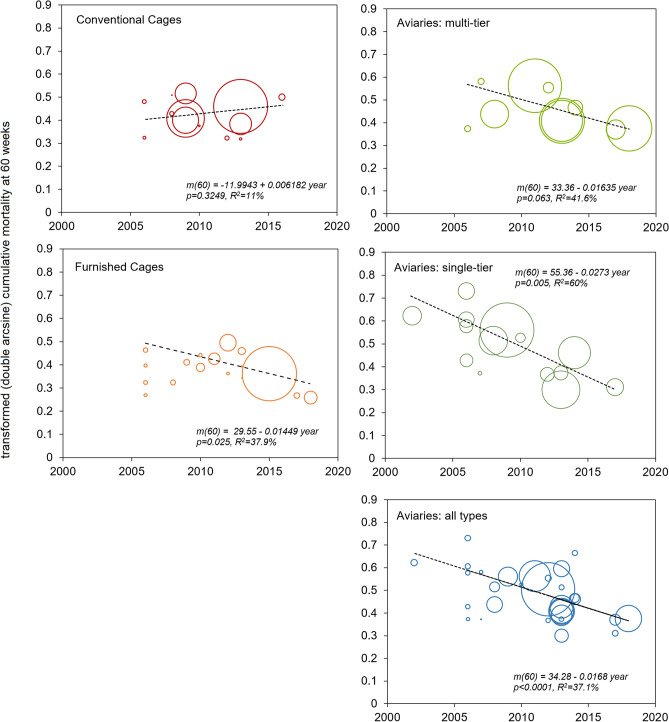
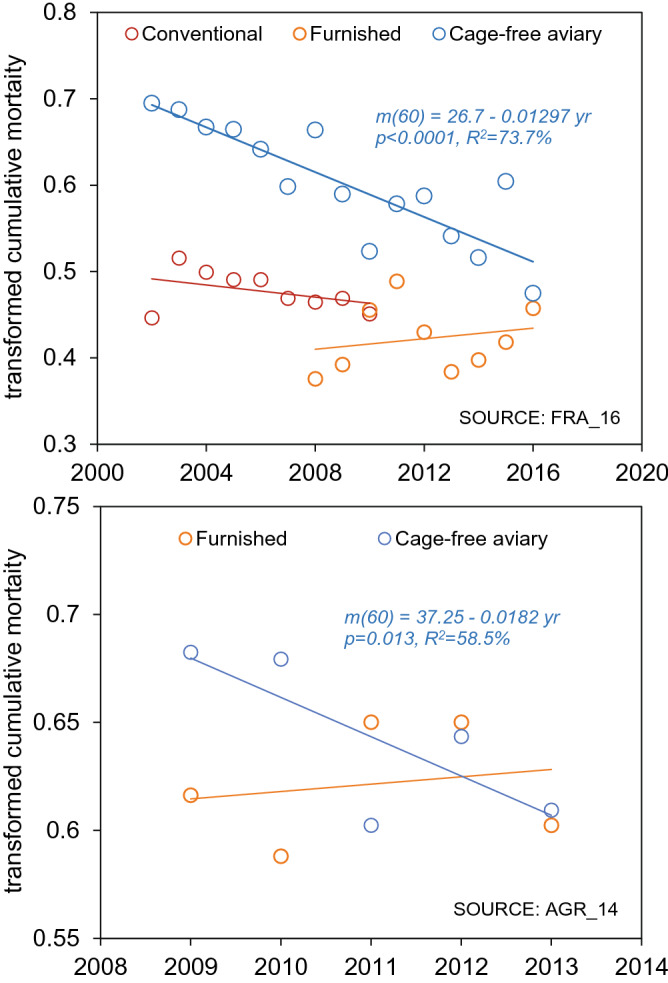
Societal concern with the welfare of egg laying hens housed in conventional cages is fostering a transition towards cage-free systems in many countries. However, although cage-free facilities enable hens to move freely and express natural behaviours, concerns have also been raised over the possibility that cage-free flocks experience higher mortality, potentially compromising some aspects of their welfare. To investigate this possibility, we conducted a large meta-analysis of laying hen mortality in conventional cages, furnished cages and cage-free aviaries using data from 6040 commercial flocks and 176 million hens from 16 countries. We show that except for conventional cages, mortality gradually drops as experience with each system builds up: since 2000, each year of experience with cage-free aviaries was associated with a 0.35-0.65% average drop in cumulative mortality, with no differences in mortality between caged and cage-free systems in more recent years. As management knowledge evolves and genetics are optimized, new producers transitioning to cage-free housing may experience even faster rates of decline. Our results speak against the notion that mortality is inherently higher in cage-free production and illustrate the importance of considering the degree of maturity of production systems in any investigations of farm animal health, behaviour and welfare.
社会对传统笼养蛋鸡福利的关注促使许多国家向无笼养殖系统过渡。然而,尽管无笼设施使母鸡能够自由移动并表现出自然行为,但也有人担心无笼鸡群的死亡率可能更高,从而影响其福利的某些方面。为了研究这种可能性,我们使用来自 16 个国家的 6040 个商业鸡群和 1.76 亿只母鸡的数据,对传统笼养、有笼饲养和无笼饲养鸡舍的蛋鸡死亡率进行了大规模的荟萃分析。我们的研究结果表明,除了传统笼养之外,随着经验的积累,死亡率逐渐下降:自 2000 年以来,无笼饲养鸡舍每年的经验与累积死亡率平均降低 0.35-0.65% 相关,而近年来,笼养和无笼饲养系统之间的死亡率没有差异。随着管理知识的不断发展和遗传优化,新的生产者向无笼饲养的过渡可能会经历更快的死亡率下降。我们的研究结果否定了死亡率在无笼养殖中更高的说法,并说明了在任何农场动物健康、行为和福利的研究中,考虑生产系统成熟度的重要性。