Weeks Claire A, Lambton Sarah L, Williams Adrian G
School of Veterinary Sciences, University of Bristol, Langford, Bristol, United Kingdom.
School of Energy, Environment and Agri-food, Cranfield University, Bedford, United Kingdom.
PLoS One. 2016 Jan 6;11(1):e0146394. doi: 10.1371/journal.pone.0146394. eCollection 2016.
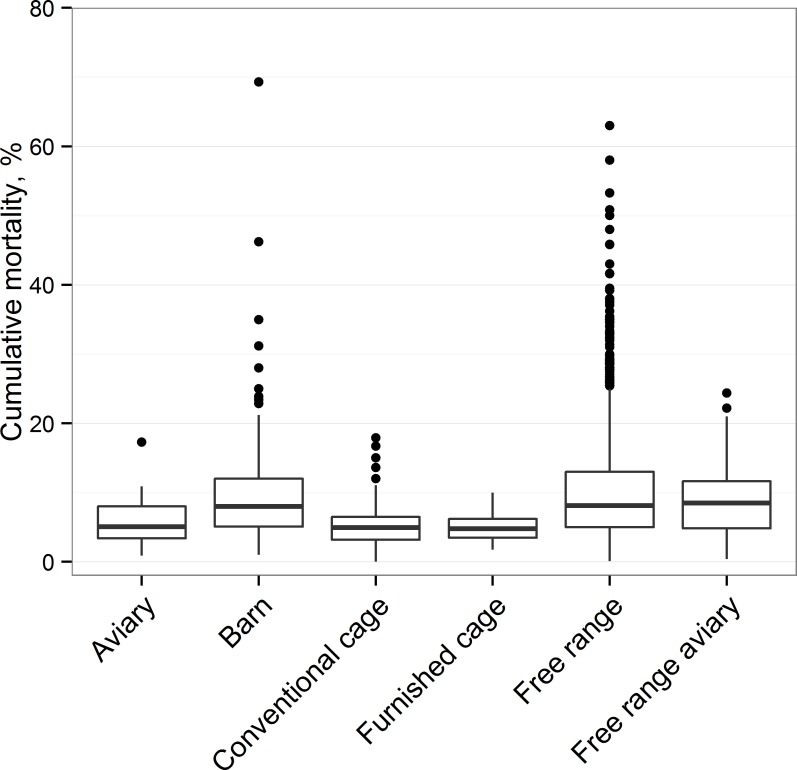
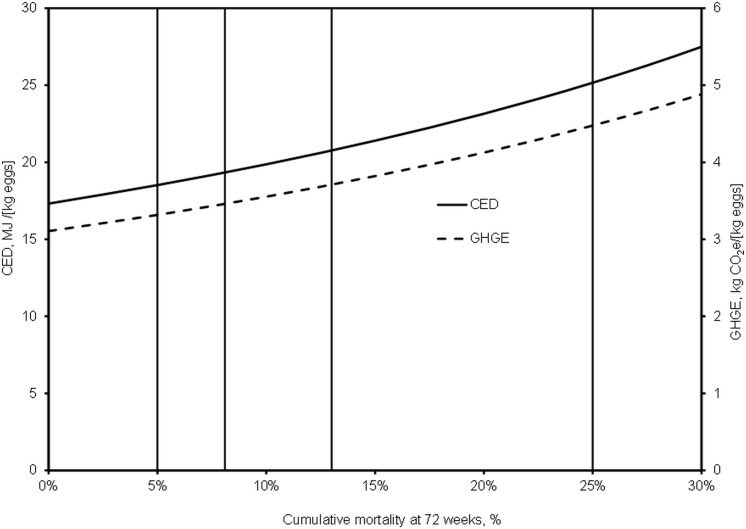
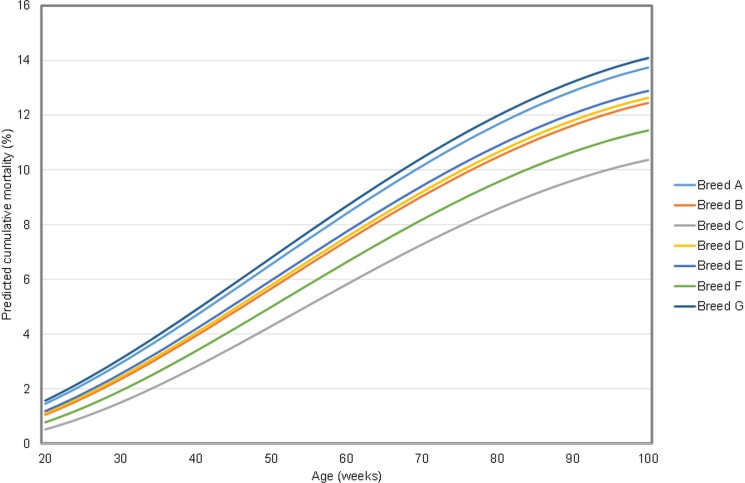
Data from ten sources comprising 3,851 flocks were modelled to identify variation in levels of mortality in laying hens. The predicted increase with age was curvilinear with significant variation between the seven breed categories. Mortality was higher in loose housing systems than in cages and variable within system, confirming previous reports. Cumulative mortality (CM) was higher in flocks with intact beaks (χ2 = 6.03; df 1; p = 0.014) than in those with trimmed beaks. Most data were available for free-range systems (2,823 flocks), where producer recorded CM at 60-80 weeks of age averaged 10% but with a range from 0% to 69.3%. Life cycle assessment showed that the main effect of increased levels of hen mortality is to increase the relative contribution of breeding overheads, so increasing environmental burdens per unit of production. Reducing CM to levels currently achieved by the 1st quartile could reduce flock greenhouse gas emissions by as much as 25%. Concurrently this would enhance hen welfare and better meet the expectation of egg consumers. More research to understand the genetic x environment interaction and detailed records of the causes of mortality is required so that improved genotypes can be developed for different systems and different breeds can be better managed within systems.
对来自10个数据源、涵盖3851个鸡群的数据进行建模,以确定蛋鸡死亡率水平的差异。预测的死亡率随年龄增长呈曲线变化,七个品种类别之间存在显著差异。散养系统中的死亡率高于笼养系统,且系统内存在差异,这证实了先前的报道。喙完整的鸡群的累积死亡率(CM)高于喙修剪过的鸡群(χ2 = 6.03;自由度1;p = 0.014)。大部分数据来自自由放养系统(2823个鸡群),生产者记录的60至80周龄鸡群的CM平均为10%,但范围为0%至69.3%。生命周期评估表明,母鸡死亡率上升的主要影响是增加繁殖间接成本的相对贡献,从而增加单位产量的环境负担。将CM降低到目前第一四分位数所达到的水平,可使鸡群的温室气体排放量减少多达25%。与此同时,这将提高母鸡福利,并更好地满足鸡蛋消费者的期望。需要开展更多研究以了解基因与环境的相互作用,并详细记录死亡原因,以便为不同系统培育改良基因型,并在系统内更好地管理不同品种。