Barallobre-Barreiro Javier, Woods Elizabeth, Bell Rachel E, Easton Jennifer A, Hobbs Carl, Eager Michael, Baig Ferheen, Ross Alastair Mackenzie, Mallipeddi Raj, Powell Barry, Soldin Mark, Mayr Manuel, Shaw Tanya J
King's College London, James Black Centre British Heart Foundation Centre, Denmark Hill Campus, London SE5 9NU, UK.
Division of Biomedical Sciences, St George's University of London, London SW17 0RE, UK.
Matrix Biol Plus. 2019 Oct 30;4:100016. doi: 10.1016/j.mbplus.2019.100016. eCollection 2019 Nov.
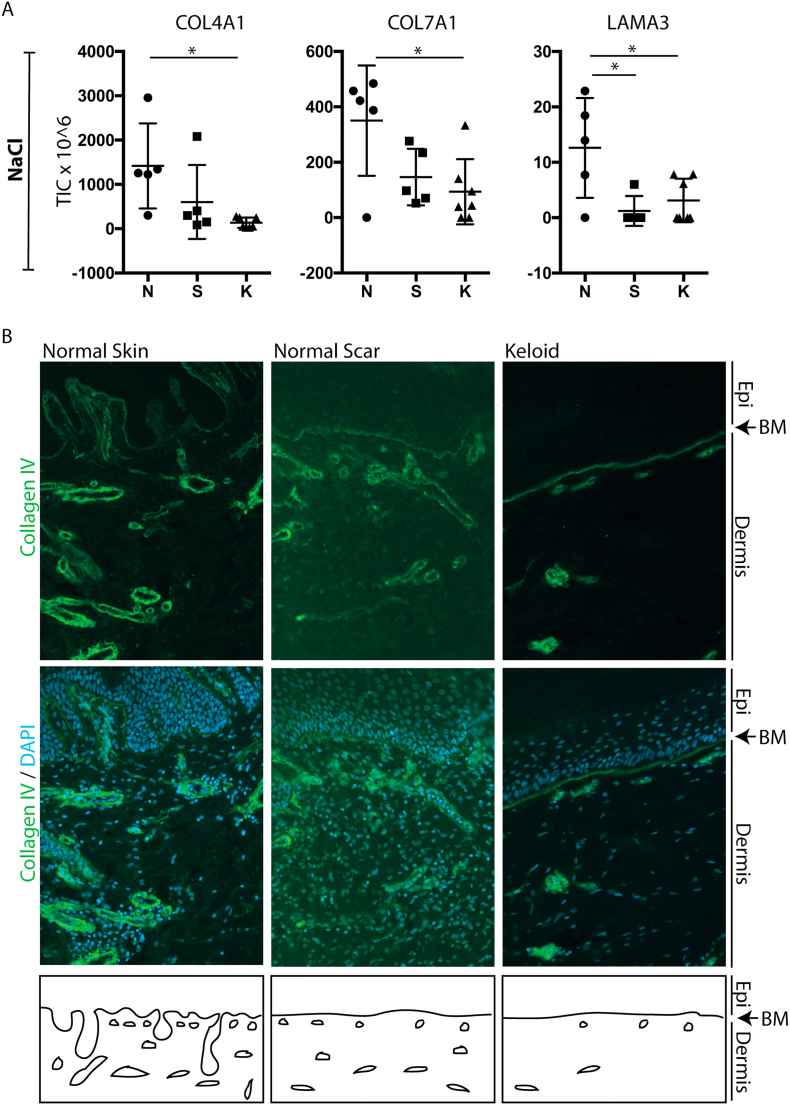
Following wound damage to the skin, the scarring spectrum is wide-ranging, from a manageable normal scar through to pathological keloids. The question remains whether these fibrotic lesions represent simply a quantitative extreme, or alternatively, whether they are qualitatively distinct. A three-way comparison of the extracellular matrix (ECM) composition of normal skin, normal scar and keloids was performed using quantitative discovery-based proteomics. This approach identified 40 proteins that were significantly altered in keloids compared to normal scars, and strikingly, 23 keloid-unique proteins. The major alterations in keloids, when functionally grouped, showed many changes in proteins involved in ECM assembly and fibrillogenesis, but also a keloid-associated loss of proteases, and a unique cartilage-like composition, which was also evident histologically. The presence of Aggrecan and Collagen II in keloids suggest greater plasticity and mis-differentiation of the constituent cells. This study characterises the ECM of both scar types to a depth previously underappreciated. This thorough molecular description of keloid lesions relative to normal scars is an essential step towards our understanding of this debilitating clinical problem, and how best to treat it.
皮肤受到创伤后,瘢痕形成的范围很广,从易于处理的正常瘢痕到病理性瘢痕疙瘩。问题仍然存在:这些纤维化病变仅仅代表数量上的极端情况,还是在性质上有所不同。使用基于发现的定量蛋白质组学对正常皮肤、正常瘢痕和瘢痕疙瘩的细胞外基质(ECM)组成进行了三方比较。该方法鉴定出40种与正常瘢痕相比在瘢痕疙瘩中显著改变的蛋白质,而且引人注目的是,还有23种瘢痕疙瘩特有的蛋白质。瘢痕疙瘩中的主要变化在功能分组时,显示出参与ECM组装和纤维形成的蛋白质有许多变化,但也有与瘢痕疙瘩相关的蛋白酶缺失,以及独特的软骨样组成,这在组织学上也很明显。瘢痕疙瘩中聚集蛋白聚糖和胶原蛋白II的存在表明其组成细胞具有更大的可塑性和分化异常。这项研究以前所未有的深度对两种瘢痕类型的ECM进行了表征。相对于正常瘢痕,对瘢痕疙瘩病变进行如此全面的分子描述是我们理解这个令人衰弱的临床问题以及如何最好地治疗它的重要一步。