Centre for Endocrinology, William Harvey Research Institute, Barts and the London School of Medicine and Dentistry, Queen Mary University of London, London EC1M 6BQ, UK.
Cells. 2021 Oct 22;10(11):2840. doi: 10.3390/cells10112840.
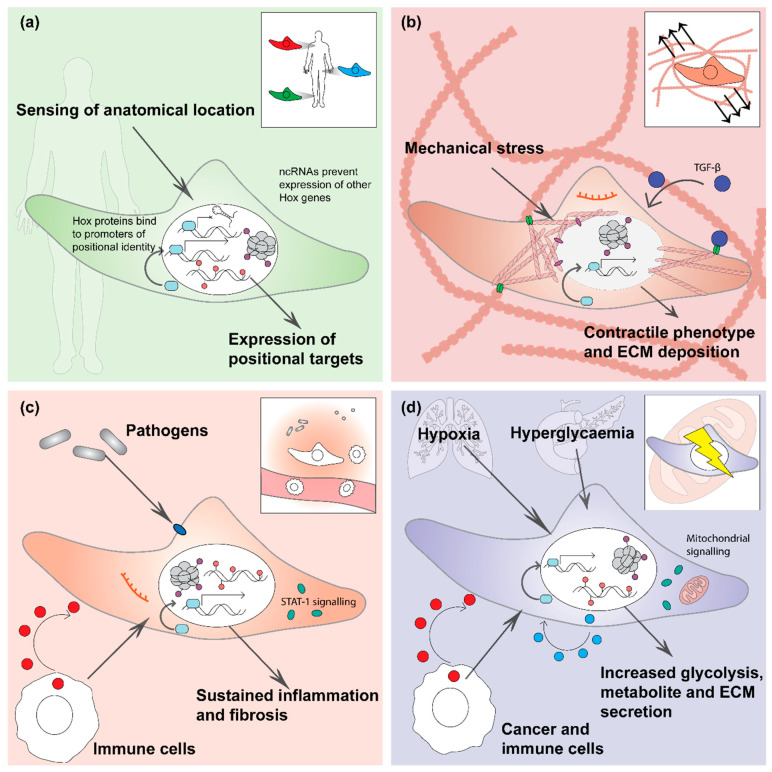
Fibroblasts are the major cell population in the connective tissue of most organs, where they are essential for their structural integrity. They are best known for their role in remodelling the extracellular matrix, however more recently they have been recognised as a functionally highly diverse cell population that constantly responds and adapts to their environment. Biological memory is the process of a sustained altered cellular state and functions in response to a transient or persistent environmental stimulus. While it is well established that fibroblasts retain a memory of their anatomical location, how other environmental stimuli influence fibroblast behaviour and function is less clear. The ability of fibroblasts to respond and memorise different environmental stimuli is essential for tissue development and homeostasis and may become dysregulated in chronic disease conditions such as fibrosis and cancer. Here we summarise the four emerging key areas of fibroblast adaptation: positional, mechanical, inflammatory, and metabolic memory and highlight the underlying mechanisms and their implications in tissue homeostasis and disease.
成纤维细胞是大多数器官结缔组织中的主要细胞群体,对于组织的结构完整性至关重要。它们最为人所知的作用是重塑细胞外基质,但最近人们认识到它们是一种功能高度多样化的细胞群体,能够持续响应和适应其环境。生物记忆是细胞状态持续改变和对短暂或持续环境刺激作出反应的过程。尽管已经确定成纤维细胞保留了其解剖位置的记忆,但其他环境刺激如何影响成纤维细胞的行为和功能尚不清楚。成纤维细胞能够响应和记忆不同环境刺激的能力对于组织发育和稳态至关重要,并且在纤维化和癌症等慢性疾病条件下可能会失调。在这里,我们总结了成纤维细胞适应的四个新兴关键领域:位置、机械、炎症和代谢记忆,并强调了潜在的机制及其在组织稳态和疾病中的意义。